Best electric vans 2026
We reveal the best electric vans to buy or lease in the UK right now

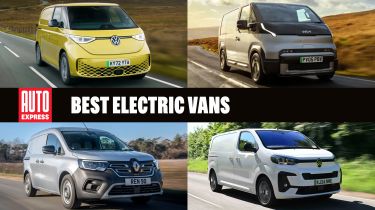
The electric van market is rapidly expanding with the very best vans offering a decent real-world range, competitive payload carrying capacities and tough build quality, all with at least a touch of style and comfort.
Many van operators will harbour serious doubts about the practicalities of running an electric van. It’s certainly a big change and it will not suit everyone but if you have easy access to overnight charging and rarely cover more than 200 miles in a day, an electric van can bring major advantages in terms of running costs and the driving experience.
From large load-luggers capable of hauling the bulkiest cargo, to small vans designed for busy urban streets, the electric vans on this list come from every corner of the commercial vehicle sector, so there should be a van to suit your specific needs.
Compare the best electric vans
Our expert road testers have tested every electric van that you can buy in the UK, and you’ll find the very best options listed below.
| Rank | Make and model | Price from excl. VAT, after PiVG | Max WLTP combined range |
| 1 | Renault Master E-Tech | £47,100 | 285 miles |
| 2 | Ford E-Transit Custom | £43,630 | 204 miles |
| 3 | Citroen e-Berlingo/Fiat e-Doblo/Peugeot e-Partner/Toyota Proace City Electric/Vauxhall Combo Electric | £28,995 (e-Berlingo) | 220 miles |
| 4 | Ford E-Transit | £51,600 | 249 miles |
| 5 | Volkswagen ID. Buzz Cargo | £31,450 | 276 miles |
| 6 | Ford E-Transit Courier | £27,000 | 181 miles |
| 7 | Citroen e-Dispatch/Fiat e-Scudo/Peugeot e-Expert/Toyota Proace Electric/Vauxhall Vivaro Electric | £41,210 (e-Dispatch) | 231 miles |
| 8 | Kia PV5 Cargo | £27,645 | 258 miles |
| 9 | Renault Kangoo E-Tech/Nissan Townstar EV/Mercedes eCitan | £34,420 | 186 miles |
| 10 | Citroen E-Relay/Fiat E-Ducato/Peugeot E-Boxer/Toyota Proace Max Electric/Vauxhall Movano Electric | £47,865 (e-Relay) | 263 miles |
Carry on scrolling to learn more about the best electric vans currently on the market, or click the links in the table above to jump directly to a specific make and model..
1. Renault Master E-Tech
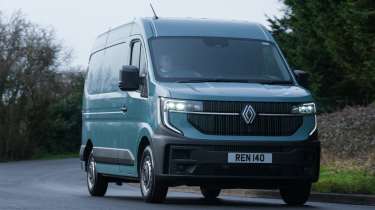
If you want an electric van, the Renault Master E-Tech is currently the best.
- Prices from: £47,100 (exc. VAT, after PiVG)
- Van size: large
- Maximum WLTP combined battery range: 285 miles
- Maximum payload: 1,125kg
- Maximum load volume: 14.8 cubic metres
The latest Renault Master E-Tech is a much more convincing electric van than the one it replaced. While the older model only offered a miserly 115 miles of battery range at best, the new one can cover up to 285 miles between charges. Covering these miles shouldn’t prove too much of a chore, either, since the latest Master is pleasingly refined on the move.
In the back, the cargo space is really vast and usable. While there was never an issue fitting a Euro pallet in the previous version of the Master, Renault has adjusted the bulkhead so it’s more upright, making it easier to stack boxes against. The maximum load volume of 14.8 cubic metres is slightly less than the Citroen e-Relay, but the maximum payload of 1,125kg is far greater than the Citroen’s 750kg.
It may be a large panel van, but the Master’s interior is a rather car-like affair. At the centre of the dashboard is a 10-inch touchscreen that operates Renault’s openR Link infotainment system (the same system used by several of the brand’s cars), and this is surrounded by a generous helping of standard kit, including air-conditioning, a digital driver’s display, automatic headlights and wipers and rear parking sensors. There’s 135 litres of handy storage space in the cab, too.
“While I found no problem piloting the Master through narrow French streets, it did feel quite bulky at times. The steering is pleasant at faster speeds, with good accuracy that makes it easy to place in its lane along the motorway.” - Dean Gibson, senior road test editor.
- Who will like it: Anyone looking for a large electric van with a maximum payload over 1,000kg will like the Master E-Tech.
- Who won’t like it: It does feel quite large and bulky when driving around town.
2. Ford E-Transit Custom
The Ford Transit is one of the best vans on the UK market, so it’s no surprise that the electric E-Transit Custom is one of the best electric vans.
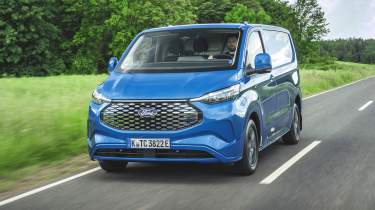
- Prices from: £43,630 (exc. VAT, after PiVG)
- Van size: medium
- Maximum WLTP combined battery range: 232 miles
- Maximum payload: 1,088kg
- Maximum load volume: 6.8 cubic metres
The Ford Transit Custom is a huge seller, so it was inevitable that this medium panel van would make the transition to electric power.
The Ford E-Transit Custom doesn’t really look any different from its diesel and plug-in hybrid powered counterparts, but this is deliberate. The E-Transit Custom is as car-like to drive as we’ve come to expect, offers plenty of kit and will happily take on a great deal of cargo.
This level of similarity is what Ford hopes will draw customers towards its fully electric medium van. The Custom’s 71kWh battery pack means longer motorway trips aren’t out of the question, either, as it returns up to 232 miles on the WLTP combined cycle. This is an important van for Ford, and it’s such an appealing machine that it’s previously bagged our Electric Van of the Year award.
“The Ford E-Transit Custom does an admirable job of remaining composed for its size, the extra ballast of the battery possibly helping here. Even at slower speeds, the ride remains mostly bounce and crash-free.” - Shane Wilkinson, senior content editor.
- Who will like it: Buyers looking for a van with a car-like driving experience will love the E-Transit Custom.
- Who won’t like it: Those who cover longer distances or want the security of more range might want to look elsewhere.
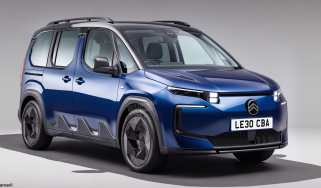
3. Citroen e-Berlingo, Peugeot e-Partner, Toyota Proace City Electric, Fiat e-Doblo, Vauxhall Combo Electric
This van comes in lots of different but similar flavours. The Citroen e-Berlingo is our current pick of the crop.
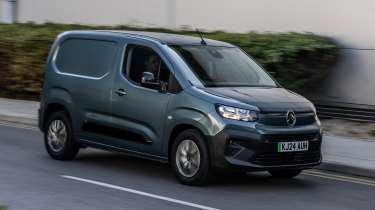
- Prices from: £28,995 (e-Berlingo, excl. VAT, after PiVG)
- Van size: small
- Maximum WLTP combined battery range: 213 miles
- Maximum payload: 781kg
- Maximum load volume: 4.4 cubic metres
If you’re after a small electric van which is a great all-rounder, look no further than the Citroen e-Berlingo. It has a competitive range of up to 213 miles, a decent payload of 781kg and there’s 4.4 cubic metres worth of space in the back.
If you’re not quite convinced by the Citroen’s styling but like the sound of everything else, why not consider the Peugeot e-Partner, Toyota Proace City Electric and Vauxhall Combo Electric which all sit on the same underpinnings and share the same battery. We’ve chosen the Citroen from this quartet of vans thanks to its competitive pricing which starts from under £29,000 excl. VAT.
CCS fast-charging at a rate of up to 100kW should also prove useful to operators, meaning these vans can be topped-up to 80 per cent in around half an hour – ideal for getting it back on the road for a new shift.
The Toyota has the edge over its Stellantis siblings when it comes to maintenance, though as with the brand's passenger cars, this small electric van is also covered by the brand's 10-year service warranty, which is significantly longer than anything offered with the other versions.
Whichever flavour of van you choose, this small electric van feels well put together and the hard-wearing plastics should do quite a good job of withstanding the daily abuse it’s likely to face at work. The dashboard layout is nice and straightforward and we like the chunky controls. There’s lots of storage space dotted around the cabin, although passengers might feel a tad cramped in three-seat versions.
“The Berlingo features a slightly different seat design when compared with its siblings, with denser foam and thicker side bolsters for greater comfort. That might be a reason to choose the Berlingo over its rivals if you spend most of your day in the driving seat.” - Dean Gibson, senior road test editor.
- Who will like it: If you spend a lot of time on the road, Citroen’s Advanced Comfort seats give this van an edge over its siblings.
- Who won’t like it: The three-seat layout in the front can make passengers feel cramped.
4. Ford E-Transit
The Ford Transit is the backbone of the British van world, and now it’s available with an all-electric powertrain.
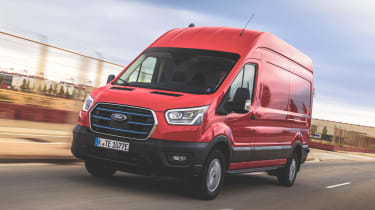
- Prices from: £51,600 (exc. VAT, after PiVG)
- Van size: Large
- Maximum WLTP combined battery range: 249 miles
- Maximum payload: 1,423kg
- Maximum load volume: 15.1 cubic metres
The Transit name has been around for well over sixty years, but now Ford has updated this iconic van for the electric age.
The Ford E-Transit offers up to 249 miles of range and there’s no reduction in cargo space compared to the diesel model. So, in other words, this is a great stepping stone into the world of zero-emission vans.
The E-transit is good to drive and surprisingly quick off the line, too — especially if you opt for the larger 265bhp motor. Ford also offers several sizes and variants of the E-Transit, so there should be a version to suit your business’s specific needs.
Inside, the E-Transit’s cabin is a comfortable place to sit, with a tall driving position, large mirrors and plenty of cabin storage. Ford’s SYNC 4 12-inch touchscreen set-up is available as an option on entry-level models, along with adaptive cruise control, climate control and electronic driver aids.
“It feels quiet and refined, yet the rear-mounted electric motor has enough punch to make the E-Transit feel quick off the line. There’s plenty of power to cope with big payloads, too.” - Dean Gibson, senior content editor.
- Who will like it: People wanting Ford Transit capability in an EV.
- Who won’t like it: If you’re on a tight budget, rivals like the Renault E-Master are cheaper.
5. Volkswagen ID.Buzz Cargo
If you want your van to come with a slice of retro style, the Volkswagen ID.Buzz Cargo delivers exactly that.
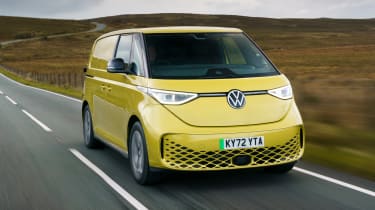
- Prices from: £31,450 (exc. VAT, after PiVG)
- Van size: medium
- Maximum WLTP combined battery range: 276 miles
- Maximum payload: 712kg
- Maximum load volume: 3.9 cubic metres
Not only does the Volkswagen ID.Buzz Cargo offer the distinctive retro charm of the classic Type 2, but it also has plenty of cleverly packed space and up to 276 miles of claimed battery range at its disposal.
VW’s groovy electric van shares the same MEB platform as the ID.3 hatchback, plus the ID.4 and ID.5 SUVs. This makes it very car-like to drive, and the suspension does a good job at soaking up bumps and imperfections in the road even when you’re not carrying any weight in the back.
Although it’s shorter than a Tesla Model Y, the Volkswagen ID.Buzz offers plenty of space on board thanks to some clever engineering, and its distinctive design will certainly help your business to stand out. Everything feels very well put together, too, which bodes well for the electric VW’s durability over the longer term.
“The ID. Buzz Cargo is very smooth for a van, which is another side effect of its car-derived platform. The suspension smothers bumps in the road very well, and this is a very relaxing place to spend time. There's no wind noise and road noise is also well suppressed, although bigger bumps can cause shudders to echo through the van's frame.” - Andy Goodwin, Auto Express contributor.
- Who will like it: Businesses that love the ID.Buzz Cargo’s retro styling.
- Who won’t like it: Those with capacity as a priority, as the 3.9 cubic metre load bay is quite small.
Volkswagen ID.Buzz Cargo review
6. Ford E-Transit Courier
If you need a small but very capable electric van, the Ford E-Transit Courier shouldn’t be ignored.
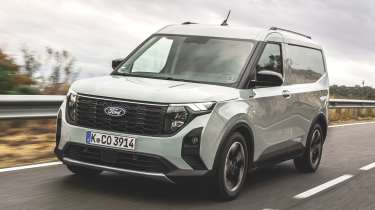
- Prices from: £27,000 (exc. VAT, after PiVG)
- Van size: small
- Maximum WLTP combined battery range: 181 miles
- Maximum payload: 698kg
- Maximum load volume: 2.9 cubic metres
If you’re zipping around the city streets and stopping on a regular basis, having a diesel engine idling constantly isn’t exactly the most eco-friendly or cost effective way to do it. It’s tasks like this where the Ford E-Transit Courier thrives, as it’s compact enough for chucking into tight parking spaces.
As is often the case with Ford’s vans, the E-Transit Courier is actually reasonably engaging to drive. The instant acceleration of electric motors means you can quickly get up to speed, and there’s enough power on hand for motorway runs, although the wind noise will make itself known at these speeds.
Electric vans normally suffer with reduced payload capacities due to the bulk and weight of the batteries, but at 698kg, this small van is surprisingly capable. In fact, it closely matches the maximum payload capacity of some electric vans in the class above. The 2.9 cubic meter load area can even accommodate two Euro pallets at floor level, too.
“Since the Transit Courier is based on the Puma platform, it can lay claim to being one of the best-handling vans on the market, while the driving position and big windows give you a clear view of your surroundings.” - Sam Naylor, Auto Express contributor.
- Who will like it: Those who want a compact van with good load-carrying capacities.
- Who won’t like it: buyers looking for long distance refinement might want to look elsewhere.
7. Citroen e-Dispatch/Fiat e-Scudo/Peugeot e-Expert/Toyota Proace Electric/Vauxhall Vivaro Electric
Want a van which does the job at hand without much fuss? The Citroen e-Dispatch would be our van of choice.
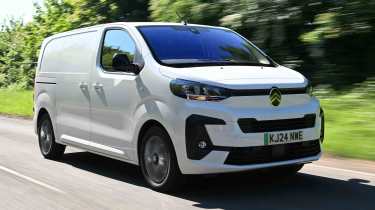
- Prices from: £41,210 (e-Dispatch, excl. VAT, after PiVG)
- Van size: medium
- Maximum WLTP combined battery range: 231 miles
- Maximum payload: 1,000kg
- Maximum load volume: 6.6 cubic metres
Stellantis isn’t afraid to share platforms, and the Citroen e-Dispatch Vauxhall Vivaro Electric, Peugeot e-Expert and Fiat e-Scudo all share the same underpinnings and basic design. If that’s not enough choice for you, though, the Toyota Proace Electric is also a member of this family of medium-sized vans.
Whichever badge you decide to go for (that choice will mostly boil down to brand loyalty and finance or leasing deals) these vans offer up to 6.6 cubic metres of load volume, while payload weights of up to 1,000kg aren't too far behind that of the diesel variants.
The e-Dispatch is only available with one sole battery option: a 75kWh pack which is capable of up to 231 miles according to Citroen. Do be aware, though, that carrying a full load will hamper the van's overall range.
Inside, these vans are packed with safety and connectivity features from the Stellantis car range. There's full connectivity and smartphone access to assorted functions, too, while double cab variants are ideal for those who need to carry passengers as well as cargo.
While these vans aren’t exactly full of driving thrills, they do remain very calm and stress-free on the move. We did find wind and tyre noise to be a bit irritating at motorway speeds, though.
“There’s light steering and a relatively tight turning circle, while the modest dimensions mean these vans are nearly as easy as a small van to manoeuvre in town. Rear parking sensors are a useful addition, though, to overcome the issue of the small door mirrors.” - Dean Gibson, senior road test editor.
- Who will like it: Whichever flavour of van you choose, there should be a wide aftersales support from the Stellantis network.
- Who won’t like it: People looking for a sharp driving experience.
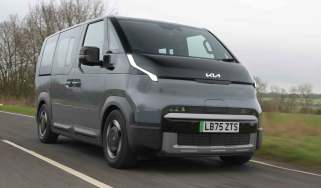
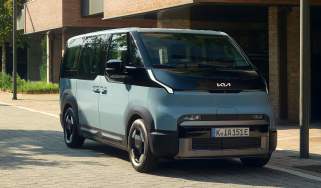
8. Kia PV5 Cargo
The Kia PV5 Cargo is the Korean brand’s first foray into the van world, and it’s a good one at that.
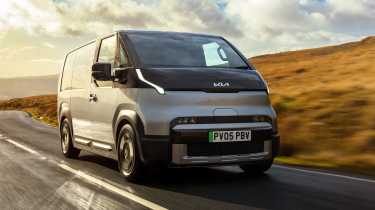
- Prices from: £27,645 (exc. VAT, after PiVG)
- Van size: medium
- Maximum WLTP combined battery range: 258 miles
- Maximum payload: 790kg
- Maximum load volume: 4.4 cubic metres
Vans are workhorses first and foremost but a little bit of style doesn’t go amiss, as is evidenced by the new Kia PV5 Cargo. Alongside its space-age looks, it's reasonably priced and has a decent payload.
Kia has utilised its knowledge of building electric cars and transferred it over to its van offering. It’s available with two different battery sizes, the first being a 51.5kWh pack capable of returning up to 184 miles, or there’s a larger 71.2kWh option which has a claimed range of 258 miles. The larger battery puts the Kia in striking distance of the VW ID.Buzz Cargo with its 276-mile range, but well ahead of the Ford E-Transit’s official range of 232 miles.
Kia only offers the PV5 Cargo in one bodystyle configuration at the moment but the loadbay is quite spacious at 4.4 cubic metres and can swallow up two Euro pallets. Loading the back of the van is straightforward thanks to its low load lips, wide-opening rear doors, plus the option of dual sliding doors. The maximum payload is rated at 790kg.
On the road, the Kia is easy to drive and thread down narrow roads due to its slim stature and tight turning circle. If you’re used to driving larger cars or SUVs, the PV5 Cargo should feel familiar in size.
The interior is smart and hard-wearing, and we found the seats to be comfortable and supportive. The infotainment system is quick and responsive, and with wireless Apple Car Play and Android Auto fitted as standard, the PV5 Cargo is an alluring electric van.
“On the road, there’s some inevitable bounciness over the most uneven surfaces (which is at its worst when the van is unladen), but the PV5 remains comfortable without any overly harsh bangs or jolts.” - Shane Wilkinson, senior content editor.
- Who will like it: The long seven-year/100,000-mile warranty will appeal to businesses planning for long-term ownership.
- Who won’t like it: If you want a higher payload, some rivals do better.
9. Renault Kangoo E-Tech/Nissan Townstar EV/Mercedes eCitan
The Renault Kangoo E-Tech might not be the newest kid on the block, but it’s a very capable small van.
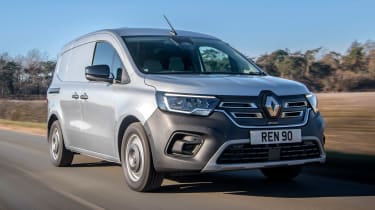
- Prices from: £34,450 (Kangoo E-Tech, excl. VAT, after PiVG)
- Van size: small
- Maximum WLTP combined battery range: 186 miles
- Maximum payload: 702kg
- Maximum load volume: 4.2 cubic metres
When it was first launched, the original Renault Kangoo Z.E was one of the first mainstream electric vans to go on sale. Today, Renault has used its experience to create the Kangoo E-Tech, and this van shares its DNA with the Nissan Townstar EV and Mercedes eCitan.
All of these vans offer sharp styling and a car-like driving experience, and with up to 186 miles of battery range on offer, occasional longer journeys won’t be a problem. If you know your Renaults, each van’s interior may look familiar as the switchgear and steering wheel are borrowed from the Renault Clio supermini.
The Nissan Townstar EV is slightly cheaper than the Renault, and, as you’d probably expect, the Mercedes eCitan’s premium appeal comes with the highest starting price of the three. We’d only pick this model over the cheaper Nissan or Renault if you’re either hellbent on an upmarket badge or can find an excellent finance deal.
Whichever model you choose, though, all three are very similarly equipped and capacious with a maximum load volume of 4.2 cubic metres and a payload just over 700kg.
“Pull away, and a spaceship-style whirr warns pedestrians about the electric van's presence at low speeds (it deactivates at speeds over 20mph). From the lights, acceleration is quite sprightly, and it can be easy to break traction with the front wheels if you're not careful.” - Sam Naylor, Auto Express contributor.
- Who will like it: Those who cover lots of miles will like the Kangoo’s car-like driving experience.
- Who won’t like it: The range is on the smaller side compared to rivals which might not suit long distance use.
10. Citroen e-Relay, Fiat E-Ducato, Peugeot E-Boxer, Toyota Proace Max Electric, Vauxhall Movano Electric
You can get this large van in various different but similar forms, but the Citroen e-Relay would be our pick.
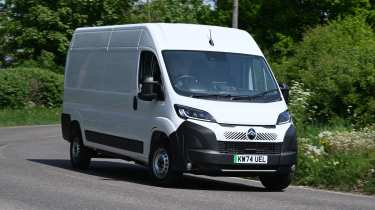
- Prices from: £47,865 (e-Relay exc. VAT, after PiVG)
- Van size: large
- Maximum WLTP combined battery range: 263 miles
- Maximum payload: 750kg
- Maximum load volume: 17 cubic metres
As with the other Stellantis vans on this list, the Citroen e-Relay comes in various different flavours. Under the skin, the e-Relay, Fiat E-Ducato, Peugeot E-Boxer, Toyota Proace Max Electric and Vauxhall Movano Electric are all largely similar and all good options depending on price, finance deals currently available and local dealers.
We’ve chosen the Citroen e-Relay as it represents the best value with its starting price from under £48,000 after the plug-in van grant and excluding VAT.
The Citroen e-Relay promises a wide variety of tailored options for buyers. While the electric e-Relay line-up isn’t quite as extensive as that of the diesel version, there are five panel van variants in four different sizes, plus a single window van and a chassis cab option. In short, there should be something to suit your needs. Cargo volumes are hard to fault with up to 17 cubic metres on offer, while payloads go as high as 1,460kg.
There's a sole battery option in the form of a 110kWh pack which can return up to 263 miles on a single charge. The battery can be topped up from zero to 80 per cent in just 55 minutes when using a suitably quick 150kW rapid charger.
It’s a fully-fledged large panel van, but the big Citroen isn’t too intimidating from behind the wheel. There’s enough power for getting away from junctions and traffic quickly, while the lack of powertrain noise makes things much more relaxing than in the equivalent diesel. The large door mirrors also help to prevent any mishaps resulting from this van’s sheer width (over two-metres).
Materials feel suitably hard-wearing, if not a bit on the plasticky side. There’s a lot of in-cab storage and a decent amount of kit as standard. Our only gripe with the cabin is that the front seats are fitted as far forward as possible to maximise cargo space so taller drivers and passengers might struggle to get comfy.
“There’s a big step up into the Relay’s cab, and when you’re on board there’s plenty of hard plastic around the cabin. That’s fine because it’s designed with function in mind ahead of form, and as a result there is plenty of storage throughout the interior in the form of a large glovebox, lidded compartment and numerous shelves.” - Dean Gibson, senior test editor.
- Who will like it: The vast number of bodystyles on offer means there should be a perfect combination for any business.
- Who won’t like it: Taller passengers might struggle getting comfy behind the wheel.
How we choose the best electric vans
As is the case with any electric vehicle, battery range will be at the forefront of many electric van buyers’ minds. Naturally, any business needs their vans on the road in order to make money, so having to constantly stop and recharge is simply no good here. Thankfully, EV technology has already come a long way, so the best electric vans of all sizes offer plenty of range on the WLTP combined cycle.
There can be a big difference between a van’s range on paper and what it can achieve in the real world, so it’s the latter which our expert road testers pay close attention to by testing these vans on various types of roads while carrying varying payloads. The better a van’s real-world performance, the higher it’ll appear on this list. When the battery is finally out of juice, a quick charging time is crucial, too, so this also plays a role in determining each van’s final score.
As with any van, carrying capacity is another non-negotiable factor. In an ideal world, opting for an electric van over a diesel one wouldn’t mean a reduction in cargo space or payload capacity. In some instances, EVs actually offer the same capacities as their combustion counterparts, so this makes a particularly good impression with our team of van experts.
Nowadays it’s perfectly reasonable for a buyer to expect their new van to be comfortable, well-equipped and easy to drive so, once again, these are yet more important areas which we assess very thoroughly during our in-depth van testing. In fact, the very best performers are virtually car-like.
How you can choose the best electric van
While they can be a bit pricier to buy than their traditionally fuelled counterparts, most electric vans will actually save your business quite a bit of cash in the long run. If you’re able to charge at home or at your place of business, having the right electricity rate can mean a full top-up will cost far less than a full tank of diesel. You’ll also avoid emissions-based charges such as London’s Ultra Low Emission Zone (ULEZ).
As with any van, the first thing you’ll need to decide is which size you require. Electric vans come in a variety of shapes and sizes, so you’ll need to be sure just how much cargo space, payload capacity and towing capacity you’ll require. While the pitfalls of a van that’s too small are pretty obvious, operating one that’s unnecessarily large could cost you far more than is necessary, too.
If a particular van has caught your eye and appears to meet your business’s requirements on paper, we thoroughly recommend getting up close and personal with an example before you buy. Take a test drive and get a feel for the driving experience and on-board kit. If you’re covering particular long trips, you’ll want a van that’s comfortable and quiet. That being said, even shorter journeys can be far more pleasant in some vans than others.
That’s the van sorted, now take a look at the best electric cars…