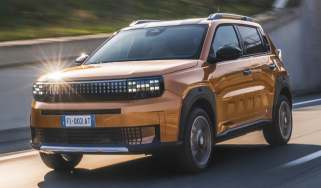
Fiat Grande Panda review
Fiat’s alternative to the Renault 5 has the substance to match its style
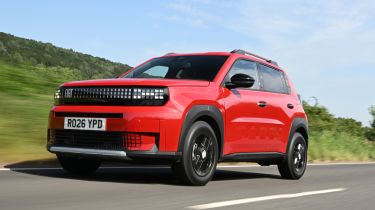

Our opinion on the Fiat Grande Panda
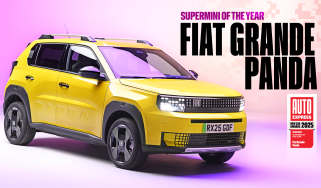
Building a desirable, affordable car is tough in this day and age, but Fiat has played a blinder by delivering a new Grande Panda that’s not just cheap, but packed full of character, too. Better still, you can have one with a powertrain to suit: electric, hybrid and – soon – a pure petrol version with a manual gearbox. True, there are some issues – motorway refinement could be improved and some of the tech could be better – but there’s so much to love about the new Grande Panda that these are not major concerns, and it’s worthy of our 2025 Supermini of the Year award. Bravo, Fiat!
About the Fiat Grande Panda
Icon is a word that has been bandied about by the car industry so much that it’s nearly lost all meaning. Yet it’s entirely justified when describing the Fiat Panda. The classic original eighties model earned a cult following that has shaped later generations of the supermini, while the current Grande Panda adds modern hybrid and all-electric powertrains to the mix.
We’ve tested the Fiat Grande Panda in both fully electric and hybrid forms, and both models offer plenty of value for money. While the Renault 5 took a lot of attention away from the older Fiat 500e for those looking for a modern car with retro charm, the Grande Panda’s distinctive styling, sensible kit and affordable price should be enough to sway at least some buyers back towards the Italian brand. It’s also worth noting that hybrid power is an option that the R5 simply doesn’t have, and there’s also a more affordable pure-petrol Panda with a manual gearbox on the way.
Fiat Grande Panda prices and latest deals
Fitted with an electric powertrain, the Grande Panda costs from just under £21,000 for the entry-level Pop model, with the mid-range Icon adding £1,000 to the price. At the top of the range, the fully loaded La Prima starts from £24,000. This makes the Grande Panda one of the cheapest EVs on sale. If you prefer your cars with an engine, the hybrid is available for around £2,000 less, and it comes in the same three grades.
You can also build the perfect Fiat Grande Panda via the Auto Express Buy a Car service, where you’ll save an average of around £2,400. We can also help sell your current car.
Performance & driving experience
Pros |
|
Cons |
|
For now, there are two Grande Pandas on offer: the electric model comes with a single battery-electric powertrain option that pairs a 111bhp electric motor mounted on the front axle with a 44kWh battery pack. While far from fast, this offers a good balance of performance and range considering the price point.
If you’re not ready to embrace electric driving with the Grande Panda, the only other option currently available is the Hybrid. It’s powered by Stellantis’s 1.2 PureTech petrol engine and an electric motor for a total of 109bhp. A pure-petrol model, with 99bhp and a manual gearbox, is set to join the range in 2027.
The handling, meanwhile, is tidy and controlled. The playful edge that used to be associated with Italian superminis isn’t quite there, but then few, if any, of the Grande Panda’s rivals drive in this manner. More important will be the fact that the Grande Panda rides remarkably well considering its short wheelbase.
| Model | Power | 0-62mph | Top speed |
| Grande Panda Hybrid | 109bhp | 11.2 seconds | 99mph |
| Grande Panda Electric | 111bhp | 11.5 seconds | 82mph |
Performance, 0-60mph acceleration and top speed
The electric Grande Panda takes 11.5 seconds to go from 0-62mph, and with a top speed of just 82mph, will run out of puff soon after. Unlike many EVs, it lacks that sense of zip and feeling of instant torque; the e-motor isn’t particularly responsive and can feel a little lethargic on faster roads. Hit the accelerator with a firm prod and the car will make progress, but at its own pace.
On-paper performance for the Panda Hybrid is similar to that of the electric version. It’s not the fastest supermini around, with a 0-62mph time of 11.2 seconds, but this is three-tenths of a second faster than the electric model, and it feels lively, too.
There is a disconnect between your acceleration and the noises of the engine and electric motor under the bonnet, but overall it remains quiet unless it’s pushed very hard. Gearshifts from the six-speed, dual-clutch automatic are smooth, too.
Town driving, visibility and parking
It’s on city streets where every generation of Panda has thrived, and the Grande Panda is no exception. We had a first taste of the Panda’s ability on the poor-quality streets of central Turin in Italy, but even on UK roads the Panda never crashed into potholes or speed humps, feeling polished and even quite plush on occasion.
Good all-round visibility and responsive controls mean the Panda is easy to drive in town, while refinement in the Hybrid model is decent. Fiat says that it can creep along in traffic without waking the engine, but in our experience this only happens when conditions are perfect – for example, when you’re doing no more than walking pace and the heater or air-conditioning aren’t working hard to get the cabin comfortable.
This is where the EV really is in its element, though, feeling responsive, agile and easy to drive. If you spend most of your time in town and have easy access to charging, this is the car we’d recommend.
Country road driving and handling
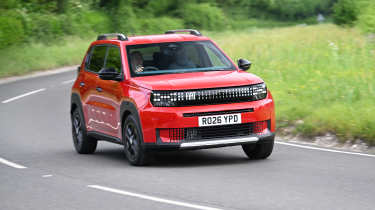
The Fiat Grande Panda isn’t as fun to drive as a Renault 5, but it’s not totally devoid of enjoyment. It holds its own on twistier roads, and body lean is kept well in check, despite the car’s rather upright stature. The steering feels well weighted and is pleasant to use, while the three-cylinder thrum of the Hybrid model adds a pleasingly sporty edge to the drive.
One downside of the car’s character is a slightly fidgety edge to the ride at higher speeds. The suspension is better suited to low-speed comfort and the 95kg lighter Hybrid model feels more unsettled the faster you go. It’s not a deal-breaker, though.
Motorway driving and long-distance comfort
When cruising at motorway speeds, the Grande Panda Hybrid isn’t the most settled performer (the electric model is better, thanks to the extra weight of the battery weighing the car down), but it has just enough grunt to keep up with traffic.
However, ambitious overtakes will need to be made with a degree of caution and some forward planning. Should the unforeseen happen, the brake pedal provides a reassuring level of feedback, as do the brakes themselves.
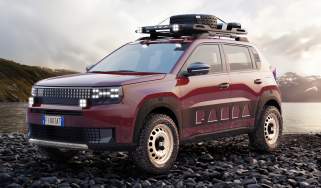
"Unlike past Pandas, Fiat currently has no plans to offer a 4x4 model this time, so if you’re after a rugged go-anywhere small car, you’ll have to look elsewhere. The only vague concession to off-road use is Hill Assist, which holds the car on a slope when setting off." - Dean Gibson, senior test editor.
MPG & running costs
Pros |
|
Cons |
|
The Grande Panda EV has an edge when it comes to everyday running costs, but the Hybrid is still impressively efficient. Officially, this car can hit 56.5mpg, and we managed around 50mpg over a mixture of urban and rural roads, plus faster motorway use. Stick to town driving, and you’ll likely see fuel economy even closer to the official figures.
| Model | MPG | CO2 | Insurance group |
| Grande Panda Hybrid | 56.5mpg | 115g/km | 19 |
Electric range, battery life and charge time
A 199-mile range was one of the big headlines when the Grande Panda EV was first announced, and it certainly delivers good efficiency at low speeds and in town, where it’ll mostly be driven. However, on faster roads most Stellantis models seem to struggle for efficiency, and the Grande Panda is no exception.
On a drive in the wind and rain, we struggled to better 2.9 miles per kWh – equivalent to less than 130 miles of range. When we conducted a test driving EVs until they died, the Fiat returned an average efficiency of 3.1mi/kWh, although admittedly that did include quite a bit of motorway work. In comparison, the Renault 5 was much more efficient – returning 3.9 miles per kWh over the same route.
| Model | Battery size | Range | Insurance group |
| Grande Panda Electric | 44kWh | 199 miles | 23 |
Insurance groups
While the Fiat Grande Panda has budget-minded roots, the Hybrid sits in relatively high groups 19 and 20 for car insurance cover. That’s better than the EV, which is in groups 23 and 24, but even the highest-spec Dacia Sandero is only in group 14.
Tax
It’s the electric Grande Panda that has an advantage for company-car drivers, too, because it sits in the lowest Benefit-in-Kind (BiK) tax band. As of 2026/27, the Hybrid is in the 29 per cent tax bracket, so even the cheapest model will cost more than £1,000 a year for 20 per cent taxpayers. Another hybrid model, the Toyota Yaris, starts in the 24 per cent tax bracket, although higher list prices mean it’s still more expensive than the Fiat.
Depreciation
Our expert data shows that after a period of 36,000 miles or three years, the Fiat Grande Panda Hybrid should retain around 41-42 per cent of its original value. The electric version fares slightly better, maintaining 42-45 per cent. In comparison, the Renault 5 holds on to 46 to 49 per cent over the same period, while the Fiat’s sibling, the Citroen C3, manages 41 to 46 per cent.
To get an accurate valuation for a specific model, check out our valuation tool...
Interior, design & technology
Pros |
|
Cons |
|
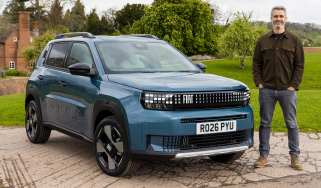
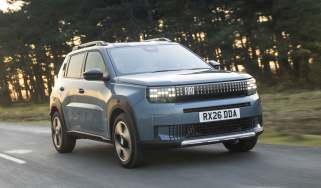
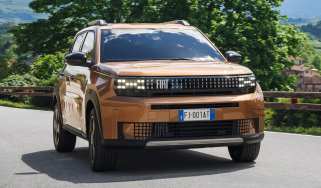
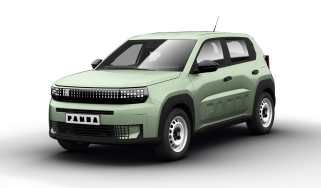
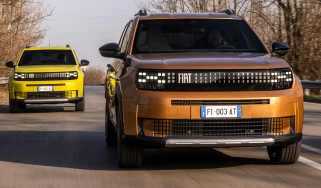
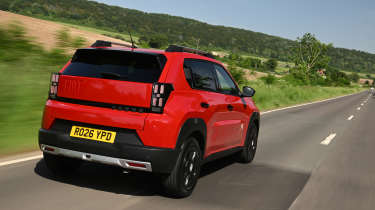
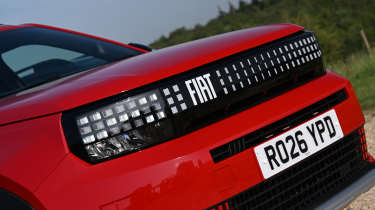
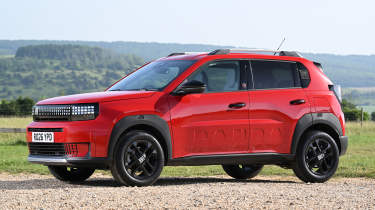
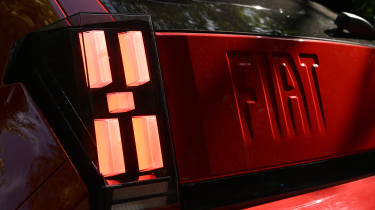
While the Grande Panda shares plenty of body panels with the Citroen C3, the Fiat arguably cuts a greater dash than its French counterpart. There are lots of great details on the outside, including the Panda lettering stamped into the door panels, the X-shaped light designs front and rear and the stylised nose that echoes the look of the original Panda. Add in the requisite SUV styling cues (roof rails, black cladding, etc), and the Panda is a chunky-looking small car.
Interior and dashboard design
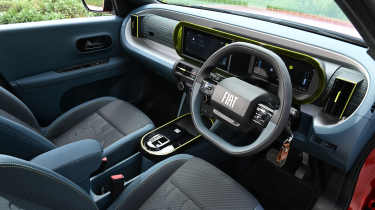
The excellence continues inside. It’s not a cabin full of expensive soft-touch materials, but what has been included is both distinctive and cleverly applied. The oval shape of the dash and many of its parts are inspired by the Lingotto test track that sits on the roof of Fiat’s historical factory in Turin.
This fundamentally stylish architecture is dotted with lots of little details that make the Grande Panda feel more like an installation at Milan Design Week than an affordable supermini. Few, if any, manufacturers have used coloured acrylic as seen on the dash and, where needed, fabrics have been deployed to keep the overall ambience from feeling too cold or stark. To round things off, a tiny relief of the original Panda sits in a clear section of the dashboard to the side of the touchscreen.
In comparison, a new Renault 5 is more premium and has more content inside. But the top-spec Grande Panda is priced at around the level where the R5 kicks off, fitting customer expectations almost perfectly.
Materials and build quality
Plenty of familiar Stellantis switchgear has been included in the Grande Panda, such as the drive-selector toggle (although this is rather frustratingly shrouded in piano black plastic that can be scratched too easily) as well as the window switches and steering wheel controls.
Cheaper materials have also been used to keep the Grande Panda’s cost under control, but Fiat’s engineers have done an admirable job of hiding these in plain sight. Previous Pandas have held a reputation for being rather durable, and we’re willing to bet that the latest model will live up to this, too.
Infotainment, sat-nav and stereo
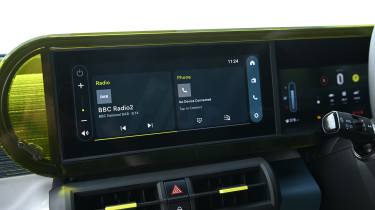
Fiat is under no illusion that offering a twin-screen infotainment system is going to change the world, but it’s a layout that is universally recognised as being effective for a car in this area of the market. The main 10.25-inch touchscreen is mounted in the right position, but the graphics are a little low rent. This is noticeable if you connect your phone using Apple CarPlay or Android Auto, where the display looks particularly grainy. The real estate at either end of the main screen is used by the volume control (there’s no physical knob) and the four shortcuts to the home screen, audio, phone and settings menus.
Screen response isn’t the fastest, while the settings shortcut doesn’t take you to a display with all functions included; some are only available when you swipe down from the top of the screen. At least there are physical buttons for the speed limit and lane assist functions, so you don’t have to mess around with the menu system. Fiat has included separate physical air-conditioning controls lower down on the centre console for convenience, while the driver’s display isn’t hugely configurable, but it still offers all the info you need at a glance.
"Stellantis has mastered the art of making two cars that are largely identical under the skin look different enough to have their own identity. When you consider how inexpensive the Fiat Grande Panda and Citroen C3 are, it’s even more impressive.
"Fiat has run with the square theme of the eighties original throughout the modern model, while the Fiat logos on the inside of the doors and Panda lettering on the upholstery look smart without trying too hard, unlike the ‘Be Cool’ fabric tags you’ll find in the C3’s cabin." - Dean Gibson, senior test editor.
Boot space & practicality
Pros |
|
Cons |
|
Even though it’s named Grande, this Panda is still a small car. Some clever packaging means it’s pretty spacious inside, though.
Dimensions and size
The Grande Panda is at the smaller end of the supermini spectrum. Some would even say it’s a large city car in comparison with its rivals.
Dimensions comparison | |||
| Model | Fiat Grande Panda | Dacia Sandero Stepway | Renault 5 |
| Length | 3,999mm | 4,102mm | 3,922mm |
| Width | 1,763mm | 1,853mm | 1,774mm |
| Height | 1,586mm | 1,586mm | 1,498mm |
| Wheelbase | 2,540mm | 2,604mm | 2,540mm |
| Boot space | 412-1,366 litres | 410-1,455 litres | 326-1,106 litres |
Seats & passenger space
The Grande Panda scores well for room up front, and there’s a good range of wheel and seat adjustment. You’ll find a number of storage cubbies inside the dash, including a space above the glovebox, plus cup-holders between the seats, a small armrest bin and reasonably sized door pockets.
There are two USB sockets ahead of the drive selector and a small tray below them where you can place your phone, which features a wireless charging pad on the top-spec La Prima version.
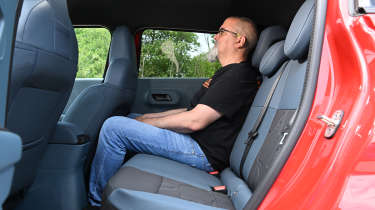
The Panda’s quasi-SUV body helps with space in the back. It can’t perform miracles, but there’s more room than you might expect – we managed to seat a pair of six-foot-tall adults fairly comfortably, with enough head and legroom for a short journey.
It surpasses the compromised Renault 5 for space in the back, but the upright position and limited kneeroom mean you wouldn’t want to sit there for longer periods if you’re tall.
Boot space
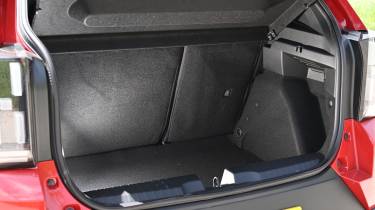
The Grande Panda Hybrid’s 412-litre boot is quite generous for a supermini, and it’s almost 100 litres more than you’ll find in the Citroen C3. The space is a little awkwardly shaped, being tall and narrow from the sill to the back seats, plus there’s a high load lip to overcome. The electric variant’s battery has to go somewhere, so the boot in this car shrinks to 361 litres. This is still 35 litres more than a Renault 5 offers, though.
The back seats are easy enough to fold from the boot via fabric straps on the shoulders, and this creates 1,366 litres of space in the Hybrid, or 1,315 litres in the Electric.
Reliability & safety
Pros |
|
Cons |
|
The Grande Panda hasn’t received a crash-safety rating from Euro NCAP yet, and neither have its sister cars, the Vauxhall Frontera, Citroen C3 or Citroen C3 Aircross. There are lots of driver-assistance systems on offer, and every model is equipped with rear parking sensors, cruise control, lane-keeping assist, active-safety braking, road-sign recognition and driver-attention monitoring. Top-spec La Prima cars add a rear-view camera.
The Grande Panda is too new to appear in our Driver Power survey as an individual model, but Fiat didn’t fare that well in our 2025 brands poll. Owners weren’t impressed by their car’s powertrains, interiors, ride and handling or practicality, but they did praise the low running costs and distinctive styling.
Based on their feedback, the Italian manufacturer finished in 21st place out of 31 companies, but other Stellantis marques did much better, with Peugeot securing seventh place and Vauxhall just missing out on a podium, in fourth place.
Fiat’s standard three-year/60,000-mile warranty applies to both the Grande Panda Hybrid and Electric models. The latter also benefits from eight years and 100,000 miles of battery cover.
Buying and owning
- Best buy: Fiat Grande Panda Hybrid La Prima
The Fiat Grande Panda is a very affordable car both in hybrid and electric forms, so we recommend the range-topping La Prima model as the best balance of kit versus cost. The walk-up from the base car to top-spec is only £3,000, and that will be negligible when spread over a three-year lease or PCP deal. If you’d rather have an EV, the equipment list doesn’t differ hugely versus the hybrid – so just choose your trim and pick your powertrain.
Fiat Grande Panda alternatives
Fiat’s not the only manufacturer to offer a well-sized, stylish and affordable supermini in both electric and hybrid forms. In fact, two of the Grande Panda’s key rivals are the Citroen C3 and Citroen e-C3, both of which share several of the same underpinnings.
The exclusively electric Renault 5 is a little more expensive, starting just below the top-spec electric La Prima, but you’ll need to keep to the entry-level model. As a car, the Renault is better to drive, more refined, and feels more substantial.
If it’s value for money that you’re looking for, then the Dacia Sandero is the bargain of the supermini class. Even the highest-spec version of the rugged-looking Sandero Stepway undercuts the base version of the Grande Panda, and yet it comes with more standard kit. Quality is obviously poorer than in the Fiat, though, while the only engine option is a petrol manual, with no electric version offered.
Key updates to the Fiat Grande Panda review
5 June 2026: General update to include driving impressions of the Grande Panda Hybrid following the Auto Express group test with the Dacia Sandero
29 April 2026: General update to include more detail and driving impressions of the Grande Panda Hybrid.
Frequently Asked Questions
We’re fans of the Grande Panda, because it’s a refreshing take on the supermini formula. The SUV styling cues aren’t overdone, and the details in the cabin manage to make it look modern and stylish while hiding its budget sensibilities well. The hybrid and electric powertrains suit the car well.