Genesis GV60 review
The Genesis GV60 is a desirable and upmarket, if slightly unconventional, electric family car

Our opinion on the Genesis GV60
Even though it’s been around for a few years, the Genesis GV60 is still one of the more advanced electric cars that you can buy. Some may find it unconventional to look at, but you can’t argue with its efficiency, long range, and ultra-rapid charging speeds that help take the anxiety out of EV ownership.
Admittedly, some of this car’s details seem borderline chintzy, but underneath the swizzling crystal ball gear selector is the same platform used by the brilliant Hyundai Ioniq 5 and Kia EV6, but with an added dose of refinement and a more luxurious interior. It isn’t the cheapest way into an electric car, but strong equipment levels and an excellent five-year, unlimited-mileage warranty package help soften that financial hit.
About the Genesis GV60
Although the GV60 isn’t the brand’s only EV (there’s also the Genesis Electrified G80 saloon and Genesis Electrified GV70 SUV), it is the brand’s first electric car to be based on a bespoke platform, rather than sharing its underpinnings with an equivalent combustion car.
Underneath its distinctive bodywork, the GV60 uses the same E-GMP platform that underpins the Hyundai Ioniq 5 and Kia EV6, but the Genesis is far more focused on softness and luxury than its stablemates. Following a midlife refresh, every GV60 is now powered by an 84kWh (80kWh usable) battery.
Used - available now

2022 Genesis
Gv60
28,159 milesAutomaticElectric
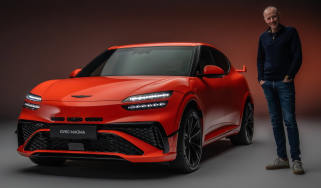
Cash £22,299Following the success of the Hyundai Ioniq 5 N, an equally fiery Genesis GV60 Magma is in the works and set to arrive later in 2026. We haven’t driven this car yet, but we have been up close and personal with it, so be sure to take a look at our in-depth walkaround…
Our chief sub-editor, Andy Pringle, lived with a Genesis GV60 for six months as part of our long-term test fleet, and we’ve also tested the rear-wheel drive Premium model (now renamed Pure) GV60 against the Nissan Ariya and Volkswagen ID.5.
Genesis GV60 prices and latest deals
The entry-level GV60 Pure starts at just over £54,000, while the mid-level Sport model with a dual-motor, four-wheel set-up costs a little over £58,500. The even zestier Performance model commands just under £68,000.
If you’d like to save on the list price, you can do so by building your dream Genesis GV60 through the Auto Express Buy A Car service. Alternatively, we have a range of GV60 leasing deals and used GV60 models in stock, plus we can also help you to sell your car.
Performance & driving experience
Pros |
|
Cons |
|
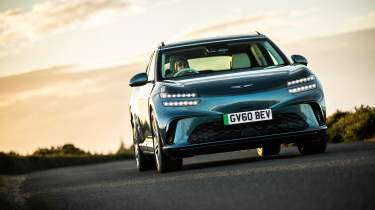
While the Hyundai Ioniq 6 and Kia EV6 take on a slightly sportier approach, the Genesis GV60 is very much skewed towards comfort. Predictably, the trade-off for increased softness is slightly compromised handling. However, this car still does a reasonable job of composing itself when being hurled around - although this is not something that we’d imagine too many luxury EV drivers will be doing that often.
We like that the Genesis offers drivers more scope to adjust brake regeneration than some of its rivals, thanks to steering-wheel paddles. The five modes range from complete freewheeling right up to full one-pedal driving. The GV60’s regenerative braking can occasionally engage more harshly than you might expect, but overall, the powertrain is slick.
| Model | Power | 0-62mph | Top speed |
| GV60 RWD Pure | 226bhp | 7.8 seconds | 115mph |
| GV60 AWD Sport | 314bhp | 5.5 seconds | 124mph |
| GV60 AWD Performance | 483bhp | 4 seconds (in boost mode) | 146mph |
Performance, 0-60mph acceleration and top speed
The entry-level, rear-wheel-drive GV60 Pure produces 226bhp and 350Nm of torque – enough to propel the car from 0-62mph in 7.8 seconds. When we tested this model, the single motor felt keener than the Nissan Ariya’s initially, but once up to speed, the pair feel very similar. Top speed stands at 115mph.
Upgrading to the GV60 Sport adds another electric motor for all-wheel drive, bumps the output to 314bhp and 605Nm of torque, and knocks the 0-62mph time down to 5.5 seconds. It also increases the top speed to 124mph.
Finally, there’s the GV60 Performance. It’s not quite as quick as the Kia EV6 GT, but it’s got 483bhp and 700Nm, so 0-62mph takes just four seconds if you activate boost mode, and it’ll keep going until you hit 146mph, says Genesis. This version also gets a drift mode that temporarily switches the car to a rear-wheel-drive bias for more oversteer in the corners, although quite why you’d want that in your luxurious family EV is beyond us.
The incoming GV60 Magma will be the fastest of the bunch. A total of 641bhp and 740Nm will erupt from this model’s twin motors, resulting in a 0-62mph dash of just 3.4 seconds. A simulated eight-speed gearbox, similar to the one found in the Hyundai Ioniq 5 N, also helps to ramp up the driver engagement.
Town driving, visibility and parking
At lower speeds, the GV60’s ride can be a little fidgety, which was especially surprising considering this car’s apparent focus on ride comfort. This problem is further amplified by the larger 21-inch wheels you’ll find on the Sport and Performance models.
This car’s 11.9-metre turning circle is over 1 metre more than the Nissan Ariya’s, and 1.7 metres larger than the Volkswagen ID.5’s, making it rather challenging to manoeuvre in tight spaces. During his six months with the range-topping GV60 Premium, our chief sub-editor, Andy Pringle, frequently used various parking-assistance systems, such as the all-round sensors and 360-degree camera, to make life a bit easier driving around town. It’s just a shame you have to get the pricey £3,000 Innovation Pack in order to get many of these features.
Country road driving and handling
Find a twisty road, and the GV60 doesn’t feel as well tied down as its sibling, the Kia EV6. But thanks to a neutral balance, its well-weighted steering and the rear-wheel-drive layout of our test car, it’s still a satisfying car to drive. Opt for the four-wheel drive Sport or Sport Plus version, and you can feel the front wheel come into play, with the additional traction benefits of its four-wheel drive system dragging you out of corners if you put your foot down. Body roll is noticeable in all versions, but it doesn’t get out of hand.
Motorway driving and long-distance comfort
Compared with the likes of the Nissan Ariya and Volkswagen ID.5, the GV60 has the softest suspension. In some areas, this approach works very well; on a motorway cruise, it takes on a floaty yet sure-footed gait, which is deeply relaxing. It’s even more so if you engage the self-steering system, which guides you between lanes automatically for short periods. There is a touch more wind noise than we experienced in the Nissan or the Volkswagen, though.
Range, charging & running costs
Pros |
|
Cons |
|
Following a midlife revamp, every Genesis GV60 is powered by an 84kWh (80kWh usable) battery, but the claimed range varies from model to model.
The entry-level GV60 Pure boasts the highest WLTP combined range at 348 miles. This falls ever so slightly short of the Hyundai Ioniq 5’s 354-mile claim, but it is more than the Nissan Ariya’s 329 miles.
Moving up to the Sport trim adds an additional motor, and the extra weight of this reduces efficiency to a claimed battery range of 318 miles. The Performance model suffers a bit more to 311 miles.
When we drove the pre-facelift GV60 Premium with a smaller 77.4kWh battery pack, it returned a very impressive 4.0 miles per kWh, trumping the 3.9 miles per kWh we got from a Volkswagen ID.5 and 3.7 miles per kWh we saw in a 63kWh Nissan Ariya we tested in the same conditions. That equates to a real-world range of 296 miles for the entry-level GV60 based on its usable battery size of 74kWh – about 10 per cent less than its claimed WLTP range at the time.
There was more promising news when we drove the refreshed GV60 Pure, too, as this returned an average of 3.8 miles per kWh after a range of testing. This equated to over 300 real-world miles on a single charge, which is more than plenty for most everyday needs.
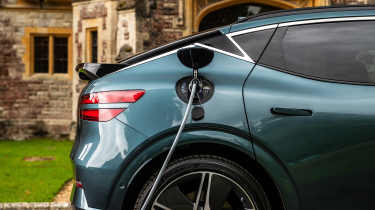
It might be an older entrant, but the Genesis is still way out in front of most of the competition in the rapid-charging race. Find a charger that’s powerful enough, and it’ll officially recharge at speeds as high as 220kW, meaning that a 10 to 80 per cent top-up – which would add roughly 200 miles of range – can take as little as 18 minutes. Compared with a Nissan Ariya that can only reach 130kW, the same 10 to 80 per cent charge requires around 30 minutes of your time.
For many electric car owners, it’ll be home charging that’s more important, where you’ll top up your battery after work at home, ready for the next morning. Every GV60 will need a little under 12 hours to fully recharge using a regular 7.4kW home wallbox.
| Model | Battery size | Range | Insurance group |
| GV60 RWD Pure | 84kWh (80kWh usable) | 348 miles | 38 |
| GV60 AWD Sport | 84kWh (80kWh usable) | 318 miles | 43 |
| GV60 AWD Performance | 84kWh (80kWh usable) | 311 miles | 46 |
Insurance groups
Unfortunately, the base Pure model falls into insurance group 38 (out of 50), while Sport and Sport Plus versions attract ratings of groups 43 and 46, respectively.
This isn’t too dissimilar to its Ioniq 5 stablemate, as that car resides in groups 33 to 41 (although the hardcore Ioniq 5 N jumps up to group 49). The Kia EV6, meanwhile, is the cheapest of the three, going as low as group 29.
Tax
Every brand-new GV60 sits above the £50,000 luxury car tax threshold for EVs, so a surcharge will be added on top of the standard VED road tax rate between years two and six after the car is initially registered.
Company car buyers will benefit from the lowest applicable Benefit-in-Kind (BiK) rates, though the Hyundai Ioniq 5 and Kia EV6 may be more tempting due to their lower starting prices.
Depreciation
Our market data indicate that the Genesis GV60 will only retain 35 to 36 per cent of its original value after three years or 36,000 miles.
The cheaper Hyundai Ioniq 5 retains 39 to 42 per cent of its value over the same period, while the Ford Capri retains between 44 and 51 per cent.
To get an accurate valuation for a specific model, check out our valuation tool...
Interior, design & technology
Pros |
|
Cons |
|
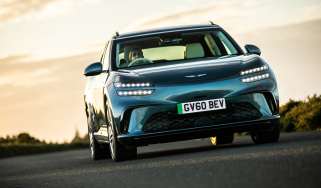
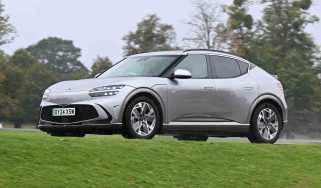
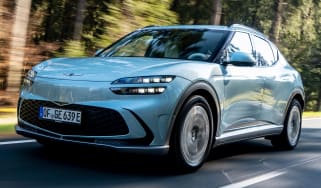
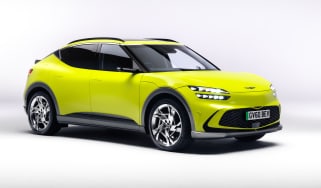
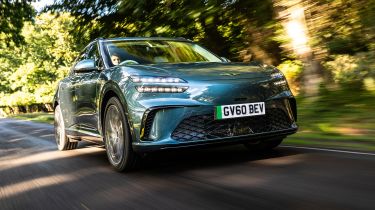
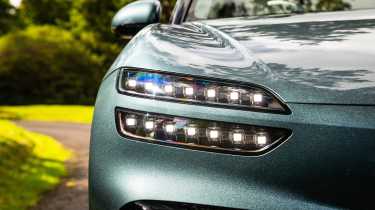
The revamped GV60 still features the firm’s signature split headlight design and Bentley-esque winged badge on the nose, as well as a sloping roofline, large alloy wheels and volt emblem on the C-pillar that are as polarising as they are eye-catching. Key changes for the facelifted model include ‘Micro Lens Array’ headlight tech, a redesigned front bumper and a slimmer front grille.
Interior and dashboard design
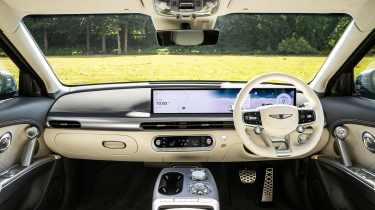
The most significant upgrades that resulted from the Genesis GV60’s midlife facelift actually took place on the inside. An enormous 27-inch OLED single-screen is now the star of the show, but we still have a few qualms about the software.
Adorning this huge screen is an array of soft materials, although a few plasticky surfaces have crept into the mix. These are in the minority, but they’re a tad questionable in a car as expensive as this.
Materials and build quality
The cabin offers plenty of drama and luxury, and the quality it offers does go some way to justifying the high price tag compared with other electric family SUVs. For instance, the chunky steering wheel is trimmed in plush, soft leather, and you can get contrasting stitching and piping across the seats and dashboard.
Some switchgear falls a little short of the premium billing, though. The rotary gear selector is also one of the GV60’s more polarising features; it’s hidden when the car’s off, but start it up and the crystal-like ball spins to reveal the dial.
Infotainment, sat-nav and stereo
Derived from the same systems you’ll find in a Kia or Hyundai, Genesis’s infotainment set-up is packed with features. The home screen is made up of four main pages; you swipe across these to bring up shortcuts and menus. However, during our infotainment system head-to-head test, we found the GV60’s system to be far more fiddly and time-consuming to use than virtually all of its competitors.
Following the car’s facelift, the dual-screen dashboard was upgraded with a single 27-inch display. However, while it is a bit more appealing to the eye, the menu layout is very similar to what went before.
The Genesis setup differs from its EV6 and Ioniq 5 siblings by offering a rotary controller to aid with operating the touchscreen while driving, but it isn’t enough to change the fact that several features remain buried in sub-menus. The layout isn’t ideal when navigating your way around the system in a stationary car, and is highly distracting when using the system on the move.
It’s not all doom and gloom, because we’re big fans of the fact that this car still has a number of proper buttons located throughout the cabin. Climate controls are accessed on a panel below the main display, while a couple of physical shortcut keys are within easy reach on the centre console.
Our road testers like the side-mounted blind-spot cameras that come as part of the rather pricey Innovation Pack. When you indicate, a camera feed is displayed clearly in the digital dials ahead of the driver, showing what’s to the side of you when changing lanes on the motorway and helping to identify any cyclists approaching when turning at a junction. A forward-facing camera is one of the screens that can be brought up between the main instruments, too.
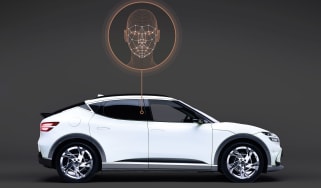
Another unique feature is the facial recognition technology which allows the car to ‘recognise’ the face of the registered owner, enabling them to drive their GV60 without the key being present.
Boot space & practicality

Pros |
|
Cons |
|
The GV60 has a long wheelbase, which helps to create a very spacious cabin. We wouldn’t recommend the light interior colour if you have a young family, but there are some practical touches dotted around the cabin, such as two USB-C ports and a storage net on the back of the centre console, two large seatback pockets, cup-holders built into the doors, and large door bins, too.
Dimensions and size
The GV60 is shorter than a Nissan Ariya or Volkswagen ID.5, but neither can match the wheelbase of the Genesis. The GV60 is also narrower and lower than an Ariya, contributing to its unique look.
| Dimensions comparison | |||
| Model | Genesis GV60 | Hyundai Ioniq 5 | Nissan Ariya |
| Length | 4,545mm | 4,655mm | 4,595mm |
| Width | 1,890mm | 1,890mm | 1,850mm |
| Height | 1,580mm | 1,605mm | 1,660mm |
| Wheelbase | 2,900mm | 3,000mm | 2,775mm |
| Boot space | 432 litres | 520 litres | 466 litres |
Seats & passenger space
One advantage of a bespoke electric car platform like the GV60’s, not to mention having a wheelbase similar to an executive limousine, is a wealth of cabin space. There’s a completely flat floor in the back, with loads of legroom available for rear-seat passengers. Despite what its coupe-esque roofline might suggest, headroom will only be an issue for anyone over six feet tall, though the panoramic roof doesn’t help matters.
Boot space
With a 432-litre boot, the GV60 is less practical than its sister cars. In fact, it offers over 100 litres less boot space than the Hyundai Ioniq 5. The high boot floor also restricts load space, but the load lip is flat and the bumper shallow, so loading items inside is relatively easy.
At the front, there’s a 53-litre storage space under the bonnet that’s ideal for the charging cables, although it doesn't match the ‘frunk’ of a Tesla Model Y. Fold the rear seats down and the GV60’s luggage capacity expands to 1,460 litres.
Towing
Every GV60 is rated to tow a braked trailer of up to 1,600kg. This is an exact match with the Nissan Ariya, but it is less than the Kia EV6’s 1,800kg capacity.
“Our daughter wasted no time in finding one of the GV60’s neat party tricks: a set of controls on the side of the front passenger seat that allow the rear occupants to adjust it from the back. This means our daughter can increase the amount of legroom available to her – albeit at the expense of her mother’s legroom.” - Andy Pringle, chief sub-editor.
Reliability & safety
Pros |
|
Cons |
|
Neither the GV60 nor the Genesis brand have appeared in Driver Power owner satisfaction survey yet. Hopefully, the brand can improve upon the mid-table results of its siblings, with Kia in 18th out of 31 brands, and Hyundai two places below in 20th.
In terms of safety, the GV60 went through Euro NCAP’s battery of crash tests and received the maximum five-star rating for its efforts in 2022. The electric coupe-SUV’s 88 per cent score for safety assistance technology was no surprise, given that every model is fitted with lane-keep and lane-change assist, highway driving assist, front collision avoidance and smart cruise control with start/stop functionality.
| Euro NCAP safety ratings | |
| Euro NCAP safety rating | Five stars (2022) |
| Adult occupant protection | 89% |
| Child occupant protection | 87% |
| Vulnerable road user protection | 63% |
| Safety assist | 88% |
Buying and owning
- Best buy: Genesis GV60 RWD Pure
No GV60 can be described as inexpensive, but sticking with the entry-level Pure trim brings the maximum claimed battery range along with more than enough tech and luxuriousness for most requirements.
Genesis GV60 alternatives
The Genesis GV60 is in the same price bracket as upmarket family EVs, such as the Audi Q4 e-tron, Mercedes EQA and BMW iX1. It also goes up against higher-spec versions of accomplished electric SUVs like the Nissan Ariya, Tesla Model Y, Volkswagen ID.5 and Ford Mustang Mach-E, plus its two sister cars, the Hyundai Ioniq 5 and Kia EV6.
Genesis GV60 long-term test
Our chief sub-editor, Andy Pringle, was smitten with his long term GV60 Premium, largely thanks to the excellent efficiency that was a step up from the previous electric cars he’d run. His neighbours even thought he’d won the pools and bought himself a Bentley, thanks to the Genesis logo bearing more than a passing resemblance to the famous winged B logo of the British luxury car maker. You can read the full long-term test here…
Key updates of the Genesis GV60 review
22 May 2026: Latest driving impressions of the facelifted model.
Frequently Asked Questions
The Genesis GV60 is covered by a five-year, unlimited mileage warranty, plus an additional 10-year/120,000-mile warranty just for the powertrain and other electric gubbins, which is more generous than most rivals.
Deals on the GV60 and alternatives
More reviews
Which Is Best