New Renault Espace MPV considered as radical E-Space concept wows Paris Motor Show
Renault's Paris Motor Show concept previews a next-generation Renault Espace MPV, with a big retro twist
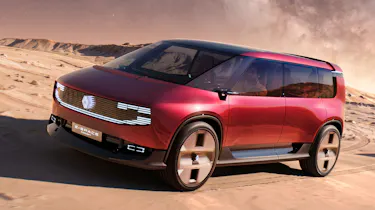
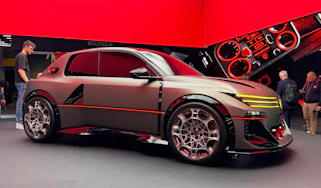
Behold what we hope is an all-new Renault Espace. Unveiled at the Paris Motor Show, the new E-Space concept puts a contemporary spin on the French firm’s pioneering people-carrier from the eighties. Could this be the car that makes MPVs properly cool again?
While the Renault E-Space is still officially a concept, Renault’s design boss, Laurens van den Acker has confirmed to Auto Express that a production Espace is under consideration. The concept's groundbreaking form and other key elements “express the brand’s values”, he said.
There will be challenges, though. In a market obsessed with SUVs, a new Espace would sit outside of the norm for many modern families, and Renault knows this. “The monovolume market is a bit of a question,” van den Acker explained, “but I think with the advent of connected cars it could make sense again. It’s not just a bridge to the past, it’s one to the future.
“If we had to go head-on against the competition, it’s always been relatively tough for us, because the main markets in the UK and Germany have their own strong offerings in the market.”
Something the original Espace has always had, though, is a sense of classlessness, similar to something like a Volkswagen Golf or Dacia Duster, which is able to sit alongside traditional premium vehicles. “People could have an Espace and a Mercedes, or an Espace and a different type of premium vehicle. It’s the car that gives us the most credibility.”
Of all the brands that could try and reintroduce a modern interpretation of an MPV, it’s Renault. “This is a concept to put our toe in the water and test the [public’s] reaction,” said van den Acker. “But it’s something we believe in, and it is a car that only we could do. It’s the most credible high-end car Renault has ever done.”
Doubling down on typically French left-field thinking to create a family car package that doesn’t compete head-on with premium rivals, but offers something fundamentally different, rooted in practicality and innovation, could be a promising avenue for Renault. With so much momentum behind the brand's other retro-styled models, and the technical capability to execute a plush MPV – if not the investment – a new Renault Espace could well be on the horizon.
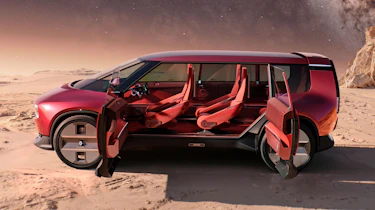
Renault E-Space concept in detail
This big retro family bus is the second time Renault has previewed a 'new Espace' this year alone. The R-Space Lab concept that was unveiled in March featured a more modern, forward-focused design. Whichever direction the brand goes, we’re expecting a production model sometime in the 2030s, giving the Kia PV5 and VW ID. Buzz time to prepare a defence.
Renault’s had massive success with the rebirth of the Renault 5, Renault 4 and Twingo, so why not give Espace the same treatment. With the E-Space, the designers have proved how they can revive the spirit and design of the original, making sure this futuristic show car is familiar to fans, while at the same time evolving things.
As you might hope with a people carrier, the first priority with the E-Space concept was designing the airy, modular, comfort-focused interior that’s supposed to feel like a living room, with various fabrics and thick long-pile wool carpets creating a cozy, relaxing atmosphere. Meanwhile, occupants are enveloped by ambient lighting and a huge amount of glass will let an equally huge amount of light in.
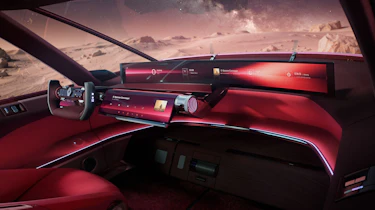
Up front is Renault's new OpenR Panorama cabin layout, with a 1.13-metre-wide display stretching from pillar to pillar across the dashboard, very similar to the Panoramic iDrive system in the new BMW iX3. It’s certainly a more impressive set-up than the French brand’s current dual-screen design, plus it puts all the vital information closer to the driver’s view of the road, and frees up more space.
This system isn’t just to turn heads in Paris. The next-generation Renault Scenic and Rafale will feature this bold new cockpit design, we’ve been told, with the compact steering yoke utilising cutting-edge steer-by-wire technology.
This ditches any mechanical link between the steering wheel and front wheels in favour of electronic impulses, enabling a continuously variable level of assistance depending on how or where you're driving the car. Rival Peugeot will also bring the same innovation to the masses very soon in the next-generation 208 supermini arriving next year.
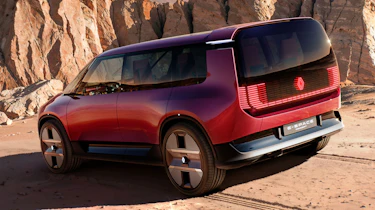
There’s no shortage of room inside, of course, with the 23-inch wheels pushed right to the corners of the car. What’s more, at 4.7 metres long and more than 2.0 metres wide, the E-Space is quite a bit bigger than the MPV that inspired it. The ratio between length and width is the same, though.
Rear-hinged coach doors, unsurprisingly, weren’t a feature of the 1984 original. But having no central B-pillar would help when loading up all six art deco-inspired seats, which are designed to look like they’re floating and can swing around so those in the back can chat on the open road. We presume a road-going model would get a conventional seven-seater layout.
In case anyone left their iPad at home, the middle-row seats also get folding tray tables and 12.3-inch screens mounted to the seats in front, and there’s a remote-controlled console that slides along the cabin’s central spine with a small fridge, video game controllers and even Connect 4 on offer. Alternatively, the second row can also fold down completely flat, creating a workspace/picnic table for those in the rearmost seats, with a view of those two large displays.
Like the revolutionary first-generation Espace, the E-Space concept is a ‘monovolume’ design, meaning it’s a ‘one-box’ people carrier with its stubby wedge-shaped nose that flows into a huge cockpit/glasshouse, recreating the famous “TGV train” profile of the old car. This shape prioritises functionality and maximises interior space, while maintaining a surprisingly aerodynamic profile.
In addition to being bigger and snazzier than its inspiration, the E-Space concept’s proportions are more generous. The wheelarches are noticeably pronounced, for instance, while the front is dominated by the U-shaped light strip and illuminated diamond emblem that rises out of the bed of pixels. The square running lights underneath look like they’ve been swiped from the Renault 5 supermini.
The side skirts help the visual bulk of the E-Space concept, and have been designed to resemble the sidepods on a Formula One car, we’re told. But there are some functional aero tricks dotted around as well, such as the subtle roof spoiler at the back, plus having no visible door handles and cameras for side mirrors. The front splitter can also be lowered closer to the road to optimise aerodynamics at high speeds.
Cars that put people first
Other than showing what could be the next Espace, Renault CEO Fabrice Cambolive explained the thinking behind the E-Space project: “When Renault created Espace in 1984, it invented a new way of designing cars by putting people and their lives at the centre. With the E-Space Concept, we revisit that pioneering spirit for the electric era.
“This design exploration pushes the 'voiture à vivre' philosophy to new heights, imagining a versatile, generous and fully electric vehicle designed around the needs, aspirations and lifestyles of tomorrow.” ‘Voitures à vivre’ means ‘cars for living’, which has been part of the brand’s heritage stretching all the way back to the Renault 16, and evidently it’s an ethos that lives on today.
In terms of the technical workings, we presume the next Espace will sit on Renault’s all-new RGEV Medium 2.0 platform, which was conceived to be electric-first, but can accommodate petrol-aided Range-Extender (REx) drivetrains to suit customers’ needs.
The new architecture should deliver enormous MPV-worthy space in a smaller footprint than today’s Espace, thanks to that long wheelbase harbouring a big battery that could deliver the magical 500-mile range figure. Meanwhile, a next-generation e-motor drives the rear wheels, which would be a first for the Espace, which traditionally has been front-wheel drive.
For customers not yet ready to go full EV, a range-extender set-up uses a small petrol engine to generate energy for the battery and motor, so the car drives like an EV, but can travel much further before needing to stop.
Did you know you can sell your car through Auto Express? We’ll help you get a great price and find a great deal on a new car, too.