Best 7-seater cars to buy 2026
We pick the best seven-seater cars for family life across a wide range of price points

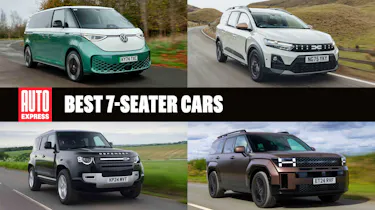
Seven-seater cars are as popular as ever with large families, and there’s a wide variety of both van-like MPVs and sleek SUVs with space for seven passengers up for grabs. With so many seven-seater cars vying for your attention, choosing the right one can feel daunting, but our expert road testers have driven and selected the very best on the market to make the task a little easier.
The kind of seven-seater car you choose will depend to an extent on how regularly you plan on using the third row of seating and who those seats will be for. If you regularly carry six or seven passengers who aren't small kids, you really will need a seven-seater with a good amount of space in those back seats - something few models can genuinely offer.
If, however, you only occasionally carry more than five people or some of your passengers are small children, this outright capacity may be less of an issue and one of the more compact seven-seat models may work.
Boot space is also a key consideration as the amount of room for luggage in some three-row cars is severely restricted when a full complement of passengers is on board. All family car buyers looking for good safety provision, low running costs and those extra practical design features that make life with an army of children that little bit easier.
We've considered all of the above in assembling our list of the top 10 seven-seaters on sale today. So, if you’re in the market for a car that can carry a couple of extra passengers, look no further.
Compare the best 7-seater cars to buy
Below you can see our top 10 7-seater cars drawn from across the car market…
| Rank | Name | Prices from |
| 1 | Dacia Jogger | £18,995 |
| 2 | Skoda Kodiaq | £39,925 |
| 3 | Hyundai Santa Fe | £49,090 |
| 4 | Kia Sorento | £43,725 |
| 5 | Citroen Berlingo | £24,205 |
| 6 | Kia EV9 | £66,645 |
| 7 | Volkswagen ID.Buzz | £60,005 |
| 8 | Nissan X-Trail | £38,245 |
| 9 | Land Rover Defender | £62,915 |
| 10 | BMW X7 | £93,280 |
Now scroll on to read the detailed assessments of each seven-seat car in the top 10 from our expert road testers, or click the link in the table above to go directly to a make and model..
1. Dacia Jogger
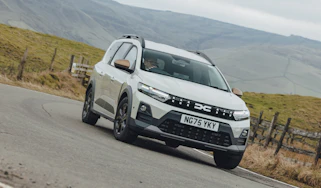
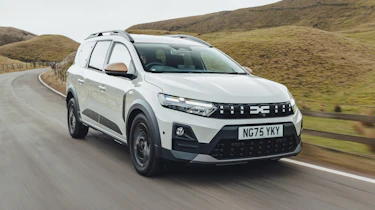
If a low purchase price and running costs are your priority, the Dacia Jogger won’t disappoint.
- Price from £18,995
- Best 7-seat car overall
| Pros | Cons |
|
|
The Dacia Jogger is nothing less than the most affordable seven-seater car on the market, and by a country mile too.
At its lowest price point, you need to spend considerably more to get the next cheapest model on this list and it clearly stands out against its rivals, winning numerous of our in-depth twin tests. Including against the C3 Aircross, Ford Tourneo Connect and Toyota Proace City Verso.
The interior feels suitably sturdy and up to anything you or your family can throw at it. It’s well equipped with an eight-inch infotainment touchscreen that’s easy to use, a rear-view camera and a leather steering wheel on some versions.
Even with all seven seats in place, you’ll still have 220 litres of cargo space at your disposal, while the rearmost row’s spacious enough even for shorter adults, so it’s not a kids-only zone.
A pair of sensible engines, a 1.0-litre turbocharged triple and a 1.8-litre hybrid, mean running costs are low. Economy of nearly 50mpg in the turbo model and over 61mpg from the hybrid, plus relatively low car insurance rating from group 13 all help the bottom line.
The performance won’t wow you, especially when the Jogger is fully loaded, but 0-62mph times in the 10-11 second range are far from insufficient. You’ll notice a tad more road, tyre and wind noise than in more expensive and sophisticated machines on this list, but the Jogger rides quite well (a long-ish wheelbase helps) and it handles much like the Sandero supermini with which it shares a platform - so no major problems there.
“We particularly like the neoprene-style fabric inserts on the seats in the Extreme model that are more interesting to the touch than regular fabric. The surface is wipe-clean which should be useful for family life.” – Dean Gibson, senior road test editor
2. Skoda Kodiaq
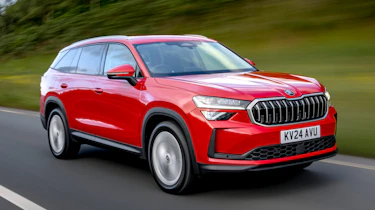
The Skoda Kodiaq is a great all-round family car which majors in practicality and versatility.
- Price from £39,925
- Best 7-seat plug-in hybrid
| Pros | Cons |
|
|
With solid build quality, a comfortable ride and excellent practicality, the Skoda Kodiaq is among the very best SUVs money can buy, available in both five and seven-seat configuration.
The Kodiaq makes full use of its size for maximum versatility inside. That all-important third row isn’t quite adult-friendly as the Hyundai Santa Fe below, but kids will be happy enough and there’s outer armrests and some storage cubbies which boost practicality. The rest of the interior is logically-arranged, is of high quality and easy to live with.
If you flip the rearmost row into the floor, they not only fold flat but also leave an enormous 845-litre boot. Even with all seven seats in position, there’s still 340-litres of space on offer, or similar to that found in the Vauxhall Astra, meaning there’s plenty of room for a large weekly shop.
A 1.5-litre mild hybrid engine kicks off the range, and offers a great blend of economy and performance. Where the Skoda stands out against its rivals is through its pair of diesel TDI engines. Available in 150 and 193 horsepower forms (the latter with four wheel drive) they return around 50mpg combined, and are both great options for those who cover long distances, or tow caravans.
The Kodiaq iV plug-in hybrid is even more frugal and with a 7 per cent BiK rate, is the obvious choice for company car users.
All Kodiaqs are an absolute doddle to drive. Not exciting, and the ride isn’t perfectly smooth, but few cars of this type are so easy to get on with, with predictable responses to every control.
“Skoda’s ‘Simply Clever’ philosophy is perfectly suited to a car such as the Kodiaq – family-friendly features make it a useful accessory to family life.” – Dean Gibson, senior road test editor
3. Hyundai Santa Fe
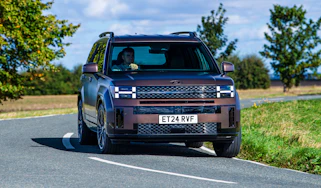
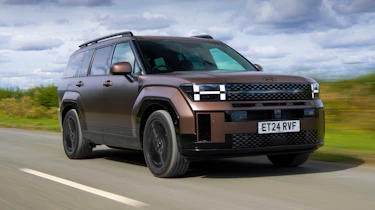
If you want your seven-seater car to stand out on the school run, the new Hyundai Santa Fe has both substance and style.
- Price from £49,090
- Best car for boot space
| Pros | Cons |
|
|
Much like the mid-sized Tucson, the latest Hyundai Santa Fe has taken a huge leap in terms of design, from generic to distinctive. It may have narrowly lost out to the Skoda Kodiaq above in our head-to-head twin test, but it shouldn’t be discounted.
Like the Kodiaq, the Santa Fe is fairly substantial, and the key upside of such a large car is the huge amount of cabin space on offer for both passengers and their luggage, enough to have the edge over the Skoda Kodiaq. If you don’t need to use all of the seats, the Santa Fe offers up to 1,949 litres of cargo capacity, but space is decent even for those in the third row, and access is easy, too.
There are hybrid and plug-in hybrid powertrains available. The plug-in hybrid Santa Fe isn’t quite as competitive as rivals when it comes to its all-electric range of up to 33.6 miles, but it will definitely help slash running costs if you keep the battery topped up and drive mostly around town.
The regular hybrid Santa Fe versions are relatively parsimonious, with just over 41mpg for the two-wheel drive car, and a little under 39mpg with AWD. During our time with a plug-in hybrid Santa Fe, we saw efficiency figures of around the mid-40s once the battery had been depleted.
Hyundai has prioritised ease of use and comfort in how the Santa Fe drives, though it’d be even easier without quite so many warning beeps and bongs. Thankfully, they’re pretty simple to turn off. Engines can get a little vocal under hard acceleration, but things calm down if you do.
“The Santa Fe’s boxy shape is very on trend right now, but more importantly, it provides a huge amount of cabin space for both passengers and luggage.” – Dean Gibson, senior road test editor
4. Kia Sorento
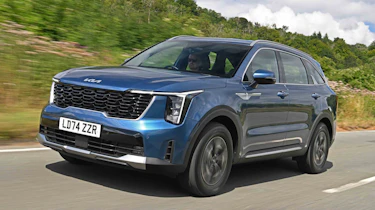
If you like the sound of the Hyundai Santa Fe, but aren’t quite sold on its retro looks or high asking price, the Kia Sorento is a great alternative.
- Price from £43,725
| Pros | Cons |
|
|
The Kia Sorento might be closely related to the Hyundai Santa Fe above, but with a more understated design, lower starting price and vast amounts of space, it’s equally as capable.
Available with the same choice of self-charging or plug-in hybrid powertrains as the Hyundai, what sets the Kia apart is the option of a punchy 2.2-litre diesel engine which is great if you plan on towing caravans or trailers. Officially, Kia states the diesel Sorento can return up to 43.5mpg and we were able to replicate and even exceed this figure during our testing.
On the road, the Kia feels comfortable, grown-up and easy to drive, although the car's size does take some getting used to in towns and cities.
Whichever version of the Sorento you choose, you’ll benefit from a spacious cabin with a flat floor. According to our measurements, the Sorento has a little more kneeroom than the Santa Fe at 607mm compared to 564mm, although the Kia’s body isn’t as boxy so headroom isn’t quite as generous. The boot space is 179-litres with seven-seats in place, or 628-litres with five. This is on par with the Santa Fe.
Inside, the Kia Sorento won’t rewrite the rulebook on style, but it is very functional and we like the dual-function physical switches for audio and heating controls. LED headlights, Apple CarPlay, Android Auto, adaptive cruise control and heated front seats and a heated steering wheel all come as standard, making the entry-level car our trim level of choice.
“Space is a little tight when getting in and out of the third row, but the second row handily drops and slides forward at the touch of a button.” - Alastair Crooks, senior news reporter
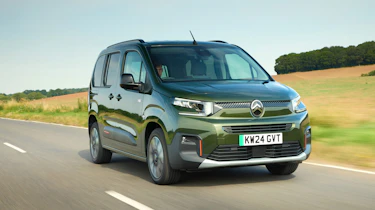
5. Citroen Berlingo
The Citroen Berlingo MPV might have humble van underpinnings, but it’s perfectly suited for family duties.
- Price from £24,205
- Best utility
| Pros | Cons |
|
|
The Citroen Berlingo might, in effect, be a van converted into an MPV, but the brand has been performing this trick for a while, and this seven-seater really appeals as a result.
The big advantage of being based on an actual van is that vans tend to be fairly pragmatic and practical, and most of this carries across to the passenger variant. Big windows mean visibility is tremendous, the middle row is wide enough for three separate seats (and is accessed through sliding doors), boot space is enormous as a five-seater (1,050 litres) and the third-row seats are a decent size too (and fully removable).
Diesel and petrol power is still on the cards and great for those who want quick refuelling and a long range for commutes and family holidays.
If long-distance driving isn’t on your radar and you only drive to work, the shops or to complete the school run, then there’s the fully-electric e-Berlingo and there’s really no better option that can offer pure-electric motoring and seven seats at the same price point. A recent update means the e-Berlingo can travel up to 213 miles, which should be plenty for most.
Despite its boxy van roots, it’s not even that van-like to drive, mainly because it’s based on a similar platform to some of Citroen’s regular passenger cars. Ride and handling are good, and grip and brakes are both reassuring. Opt for the e-Berlingo, and the silence and smoothness add to the appeal.
“The Berlingo doesn’t have the kerb appeal of a typical family SUV, but those with more sense than money should have it on their next family car shortlist.” – Ellis Hyde, news reporter
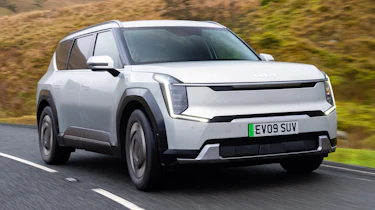
6. Kia EV9
While the EV9 is the most expensive car Kia has ever sold in the UK, it’s hugely practical.
- Price from £66,645
- Best car for in-car tech
| Pros | Cons |
|
|
The Kia EV9 heralds a new styling direction for the brand, one that has been followed up with the smaller EV3 and EV4, but the big news about this big car is that it’s a proper seven-seater electric vehicle. It even beat the Volvo XC90 in our head-to-head twin test.
Whichever way you look at the Kia EV9, it’s a very well-equipped and technologically advanced car. Even the basic EV9 Air gets Kia’s Level 2 driving assistance, heated and ventilated front and second-row seats, an electric boot lid, a triple-screen layout including a pair of 12.3-inch screens, plus a wireless smartphone charger and 19-inch alloys.
Front and middle rows are spacious but as is often the case, we think the third row is best left for smaller passengers. There’s also a spacious amount of boot space at 333 litres.
The car’s enormous size may benefit interior room, but it does hamper manoeuvrability. We found that parking can be a bit of a chore despite all the tech to help you. You’ll be forever sticking out of tight supermarket spaces, and the turning circle is quite large, too. The EV9 is happier at higher speeds, being smooth, stable and refined.
Kia claims up to 349 miles of range from the EV9 on a single charge, courtesy of a rather substantial 99.8kWh battery. During our time with the EV9 in Air trim, we saw efficiency figures of around 3.2 miles per kWh during colder conditions, translating to 270-320 miles of real-world range. When it comes to topping up the battery, a 10-80 per cent ‘refill’ will take just 24 minutes.
You can get the EV9 with either a single motor with rear-wheel drive, or twin motors and all-wheel drive. The latter is pretty brisk, with 378bhp and 0-62mph in 5.3 seconds… but do you really need that in a seven-seater?
“The Kia EV9 is supremely practical for families, providing space inside for seven plus a useful amount of luggage capacity” - Dean Gibson, senior test editor
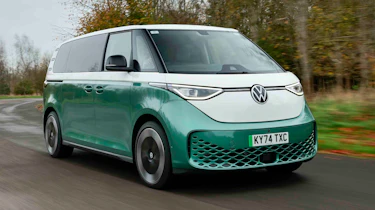
7. Volkswagen ID. Buzz
If you thought seven seater cars had to be boring, the Volkswagen ID.Buzz wants you to think again.
- Price from £60,005
- Best car for style
| Pros | Cons |
|
|
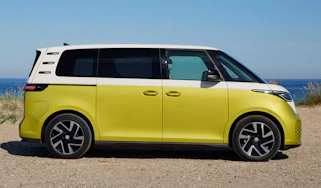
It took Volkswagen a very, very long time, but in 2022 the brand finally launched its spiritual successor to the classic microbus, the ID. Buzz.
Then, in 2024, it got the seven-seat variant the Buzz had surely been crying out for since the start, making this a proper bells ‘n’ whistles electric multi-purpose vehicle, and easily the most stylish one on the market – arguably one of the most stylish (or at least most fashionable) modern cars full stop. It gets seven proper seats, with room for all, and they slide and fold for extra utility.
Seven-seat ‘LWB’ models aren’t quite as efficient as their shorter counterparts, and the Buzz was already borderline for true road-tripping since all models fall short of 300 miles on a charge – you’ll go a lot further for longer in a less stylish Volkswagen Multivan. Officially, 293 miles is the maximum range, although we found the indicated range to be very reliable on the whole during the six months we lived with a LWB ID.Buzz on our long-term test fleet.
All get a decent whack of power so straight-line performance isn’t an issue; 0-62mph takes a snip under eight seconds, plenty for a big brick like this. And it’s fun too, if not for sports car handling more the joy of staring out of its glassy, colourfully-trimmed cabin. The high price hampers its appeal though, at over £60,000 for the seven-seat ID. Buzz Life.
“If you can stomach the high asking price, then the ID.Buzz is a characterful family car that will have buyers thinking twice about choosing an SUV to fit the same brief.” – Dean Gibson, senior road test editor
Latest Volkswagen ID.Buzz deals
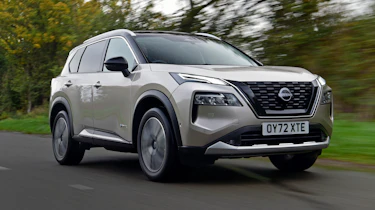
8. Nissan X-Trail
The Nissan X-Trail is easy to live with, practical and refined. It should feature somewhere on your seven-seat family car shortlist.
- Price from £38,245
- Best car for logical controls
| Pros | Cons |
|
|
The latest Nissan X-Trail is the best yet, delivering more passenger space and better cabin quality than its predecessor.
The entry-level mild-hybrid and range-topping all-wheel-drive e-4ORCE versions of the X-Trail come with five seats as standard, but are available with seven seats at an extra cost.
Even so, only kids will really feel comfortable in the back row, because of the limited knee and headroom. The 585-litre boot is pretty decent however, and the X-Trail’s dashboard layout feels blissfully simple compared to some rivals.
Nissan’s e-Power hybrid setup brings EV-like smoothness and performance without the range anxiety, although at just shy of 50mpg, it’s not as efficient as some of the other hybrids on this list. The 1.5-litre arrangement provides 201bhp, so 0-62mph takes a brisk eight seconds in front-drive form; an ‘e-4ORCE’ all-wheel drive is also available.
It’s comfortable out on the road, with the suspension only really troubled by the worst of the UK’s pockmarked routes. It doesn’t protest on B-roads either, leaning a little in corners but otherwise feeling composed, and on the motorway it does a good job of keeping out engine, road and wind noise, making it an accomplished cruiser.
“Family car buyers will be pleased to know there have been some big improvements to the Nissan X-Trail SUV, delivering more passenger space, better cabin quality and a more extensive list of standard safety features.” - Ellis Hyde, news reporter
9. Land Rover Defender
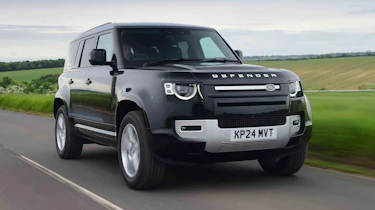
If you want a seven-seater car with some real off-road credentials, look no further than the Land Rover Defender.
- Price from £62,915
- Best car for all-terrain use
| Pros | Cons |
|
|
In the blink of an eye, the Land Rover Defender has gone from a utilitarian workhorse to one of the best luxury SUVs on the market.
The Defender is available in three forms: the three-door 90, the 110 model that offers seating for up to seven people, and the even larger 130 which offers space for up to eight occupants.
In Defender 110s fitted with seven seats, the middle row provides ample space and can slide forward to make the third row passable for taller passengers, although adults will feel squeezed on longer journeys. There are cup-holders, power outlets and air vents for all, while the 231-litre boot with three rows in place expands to a van-rivalling 2,233 litres if you fold down the rear seats.
Its charming boxy style will win over many buyers’ hearts, but so will the way it drives. Four- and six-cylinder diesels offer passable economy in the low to mid 30mpg range, while the plug-in hybrid P300e gets you 31 miles of EV range.
It’s pretty imperious on the road. Big, too. Really big in fact, enough that you’ll struggle with some width restrictors, and may have to rule out car parks with height restrictions. If you have to venture off the beaten track, the Defender is one of the most capable off-roaders money can buy with great ground clearance, a fantastic four-wheel drive system and locking differentials. Wherever you drive, it’s supremely comfortable.
“Behind the wheel, the Defenders steering wheel is lovely to hold, and we found the seats comfortable yet supportive, even after a long day of driving.” - Richard Ingram, deputy editor
Latest Land Rover Defender deals
10. BMW X7
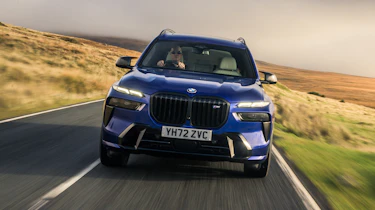
Want your seven-seat SUV to come with some great driving dynamics? That’ll be the BMW X7.
- Price from £93,280
- Best driving experience
| Pros | Cons |
|
|
There’s a common belief that family cars are pretty boring to drive, but the BMW X7 smashes this theory to pieces and still ticks the practicality box, too.
At more than 5.1 metres long, space isn’t really an issue, and while the rearmost seats aren’t going to trouble proper MPVs for room, they’re perfectly adequate for children. The cabin, aided by plenty of glass, feels airy so those in the middle and rear rows won’t feel hemmed in as they do in some seven-seaters. BMW’s current interiors are beautifully built, too.
With no EV model or the option of a plug-in hybrid powertrain, the X7 immediately rules itself out as a company car through huge tax bills (you’ll want the smaller, five-seat BMW iX for that) but private buyers will appreciate 36.2mpg economy from the xDrive40d with its silky six-cylinder diesel.
Four-wheel steering helps offset the car’s size so it’s not as intimidating as you might expect, even in town – at least for the driver. Air suspension helps the ride quality but it won’t challenge a Range Rover for plushness, as BMW hasn’t quite managed to hide the thumping effect of its enormous alloy wheels.
As two-tonne SUVs go, it handles decently, and even the ‘entry level’ 40i petrol launches you to 62mph in under six seconds. The 523bhp M60i is overkill, as is its £118k price.
“The BMW X7’s blend of quality, luxury, high-tech equipment and superb refinement make it a compelling option – if you can get your head around its looks.” – Jordan Katsianis, news editor.
How we choose the best seven-seat cars
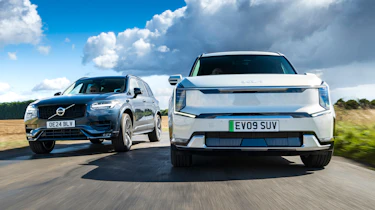
Our evaluation of the seven-seat car market is built on our in-depth single car testing and our head-to-head group tests, where our expert test team examines the strengths and weaknesses of two or more cars head-to-head. The twin-test format is particularly useful for seven-seat family vehicles where the rear of the passenger compartment is just as important as the front and how the car drives.
Space
We pay particular attention to interior space, looking at leg and headroom in all three rows. Access is also crucial, whether for loading cargo into the rear or climbing through into the third row chairs.
Family-friendly features
Then come the other features that make family life less of a chore. How robust and easy to clean are the fixtures and fittings? Is there enough storage space and device charging capacity? How easily can you fit kids’ car seats? Does the seating fold, slide and recline in a way that helps owners make the most of the space available?
There’s a lot to think about but our testers leave no cup holder unfilled or seat back unfolded in their quest to determine which seven-seater really is the best for families to live with.
How you can choose the best seven-seater car
There’s a lot to think about when buying a seven-seater and these are some of the key things you should have in mind when making your shortlist and taking some test drives.
What do you need to fit in it?
If you’re looking for a seven-seat car, it’s likely that a conventional five seat vehicle isn’t enough for your family’s needs, either some or all of the time.
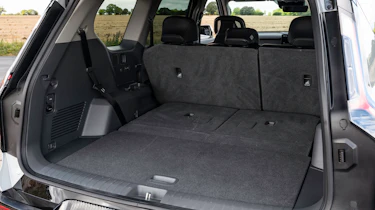
It could be that you rarely need to carry more than five passengers but want a very large boot area. It could be that the occupants of the third row seats will be mainly small children or maybe you need to fit adults back there. You may even need to carry six or seven passengers while retaining enough space for luggage.
The answers to these questions will determine which seven-seat cars could work for you and which simply will not. Many cars in this class are left with very small boot areas when all seven seats are being used. Sometimes the space is quite large in terms of litres but is actually very tall and shallow without much floor area - forcing you to stack your cargo.
If you want to seat adults in the rear, don’t just check the legroom and headroom, think about access as some cars make it more difficult than others to clamber back there. You want a nice easy mechanism for sliding or folding the seats into their different positions but they also should feel sturdy and built to last.
How easy is it to drive and park?
Seven-seat cars by nature are big vehicles and they can be a challenge to drive. If you’re less than confident, look for models that have good visibility with clear reference points at the front to help you judge distances, plenty of glass area to see out of and good mirrors. Parking cameras and sensors also inspire confidence, while driver aids like self-parking and rear cross traffic alerts will also be very useful for manoeuvring.
On your test drive, make a point of doing a reverse park or a three-point turn to get a feel for the manoeuvrability and turning circle of the car.
Will it be cheap to run?
Big, heavy seven-seat vehicles can be expensive to run so have an eye on the potential fuel costs. EVs are a great option for cutting running costs generally but if you plan on doing a lot of long journeys with a full load, you may find yourself having to stop and charge more regularly than you’d like.
Hybrids can be a good compromise but just as with electric cars, be aware that carrying lots of extra weight will make the official fuel economy figures difficult to replicate in the real world. This is especially true of plug-in hybrids, which can become quite inefficient when you’ve used all the charge in the battery. A lot will depend on the kind of driving you do.
Will the kids like it?
The most important people in all of this are the kids. If you’re buying a seven seater as a family car, keeping the youngsters content is the car’s primary mission. Features like tray tables in the seat backs, rear cup holders and charging sockets will be appreciated and many cars now have specially designed holders for phones and tablets in the rear.
Also consider what the view out is like. Kids want to see out of the windows so those with smaller children may not want cars with high window lines and narrow glass areas that produce a gloomy environment in the back. Panoramic sunroofs are good options for giving the cabin a lighter feel but can be expensive and limit headroom.
From a parent’s point of view, think about how easy the materials will be to clean and if they are likely to show marks and damage.
Frequently Asked Questions
The Dacia Jogger is the best 7-seater car on sale, as well as being the most affordable.
Other excellent 7-seaters currently on sale include the Skoda Kodiaq and Hyundai Santa Fe, each with a more SUV-like body style than the Dacia, but neither comes close to the Dacia’s sub-£20,000 price tag.
Buy a car with Auto Express. Our nationwide dealer network has some fantastic cars on offer right now with new, used and leasing deals to choose from...