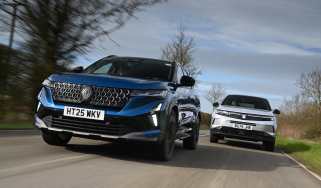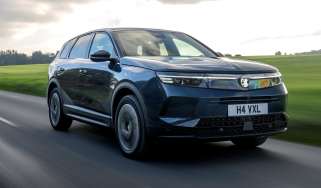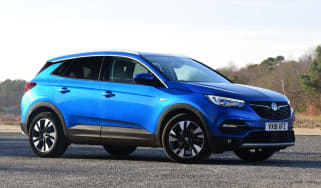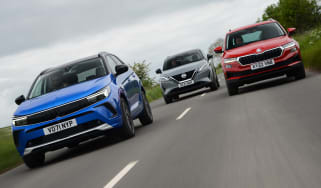
Vauxhall Grandland review
Hybrid and all-electric powertrain options boost the versatility of the Vauxhall Grandland family SUV
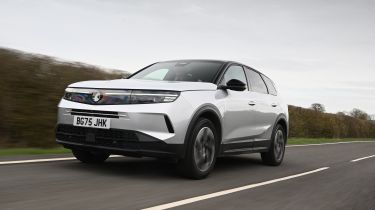

Our opinion on the Vauxhall Grandland
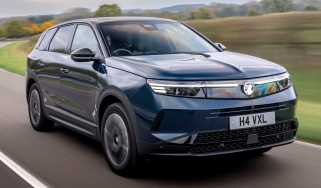
The second-generation Vauxhall Grandland is a vast improvement over the original. There are some impressive family-friendly touches to accompany class-leading practicality, although we’ve seen better-quality interiors. Standard equipment is generous, especially on our preferred mid-spec GS trim, while a distinctive front end and smart LED lighting help the car to stand out.
It’s not the best car to drive in this segment, especially in hybrid form, with an unsettled ride and vague steering holding it back. The Grandland Electric is our preferred choice from behind the wheel because it’s more comfortable and is better value for money than the hybrid or plug-in hybrid.
About the Vauxhall Grandland
The Grandland uses the same Stellantis STLA Medium platform that you’ll also find under the Citroen C5 Aircross and Peugeot’s 3008 and 5008 duo, although there are plenty of differences to help them stand apart.
The Grandland range comprises Design, Griffin, GS and Ultimate trims, and you have a choice of hybrid, electric, or PHEV power across most trims except for Griffin, which misses out on a PHEV option. Most Grandlands come with front-wheel drive, but four-wheel drive is available with the electric version.
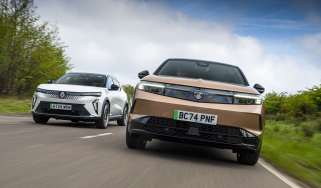
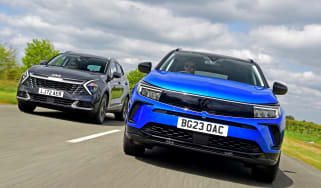
We’ve tested the Hybrid and Electric Grandlands extensively on UK roads, and have even run a 73kWh Vauxhall Grandland Electric in GS guise on a long-term basis. We've also subjected the Grandland Electric to a group test with the Renault Scenic E-Tech, and put a hybrid Grandland against a Renault Austral hybrid.
Vauxhall Grandland prices and latest deals
Pricing for the Grandland has been adjusted, so the least expensive Griffin trim starts at round £31,500. The PHEV model costs just over £36,500 in Design trim, and in between the two is the Grandland Electric, which starts at £34,500 in Griffin form. Those going for the Grandland Electric will be pleased to know that it's eligible for the £1,500 Electric Car Grant (ECG), and this is applied automatically when you buy.
We can help you get behind the wheel of the Grandland via the Auto Express Sell My Car service. You can configure your ideal model, get top offers from local dealers, check out the latest leasing deals, or search for used models with our Buy A Car service, saving thousands on list prices in the process.
Performance & driving experience
Pros |
|
Cons |
|
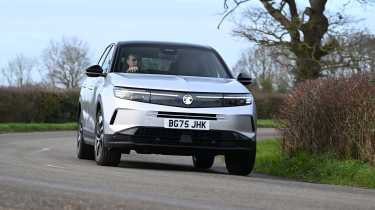
The Grandland line-up comprises three powertrain options: one hybrid, one electric and (new for 2026) a plug-in hybrid, all of which are front-wheel drive, although the EV with the smaller battery can be had with four-wheel drive, too.
Used - available now

2024 Vauxhall
Grandland
26,845 milesManualPetrol1.2L
Cash £13,900
2024 Vauxhall
Grandland
45,369 milesManualPetrol1.2L
Cash £13,992
2024 Vauxhall
Grandland
11,885 milesAutomaticPetrol1.2L
Cash £16,510
2024 Vauxhall
Grandland
40,904 milesManualPetrol1.2L
Cash £14,099As with many compact SUVs, the Grandland isn’t a car that’s designed to offer driving fun. The Hybrid is pegged back even more by a less-sophisticated suspension set-up than the one found under the electric version.
Performance, 0-60mph acceleration and top speed
The Grandland Hybrid comes with a 1.2-litre, three-cylinder turbo petrol engine that adds a 48-volt electrical system and 28bhp electric motor for a total output of 143bhp. It comes with a six-speed dual-clutch transmission as standard, while all versions are front-wheel drive.
The electric motor is pretty flexible, and is able to operate at speeds of up to 84mph, while Vauxhall claims that around 50 per cent of urban driving can be achieved on electric power alone. An overall output of 143bhp is enough for a car the size of the Grandland, and the electrical assistance from the hybrid system is fairly smooth. This engine isn’t the most cultured unit, although the sluggish yet smooth-shifting automatic gearbox somewhat dials down the lack of refinement.
The Grandland Electric has a healthier 206bhp, so it manages the 0-62mph sprint in nine seconds flat. It has a lower top speed than the mild-hybrid version, at 106mph, but even if you could do that speed legally, you wouldn’t want to for very long because that will use lots of energy and compromise how far you can travel on a charge.
Elsewhere in the line-up, the more powerful 227bhp 98kWh EV has more weight courtesy of its bigger battery, so it’s no quicker than the 73kWh version from 0-62mph. The Grandland AWD uses its four-wheel-drive traction and 321bhp output to get from 0-62mph in a rapid 6.1 seconds.
The second-fastest model in the line-up is the Grandland PHEV, with an official 0-62mph time of 7.8 seconds for its 222bhp powertrain.
| Model | Power | 0-62mph | Top speed |
| Grandland 1.2 Hybrid | 143bhp | 10.2 seconds | 126mph |
| Grandland 73kWh Electric | 210bhp | 9.0 seconds | 106mph |
| Grandland 1.6 PHEV | 222bhp | 7.8 seconds | 137mph |
Town driving, visibility and parking
In town, the Grandland is a breeze to drive thanks to great visibility. An elevated seating position and proper rear three-quarter windows help here, as do the various safety systems, which work effectively. It’s a shame that the hybrid model doesn’t have the same low-speed ride quality as the EV, with a constant fidget to the suspension that never really settles.
While front and rear parking sensors are fitted to all models, the mid-range GS version adds a reversing camera, while top-spec Ultimate trim includes a 360-degree camera system.
The Grandland’s steering has a good weight to it, although it’s not overly keen to self-centre, so you’ll be turning the wheel a little more often than expected around town.
Country road driving and handling
Increase your pace, and it soon becomes apparent that the Grandland isn’t the kind of car you’d take on a spirited drive. The hybrid powertrain doesn’t feel especially punchy, and a slow gearbox dulls the experience. The steering, while nicely weighted, doesn’t give you much feedback. Overall grip is pretty decent, and the Grandland corners in a safe, stable manner, but the constant fidget from the dampers takes the edge off the car’s overall comfort.
Compared with the MHEV, the Grandland Electric is much more compliant over bumps and ruts in the road. We put this down to the extra weight (it’s 532kg heavier than the hybrid), a more sophisticated multi-link rear suspension set-up, plus Vauxhall’s frequency-selective damping technology, which adds another valve in the damper to provide different characteristics depending on road conditions and driving style. The latter two features aren’t included on the hybrid because of cost.
Motorway driving and long-distance comfort
The Grandland is pretty refined on the motorway in terms of wind and road noise, but again, the extra weight that the EV carries means it’s more comfortable on long trips, and the mild-hybrid feels unsettled in comparison.
All Grandland models come with adaptive cruise control to keep you a safe, preset distance from the car in front, and it features intelligent adaptation to adjust your speed if it recognises that the limit has changed.
"The speed readout in the Grandland hybrid turns blue when the car is running on electricity, but most of the time it’s the noise of the combustion engine under the bonnet that gives the game away. The 1.2-litre three-cylinder isn’t particularly harsh, but it does make its presence known." - Dean Gibson, senior test editor
MPG & running costs
Pros |
|
Cons |
|
The Vauxhall Grandland comes with a relatively low drag coefficient of 0.28Cd, which helps overall efficiency. Some of the Grandland Hybrid’s rivals fail to crack 50mpg on a combined cycle, so a claimed 51.4mpg combined efficiency is impressive.
Vauxhall says that around 50 per cent of urban driving can be done on electricity alone, and we found that the electric motor is happy to provide a surprising amount of the Grandland’s power at low speeds, despite having only 28bhp.
We saw a return of 49.5mpg on our test, which was better than the figure achieved by the full-hybrid Renault Austral in similar conditions and with a significant amount of motorway miles included. Match our economy figure and there’s a potential 600-miles of range on offer.
| Model | MPG | CO2 | Insurance group |
| Grandland Hybrid | 51.4mpg | 125g/km | 24 |
| Grandland Plug-in Hybrid | 117.7mpg | 55g/km | 33 |
Electric range, battery life and charge time
The Grandland Electric is offered with a 73kWh battery with a maximum range of 323 miles in Design trim. There's also a high-performance four-wheel-drive version with the same capacity battery and 306 miles of range. For comparison, the Peugeot E-3008 is available with similar battery and electric motor configurations, and has a range of between 303 miles and 435 miles, depending upon the configuration.
Our long-term test of a Grandland Electric yielded an average efficiency of 3.6 miles/kWh, or 263 miles of range based on its 73kWh battery capacity.
Charging speeds are reasonable, if not outstanding, for the large EV segment. The 73kWh battery model provides 160kW charging, taking around 30 minutes to charge from 20 to 80 per cent. Strangely, Vauxhall quotes a maximum charging rate of 150kW for the bigger battery, but it still takes half an hour for the 20-80 per cent charge.
While the Grandland Electric is capable of accepting up to 11kW charging from an AC power source, many will have a slower 7.4kWh wallbox charger at home, and that’ll take around 12 hours to fully recharge the 73kWh version. The 98kWh battery is quoted to go from 20-80 per cent capacity in four-and-a-half hours from an 11kW source.
Brake regeneration comes as standard and features three levels of recuperation. We found each level to provide a distinct difference in terms of strength, although one-pedal driving isn’t quite possible. An energy-efficient heat pump is provided as standard, and helps to preserve the driving range by consuming less electricity to warm the interior in colder weather.
As part of the warranty, the battery is protected for up to eight years and 100,000 miles. Vauxhall will also guarantee the battery will hold up to 70 per cent of its charge during this period.
| Model | Battery size | Range | Insurance group |
| Grandland GS Plug-in Hybrid | 21kWh | 51 miles | 33 |
| Grandland Electric GS 73kWh | 73kWh | 323 miles | 36 |
| Grandland Electric GS 73kWh AWD | 73kWh | 306 miles | 41 |
Insurance groups
The Grandland starts in insurance group 23 for the 1.2 Hybrid Design, which is similar to other hybrid family SUVs, although non-hybrid models tend to have lower insurance ratings. For comparison, the Grandland Plug-in starts at group 33 and the Electric is in group 36.
Tax
Emissions of 125g/km mean the Grandland Hybrid beats rivals such as the Ford Kuga Hybrid (132g/km), Toyota RAV4 (130g/km) and the mild-hybrid Hyundai Tucson (142g/km).
Company car drivers can lower their costs by choosing the full EV, and if they can’t quite make that work, then the Plug-in Hybrid has costs that are about a third of those for the Hybrid.
All versions of the Grandland hybrid and PHEV cost less than £40,000, so they avoid the luxury car road tax surcharge, although adding a few options to the top-spec PHEV version will tip it over the threshold. Electric cars like the Grandland Electric have a more generous threshold of £50,000, which this Vauxhall comfortably undercuts.
Depreciation
Residuals for the Grandland Hybrid after three years and 36,000 miles aren’t stellar, hovering between the 40 and 47 per cent mark. The Hyundai Tucson does better, maintaining between 48 and 53 per cent.
In contrast, the Grandland Electric is expected to maintain between 43 and 47 per cent, which is a lot better than its sibling, the Peugeot E-3008, which is predicted to retain around only 38 per cent per cent of its value. However, the Renault Scenic is expected to still be worth 54 per cent of its original value over the same period.
To get an accurate valuation on a specific model check out our free car valuation tool...
Interior, design & technology
Pros |
|
Cons |
|
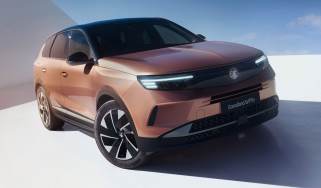
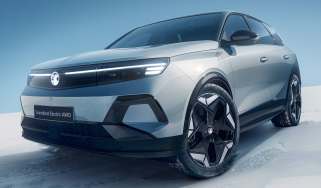
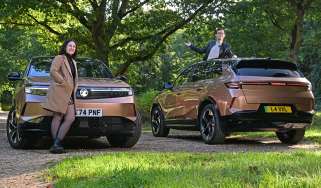
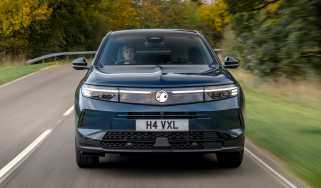
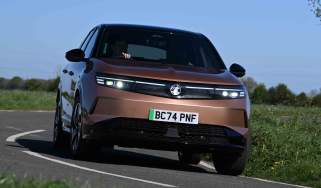
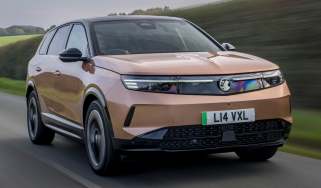
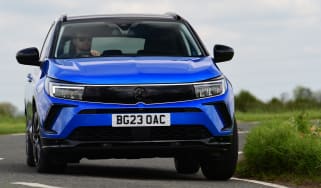
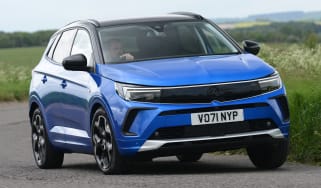
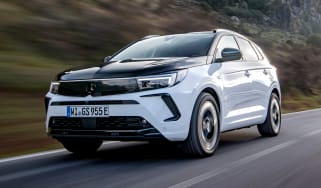
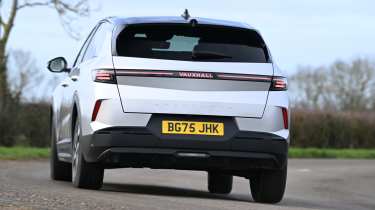
The second-generation Grandland features Vauxhall’s Visor front end, which incorporates LED headlights plus an illuminated grille and badge, while at the rear there’s illuminated lettering across the bootlid.
Entry-level Design cars feature Vauxhall’s PureSense safety systems, plus twin 10-inch displays, wireless phone compatibility and 19-inch alloy wheels. The slightly cheaper Griffin trim comes with everything Design has, but adds rear privacy glass, heated front seats and steering wheel, and some more comfortable front seats with additional adjustments.
Our preferred GS trim gains:
- A larger 16-inch infotainment screen with sat-nav
- A wireless phone charger
- Ambient interior lighting
- Illuminated badges front and rear
The range-topping Ultimate trim adds Vauxhall’s Intelli-drive 2.0 safety kit, an uprated sound system, a head-up display and a powered bootlid.
Interior and dashboard design
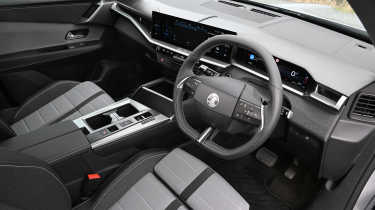
Jump inside the Grandland, and you’re met with a two-screen dashboard layout. The 10-inch driver’s display butts up to the central touchscreen, which measures 10 inches in Design trim and 16 inches in mid-range GS cars and above. They don’t take up a lot of the dash and don’t feel too distracting, while the driver’s display has all the necessary information you’d expect. Its position behind the steering wheel means it’s easier to read than the high-set display found in the Peugeot 3008.
While Vauxhall says the latest Grandland goes “upwards in quality and positioning”, and it’s certainly an improvement on the previous car, there are some noticeable scratchy black plastics in places such as the doors and centre console.
Materials and build quality
There are a lot of different materials on show in the Grandland’s cabin, although some people might find it a little fussy. The good news, though, is that Vauxhall says 85 per cent of them are recyclable. However, even with the ambient lighting function offered on GS trim and above, it’s a little dreary and certainly lacks the flair of the Peugeot 3008’s cabin.
Common touchpoints, such as the doors, steering wheel rim and centre console, generally feel premium enough for the segment, however. We’re just not all that convinced by the touch-sensitive controls on the steering wheel, which lack the tactility of proper buttons while looking and feeling a bit cheap.
Infotainment, sat-nav and stereo
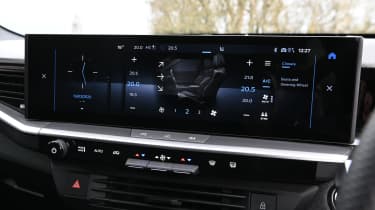
We like the Vauxhall’s central infotainment screen, which is angled towards the driver for easier access. It’s 10 inches on Design and Griffin trims, while the GS and Ultimate versions feature a 16-inch unit with sat-nav.
We found smartphone pairing to be pretty seamless, and the screen sufficiently responsive. The climate controls are constantly visible on the sides of the screen, and they are complemented by a row of physical tabs beneath, comprising climate, volume and demisting controls.
Up front, there’s a single USB-C port on entry-level Design models, with GS adding two more for the rear passengers, plus wireless smartphone charging. The top-of-the-range Ultimate trim features an upgraded 10-speaker Focal sound system, similar to the set-up found in its Peugeot 3008 sibling.
"Cabin quality in the Grandland is good, and the mid-range GS model is given a lift with the inclusion of light-coloured inserts for the fabric upholstery, plus additional grey material across the dashboard and centre console." - Dean Gibson, senior test editor
Boot space & practicality
Pros |
|
Cons |
|
The Grandland is one of the most spacious cars in its class. It doesn’t feel like a dauntingly big car on the road, however, thanks to a lofty driving position that provides a decent view of its extremities.
Although it’s Vauxhall’s flagship, there’s no seven-seat option. If you need the extra seats, then ironically you have to opt for the smaller Vauxhall Frontera, or the van-based Vauxhall Combo and Vivaro Life models.
Dimensions and size
The Grandland is at the larger end of the spectrum for the class, which is to the benefit of passenger and luggage space.
Dimensions comparison | |||
| Model | Vauxhall Grandland | Nissan Qashqai | Ford Kuga |
| Length | 4,650mm | 4,425mm | 4,615mm |
| Width | 1,905mm | 1,835mm | 1,882mm |
| Height | 1,657mm | 1,625mm | 1,623mm |
| Wheelbase | 2,784mm | 2,665mm | 2,711mm |
| Boot space | 550-1,645 litres | 504-1,447 litres | 645-1,534 litres |
Seats & passenger space
Vauxhall claims it has improved the Grandland’s comfort on long journeys compared to the old model, and it’s certainly a step in the right direction. We’d recommend that you go for the mid-range GS trim because both front seats come with adjustable lumbar support, which should further improve comfort over long journeys.
Interior space upfront is generally very good, with plenty of headroom and legroom for front occupants, who also get under-thigh support extensions. Despite the wide centre console, it doesn’t feel cramped, thanks in part to a large glasshouse and a windscreen set far back from the dash.
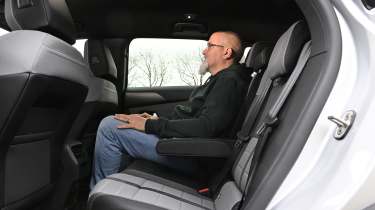
Occupants won’t be complaining about headroom or kneeroom in the back; even our tallest testers still had plenty of room. The Hybrid model has the same high floor as found in the all-electric model, but that means there isn’t a great deal of space for those in the back to slide their feet under the front seats. That’s a surprise given the wheelbase is now 2,784mm – some 109mm more than the old car.
Boot space
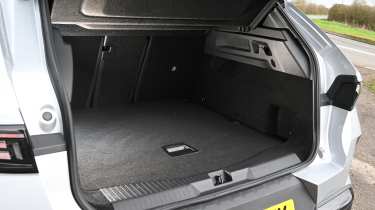
Unlike many of its rivals, the Grandland has the same boot capacity in Hybrid and Electric guises. A total of 550 litres is offered, and there’s a 40:20:40 split rear bench that creates 1,645 litres of space.
The boot sill is a little high, but the floor is level and the opening is impressively wide. A couple of bag hooks and elasticated holders are helpful, too.
"Out of the entire Vauxhall Grandland range, it’s the electric version that has the most towing capacity. However, a 1,350kg capacity for the four-wheel-drive version isn’t a huge amount, especially when the Ford Kuga can pull up to 2,100kg in either plug-in hybrid, or four-wheel-drive hybrid forms, while the all-electric Kia EV6 can handle up to 1,800kg." - Max Adams, online reviews editor
Reliability & safety
Pros |
|
Cons |
|
As standard, the Grandland gets safety features such as adaptive cruise control, lane-keep assist and traffic sign recognition, but if you want Vauxhall’s Drive Assist 2.0 system with rear cross-traffic alert, blind-spot monitoring, lane assist and a 360-degree parking camera, you’ll have to upgrade to the range-topping Ultimate trim.
The Vauxhall brand and its dealers seem to be doing the right thing by their customers, because it finished fourth out of 31 brands in our 2025 Driver Power manufacturer’s survey, ahead of the likes of Renault (6th), Skoda (12th), Kia (18th), Hyundai (20th), and VW (27th).
This is backed up by the latest Grandland finishing in 3rd place out of 50 cars in the best cars to own list of our 2026 Driver Power customer satisfaction survey. Owners appreciated the car's more practical features, such as its interior flexibility, child-friendly features, and boot space. Low running costs – and in particular servicing costs – were a particular point of praise. It wasn't a clean sweep, because owners of the Grandland Electric weren't so pleased with the real-world driving range falling short of official figures.
| Euro NCAP safety ratings | |
| Euro NCAP safety rating | Four stars (2025) |
| Adult occupant protection | 80 per cent |
| Child occupant protection | 85 per cent |
| Vulnerable road user protection | 79 per cent |
| Safety assist | 62 per cent |
Buying and owning
Best buy: Vauxhall Grandland Electric GS
We recommend stepping up to the GS trim above the entry-level Design, because it offers a range of useful equipment without a steep price increase, with niceties such as a larger 16-inch touchscreen display, a wireless phone charger, and sat-nav.
The electric Grandland costs less than the hybrid or the plug-in hybrid, and with the potential to save even more money with home charging on a dedicated electric car charging tariff using cheaper overnight electricity rates, it's a no-brainer to go electric.
Vauxhall Grandland alternatives
The mid-sized family SUV market is heavily congested, so while the Grandland looks like a decent choice in isolation, there are, in fact, plenty of better options on the market. Key rivals for the Hybrid and Plug-in models include the Hyundai Tucson, Renault Austral, Kia Sportage, Ford Kuga, Nissan Qashqai and Volkswagen Tiguan. The Grandland Electric, meanwhile, takes on its Stellantis stablemate, the Peugeot 3008, as well as the Kia EV5, Hyundai Ioniq 5, Nissan Ariya, Ford Explorer and Volkswagen ID.4, among others.
Key updates of the Vauxhall Grandland review
20 April 2026: Updated following our group test with the Renault Austral.
2 February 2026: Updated to reflect the increased expensive car supplement threshold and mention the proposed pay-per-mile tax for EVs from 2028.
Deals on the Vauxhall Grandland and alternatives
Vauxhall Grandland Electric GS long-term test
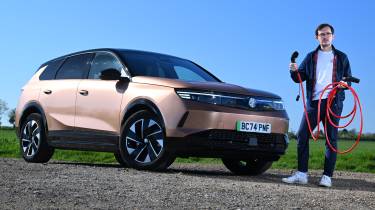
Consumer reporter, Tom Jervis, is currently running a Vauxhall Grandland Electric GS as part of an Auto Express long-term test. So far, it's proven to be a refined motorway companion, while the cooled centre console has kept all manner of things cold on longer trips, from bottles of water to a tub of ice cream.
There have been some niggles, such as the touchscreen getting rather hot, and a chirping noise from the air-conditioning system behind the dashboard. You can read the full long-term test here…
Frequently Asked Questions
Vauxhall still offers an average three-year/60,000-mile warranty as standard, although extended cover is available at extra cost.