Volvo ES90 review
All-electric executive offers something different from the default German options

Our opinion on the Volvo ES90
The arrival of the Volvo ES90 marks the Swedish firm’s entry into the all-electric executive car class, but it uses a lot of familiar technology on board because it’s based on the same platform and running gear as the EX90 SUV. The slipperier shape means it can go further on a charge, while refined comfort is the order of the day, with silent running at all speeds and a focus on cruising comfort above all else. We wish there was a bit more space in the back, because headroom is a little tight, and the high floor affects the seating position, but the fastback body does at least boost the car’s versatility. All models are well equipped for the price, while the top-sec Performance version offers impressive pace.
About the Volvo ES90
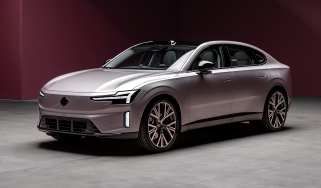
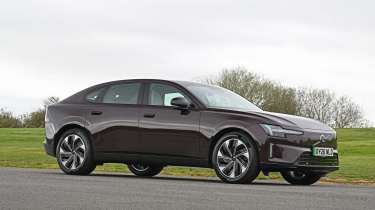
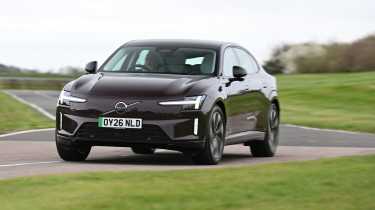
While the Volvo ES90 is a replacement for the S90 saloon, the Swedish manufacturer has taken the opportunity to reimagine its executive model and created a swooping sportback-style body that incorporates a hatchback rear end.
Under the skin, the ES90 shares the same running gear as the EX90 seven-seat SUV and the Polestar 3, so there are big batteries and powerful electric motors on offer, while Volvo’s latest computing tech boosts charging and on-board comfort.
The UK line-up kicks off with the Single Motor Extended Range powertrain, which has a rear-wheel-drive layout and a 92kWh battery to deliver an official range of up to 411 miles in Plus trim (it’s a bit shorter for the Ultra model). The four-wheel-drive Twin Motor pumps up the power and has a larger 106kWh battery, and this layout is retained for the Performance model, which is even more powerful than the Twin Motor variant.
All cars come very well equipped, and of course Volvo’s state-of-the-art safety systems are all included, too.
Volvo ES90 prices and latest deals
Prices for the ES90 are high, starting from around £68,000 for the entry-level Extended Range model in Plus trim. You need to add nearly £10,000 to the price to upgrade to Ultra spec, while the Twin Motor only comes in Ultra trim and starts from around £82,000. The fastest model in the line-up is the Performance, and this starts at £86,000. The ES90 is still quite new and is likely to sell in low volumes, but there will be plenty of offers available at the Auto Express Buy a Car service to help shift cars to customers.
Performance & driving experience
Pros |
|
Cons |
|
Executive models need to offer effortless comfort at all speeds, and the ES90 certainly delivers on that promise. Higher-spec versions feature air suspension to provide an even more comfortable ride.
Performance, 0-60mph acceleration and top speed
There are three powertrain options available for UK buyers of the ES90. The entry point to the line-up is the Single Motor Extended Range, which features one 328bhp/480Nm electric motor driving the rear wheels that’s powered by a 92kWh battery.
Above that sits the Twin Motor with 450bhp and 670Nm of torque, which, courtesy of its two electric motors, comes with four-wheel drive. This set-up is also the basis for the Performance model, which has a massive 671bhp and 870Nm of torque.
While the Twin Motor variants deliver searing acceleration for such large cars, with 0-62mph times of 5.4 and four seconds respectively, the reality is that the Single Motor model has more than enough performance for everyday use. There’s instant torque from a standstill, so the Volvo never feels short of acceleration off the line, while the rear-drive layout means traction is fine.
| Model | Power | 0-62mph | Top speed |
| ES90 Single Motor Extended Range | 328bhp | 6.6 seconds | 112mph |
| ES90 Twin Motor | 450bhp | 5.4 seconds | 112mph |
| ES90 Twin Motor Performance | 671bhp | 4.0 seconds | 112mph |
Town driving, visibility and parking
Silent running is key to the ES90’s talents at urban speeds. The cabin is hushed, with hardly any noise coming from the tyres or powertrain, while the suspension does a good job of ironing out bumps, leaving passengers isolated from the outside world.
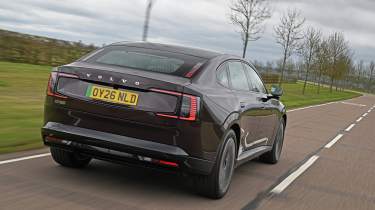
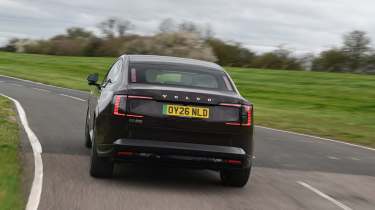
A 360-degree camera system helps with visibility, which is useful because the view out the back of the ES90 is somewhat limited. The tiered rear seats, the shallow angle of the tailgate glass and the height of the sloping roof mean vision is rather restricted, although you also get front and rear sensors to help with parking. At five metres long, the ES90 isn’t the easiest car to manoeuvre, but Park Pilot Assist with automatic driving and steering is fitted as standard.
Country road driving and handling
While the ES90’s powertrain is responsive at all speeds, this big executive is clearly better suited to a long-distance cruise than a back-roads blast. There’s a hefty 2,335kg kerbweight for the suspension to deal with, and when you add a typically uneven British B-road into the mix, the soft springs and dampers struggle to cope. There’s plenty of movement from the suspension as it attempts to keep the car in check, which means an unsettled ride for passengers, while the steering lacks any sort of feedback to help you know what’s going on beneath you.
Motorway driving and long-distance comfort
The combination of a slippery body and quiet electric powertrain delivers hushed refinement, but it’s not all good news at higher speeds. Hit a bigger bump, such as a motorway expansion joint, and the soft suspension and long wheelbase combine to send a delayed ripple back through the car as the rear axle crosses the same imperfection. It only happens over the worst bumps, though.
"One-pedal driving is available in the ES90, but it took us a while to get to grips with it. You have to be very delicate with what feels like an extremely heavy throttle in order to drive smoothly: a bit too much pressure and the car can bolt forward, while easing off too quickly would see it suddenly slow down. But after a while we got the hang of it.
There’s also a one-pedal auto mode, which is helpful if your journey involves a mixture of town, country and motorway driving, because the car won’t slow when you lift off unless it detects a vehicle in front of you." - Ellis Hyde, news reporter.
Range, charging & running costs
Pros |
|
Cons |
|
With prices starting at more than £67,000, the ES90 isn’t cheap, but all models are very well equipped, and even the Plus version feels like a well appointed luxury car.
Electric range, battery life and charge time
Volvo quotes some impressive range figures for the ES90. The poorest performer in the line-up is the 92kWh (88kWh usable) Single Motor Extended Range in higher-spec Ultra trim with a WLTP-tested maximum of 398.3 miles quoted. The lower-spec Plus model offers 411.3 miles, while both the Twin Motor variants with the larger 106kWh battery (102kWh usable) have a range of 426.3 miles. All cars come with a heat pump as standard.
We’ve spent time with the 92kWh Plus version of the ES90, and in chilly conditions with a number of motorway miles factored in, we saw a return of 3.3 miles per kWh, which is only 0.1mi/kWh less than the lowest official figure quoted by Volvo. Match our return, and you’re looking at 290 miles of range, which is around 120 miles short of the official quote. However, if you do more low-speed journeys, we’re confident that the ES90 would be able to match its official figures in the real world.
Another figure we’d like to see the Volvo match in the real world is its maximum charging rate of 310kW. This is possible courtesy of the 800-volt electrical system that’s fitted, although few DC chargepoints will be able to accommodate this maximum rate. Find one, and that 310kW figure is fast enough that a 10-80 per cent top-up can take as little as 22 minutes.
| Model | Battery size | Range | Insurance group |
| ES90 Single Motor Extended Range | 92kWh | 411 miles | 44 |
| ES90 Twin Motor | 106kWh | 426 miles | 47 |
| ES90 Twin Motor Performance | 106kWh | 426 miles | 50 |
Insurance groups
Insurance group ratings for the ES90 are on the high side, starting at 44 and increasing to the highest group 50 rating for the Twin Motor Performance variant. We had a quote of just under £1,500 for 12 months of cover for our sample driver, although that’s in the ballpark for rival executive machines.
Tax
Annual company-car liabilities for the ES90 are far lower than they were for the outgoing S90, although the 2026/27 tax year sees the Benefit-in-Kind (BiK) bracket for electric vehicles increase from three per cent to four. That means the ES90 costs £1,080 for higher-rate taxpayers, whereas in 2025/26 the figure was £810. High list prices mean that ES90 buyers have to stump up for the luxury car road-tax surcharge for years two to six, so it costs £640 on an annual basis.
Depreciation
It’s often the case that new cars start out with strong depreciation figures, only for them to gradually decrease over time. The Volvo’s initial figures aren’t great, with the best-performing model in the line-up being the entry-level Plus, at 45.5 per cent. At the top of the range, the Performance version retains 44 per cent, while the Extended Range Ultra is the poorest of the line-up, at 43 per cent.
Interior, design & technology
Pros |
|
Cons |
|
Volvo has always cut a distinctive dash in the executive sector, and the ES90 takes styling cues from the EX90 and blends them into a fastback shape that looks understated when compared with some ostentatious rivals.
Interior and dashboard design
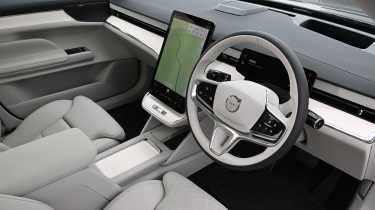
While there are nods to the EX90 on the outside, such as the smooth front end with inset Volvo badge and sharp running lights, the interior features a layout that is all but carried over from the electric SUV. You get a large 14.5-inch portrait touchscreen that takes pride of place on the centre console, while there are wood inserts and silver trim that spreads across the dashboard, with minimalist air vents above. The seats are beautifully sculpted, while Volvo offers a choice of colours for the cabin, with black, cream and beige options on offer, plus a grey colourway for Ultra models.
Materials and build quality
The seats are finished in Volvo’s Nordico artificial leather, and while real Nappa leather is available as an option, we don’t think anyone will feel short-changed by the standard upholstery. Fit and finish inside is first rate, although our test car did seem to have a minor clunk from one of the front seats when driving over harsher bumps.
Infotainment, sat-nav and stereo
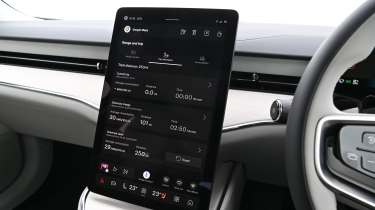
One piece of tech that’s carried over from the EX90 is the central touchscreen. The 14.5-inch portrait display has the same layout as the SUV’s, with the home screen split into three, plus a bank of touch-sensitive climate controls across the bottom. The only physical switches are station skip buttons that sit either side of a crystal glass volume controller that’s inset into the wood veneer beneath the screen.
Volvo’s Google-sourced operating system is very quick and easy to use, with fast loading times and the power of the tech giant’s search and mapping functions at its disposal, offering comprehensive information. Buyers receive a complimentary four-year subscription to Car Connect Plus for additional online services, while you can log into the system with any audio streaming accounts that you might have, allowing you to bypass your phone completely if you want to.
The nine-inch driver’s display is another piece of tech that we’ve seen in other Volvo and Polestar models, and as with the main screen, the graphics are crisp and easily legible. The display can be configured via the buttons on the steering wheel, but while the gloss-black finish makes them look as if they could be touch-sensitive, they simply operate as standard button controls.
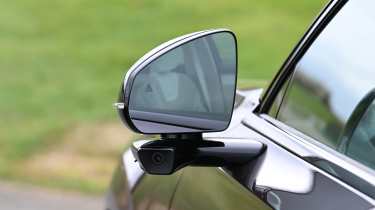
"Adjusting the door mirrors in the ES90 is a bit more complicated than simply playing with a toggle switch on the driver’s door. As with a Tesla, you adjust them via the touchscreen.
Select which mirror you want to adjust, and then you use the right-spoke buttons on the steering wheel to move them up, down, left and right. It seems like a bit of a faff, but then how often do people adjust the mirrors once they’re set up in the first place? Handily, Volvo gives you the option to fix them (and the seat position) each time you get into the car." - Dean Gibson, senior test editor.
Boot space & practicality
Pros |
|
Cons |
|
Overall the E90’s proportions are a mix of the outgoing S90 saloon blended with styling cues first seen on the EX90 SUV. The smooth nose is distinctive, as is the sloping tailgate that blends into the rear bootlid. That’s a lot shorter than the S90’s rear deck courtesy of the hatchback rear, while the two rows of lights that run down either side of the tailgate add a distinctive touch.
Dimensions and size
The ES90 is similar in size to the BMW 5 Series and Audi A6 e-tron, although a greater overall width will make it trickier to manoeuvre through width restrictions. This is offset by increased space in the cabin.
Dimensions comparison | |||
| Model | Volvo ES90 | BMW i5 | Audi A6 e-tron |
| Length | 5,000mm | 5,060mm | 4,928mm |
| Width | 2,054mm | 1,900mm | 2,137mm (incl mirrors) |
| Height | 1,554mm | 1,515mm | 1,455mm |
| Wheelbase | 3,102mm | 2,995mm | 2,950mm |
| Boot space | 424 litres | 490 litres | 502 litres |
Seats & passenger space
Volvo has a strong reputation for making comfortable seats, and the ones in the front of the ES90 don’t disappoint. There’s good support and plenty of comfort, and you’re going to need to charge the car up well before you’ll need to stop and stretch out. Heated seats are standard, while the steering wheel is heated, too.
Storage is good, with a deep centre armrest bin and twin cup-holders beneath a sliding, wood-effect roller cover. There’s a wireless phone charging tray ahead of that, while a pair of USB sockets are included at the front of the centre armrest. The door pockets are a decent size, as is the glovebox, which is opened via the touchscreen.
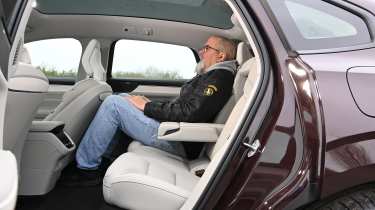
Headroom in the back is fine, although the Volvo’s sloping roof means there’s just enough space rather than an excess of room. Knee and shoulder space are good, but it’s not quite as big in the back of the ES90 as you might expect.
A raised floor makes space for the battery beneath, but the seats are set low in comparison, so you sit with your legs high and without much under-thigh support, while foot space is a little cramped beneath the front seats. Having said that, the back ones have a stadium layout, so you sit tall relative to the front seats. There are heated outer rear seats here, with separate climate controls for either side and a pair of USB sockets.
Boot space
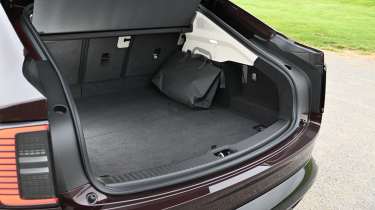
A powered tailgate lifts to reveal a large hatchback rear with 424 litres of space in five-seat mode. The back seats fold three ways to create up to 1,427 litres of space, while there’s a modest amount of room under the floor for a tyre repair kit and the Volvo’s charging cables. The other option is to use the ‘frunk’ under the bonnet, but at 22 litres this is on the small side.
Towing
There’s a towing capacity of 1,600kg for the Single Motor version of the ES90, while the Twin Motor variants can pull 2,000kg. It’s worth noting that, as with other Volvo and Polestar models, the ES90 needs special extended mirrors when towing a caravan, because the frameless door mirror design means that traditional clamped extenders won’t fit. You can get ones that sucker onto the existing glass, although this does limit the amount of rear visibility you might otherwise have when towing.
"Volvo has tapped into the novelty of dual-function controls in a couple of places. The electric window selector on the driver’s door has a Volkswagen-style set-up, where you press a button to choose between front or rear windows for the two switches.
When you adjust the electric driver’s seat, a controller adjusts the base and back, but press the button in the middle, and the same controller also tilts the seat and alters the lumbar support. One feature that’s manually operated is the extendable seat cushion." - Dean Gibson, senior test editor.
Reliability & safety
Pros |
|
Cons |
|
The launch of the EX90 was delayed due to various technical issues, but the ES90 features revised electronics with new processors that should hopefully help with its reliability.
It needs the computing power to look after the suite of safety systems on board, which are comprehensive to say the least. The same technology from the EX90 features, with sensors, cameras and even radar around the car monitoring your surroundings, as well as the driver, at all times.
The ES90 is backed up by a standard three-year/60,000-mile warranty with breakdown cover for the same period. The warranty can be extended by a year and up to 80,000 miles.
Buying and owning
Best buy: Volvo ES90 Single Motor Extended Range Plus
It’s the entry point to the line-up, but nobody is going to feel short-changed in terms of the equipment and luxury on board. Moving up to Ultra spec for £7,000 more adds air-suspension, panoramic glass, a Bowers & Wilkins sound system and pixel lights, among other things, but some of the extras are available as options on Plus spec.
Volvo ES90 alternatives
The obvious alternatives come from Germany in the form of the Audi A6 e-tron and BMW i5, with the former offered in Sportback hatch and Avant estate guises, while the latter comes as either a saloon or Touring estate. The Mercedes EQE is another option that is only available as a saloon and matches the Volvo for tech and safety. If you’re after something a bit more leftfield, the DS No.8 is a quirky choice, but isn’t as roomy as the ES90 in the back, while Lexus will soon introduce an all-electric version of the ES saloon.
Deals on the Volvo ES90 alternatives
Volvo ES90 pictures
Frequently Asked Questions
It’s an interesting addition to the line-up, and if you don’t need the seven seats of the EX90, then it’s worth considering for the extra range that it offers.