Volvo EX40 review
It might have a different name, but this electric SUV still has the capabilities of the old XC40 Recharge

Our opinion on the Volvo EX40
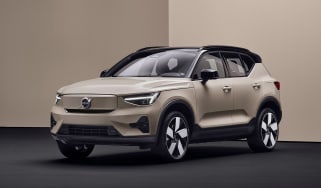
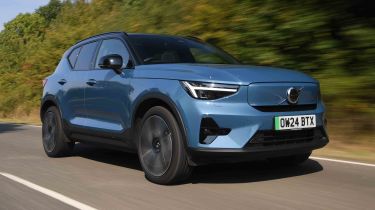
Aside from the badge on the tailgate, not much else is different between the older Volvo XC40 Recharge and the current Volvo EX40. This is a comfort-focused electric SUV that’s stylish to look at, has a decent amount of performance and strong battery ranges. While it follows an older interior design than the Volvo EX30, the cabin still feels premium. Plus, one of the biggest upsides here is that it lacks its younger sibling’s overdependence on touchscreen controls.
About the Volvo EX40
While it started out in life as the Volvo XC40 Recharge, this mid-size premium electric SUV was renamed the Volvo EX40 to bring it into line with the newer EX30 and EX90. The visually identical Volvo XC40 is still on sale alongside its EX40 twin, but only in mild-hybrid petrol form.
There are single motor and twin motor powertrains to choose from, along with the option of an Extended Range and Performance model. As its name suggests, the EX40 Single Motor Extended Range can achieve the longest range - 356 miles on the WLTP combined cycle.
The XC40’s coupe-SUV sister car, the Volvo C40, underwent a similar naming change. The combustion model has been axed completely, but the electric model lives on as the Volvo EC40.
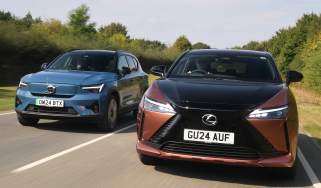
We’ve tested EX40 extensively on UK roads and conducted a twin test against the Lexus RZ in 2024.
Volvo EX40 prices and latest deals
EX40 prices reflect its premium brand billing. EX40 Black Edition comes at a £5,500 premium over the standard model, and this can only be had in the fancier Plus, Plus Pro or Ultra trims.
- EX40 Core Single Motor Extended Range
- EX40 Ultra Twin Motor - £54,500
Whichever version takes your eye, you can spec it through the Auto Express Buy a Car service and get offers from local dealers. We also have a selection of EX40 leasing deals to choose from, if you prefer a shorter commitment.
Performance & driving experience
Pros |
|
Cons |
|
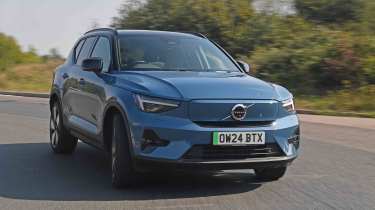
While the EX40 has the firepower to be rapid in a straight line, the chassis is geared more towards comfort than sharp handling. Despite its size, though, this is one of the better SUVs for driving through tightly packed city streets.
| Model | Power | 0-62mph | Top speed |
| EX40 Single Motor | 235bhp | 7.3 seconds | 112mph |
| EX40 Single Motor Extended Range | 249bhp | 7.3 seconds | 112mph |
| EX40 Twin Motor | 402bhp | 4.8 seconds | 112mph |
| EX40 Twin Motor Performance | 436bhp | 4.6 seconds | 112mph |
Electric motors, 0-60mph acceleration and top speed
There are standard and Extended Range battery options available with the Single Motor powertrain. The former has a 70kWh pack, while the latter features an 82kWh unit, and their rear-mounted electric motors have power outputs of 235bhp and 249bhp, respectively. The power difference is there to compensate for the extra 42kg of weight that the Extended Range car carries, and both can sprint from 0-62mph in 7.3 seconds.
The Twin Motor version has a 254bhp rear-mounted unit that’s joined by a 148bhp motor up front for a combined total of 402bhp. This four-wheel-drive model can sprint from 0-62mph in a sports-car-baiting 4.8 seconds. But if that isn’t fast enough for you, the Performance version bumps the power up to 436bhp and can accelerate from 0-62mph in 4.6 seconds. Both of these variants are powered by the 82kWh battery.
Town driving, visibility and parking
Light steering and a tight turning circle – albeit not as tight as in some rivals with rear-mounted electric motors – mean low-speed manoeuvres are easy. A punchy power delivery means there’s plenty of get-up-and-go at the lights, although hard acceleration sees the car rear up on its relatively soft suspension as its weight transfers backwards.
The EX40’s upright body gives you a tall seating position that allows you to place it on the road precisely, while the flat bonnet only slopes away slightly, so you know where the front of the car is. And if you can’t judge that, front and rear parking sensors and a reversing camera are standard on all models.
Country road driving and handling
At faster speeds, the electric motors still offer a decent amount of power, especially in Twin Motor guise, but the chassis doesn’t have a sporty enough set-up to keep pace, with some pitching under acceleration and braking. It’s not unnerving, though.
The soft set-up also compromises the EX40 in corners, where some body roll makes its presence felt. There’s still plenty of grip, but this and a light steering setup mean you’re unlikely to want to explore the limits of the car’s handling further. However, that’s not what this car is about, and it’s better to enjoy the ride comfort instead.
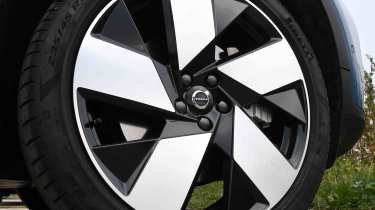
Bumps and lumps are dealt with well, although the larger 20-inch alloys offered on higher-spec versions amplify the shocks that enter the cabin, and there’s a bit more fidget from the suspension with big wheels fitted.
Motorway driving and long-distance comfort
With plenty of power on tap, getting up to motorway speeds is a breeze, and there’s still lots of urge left once you’ve reached the national limit. Cruising comfort is reasonable, although tyre roar and a whistle around the door mirrors do develop when you’re approaching 70mph.
“I resent the fact you can’t adjust the regenerative braking system on the fly. The Volvo has a super-intuitive one-pedal set-up, but you need to delve into the infotainment menu to turn it on or off.” - Richard Ingram, deputy editor.
Range, charging & running costs
Pros |
|
Cons |
|
The best performer for driving range on the official tests is the EX40 Single Motor Extended Range. This model can manage up to 356 miles on the WLTP combined cycle, which is quite a lot more than the BMW iX1 eDrive20 Sport’s 318-mile limit. The Lexus RZ 350e comes pretty close, though, at 353 miles.
The second longest-range EX40 is the Twin Motor, as this claims up to 332 miles from a full charge of the same 82kWh battery pack. The high-speed Performance version isn’t far behind at 326 miles.
The odd model out here is the base Volvo EX40 Single Motor, as this is powered by a smaller 70kWh battery. At up to 294 miles on the WLTP combined cycle, though, it's still a respectable performer in this regard.
It’s worth noting that the Core trim level doesn’t come with a heat pump, so this variant’s range will see a bigger reduction in cold weather when compared with higher-spec models. It’s not even available as an option, so you’ll have to spend around £2,500 extra to upgrade to Plus trim.
The EX40’s maximum DC charging speed varies depending on which battery is fitted. The 70kWh unit has a maximum rate of 135kWh, which Volvo claims is good for a 10 to 80 per cent charge time of 26 minutes. The 82kWh pack bumps the speed up to 205kWh, but its larger capacity means a slightly slower 28 minute charging duration.
| Model | Battery size | Range | Insurance group |
| EX40 Single Motor Core | 70kWh | 294 miles | 33 |
| EX40 Single Motor Extended Range Plus | 82kWh | 353 miles | 25 |
| EX40 Twin Motor Plus | 82kWh | 331 miles | 40 |
Insurance groups
Insurance cover costs for the EX40 are on a par with most other premium small electric SUVs. The bandings sit between groups 33 and 40 (out of 50), with trim levels and power outputs both bumping up the costs.
In comparison, the slightly more driver-focused BMW iX1 resides in groups 29 to 38, so coverage will be cheaper in some instances. The combustion-powered Volvo XC40 is also a bit more affordable to cover than its zero-emission twin, as it finds itself in groups 23 to 30.
Tax
The standard rate of VED road tax applies to every Volvo EX40, but being too bold on the spec or options lists does carry a risk of crossing the £50,000 electric luxury car tax bracket. This will land you an additional £440 on your annual tax bill between the second and sixth year after the car is initially registered.
The EX40 is a much stronger proposition for business buyers than the XC40, though, as this zero-emission car carries the very lowest applicable rates of Benefit-in-Kind (BiK) company car tax.
Check your tax status and renewal date in seconds. Check your VED car tax now...
Depreciation
Perhaps a consequence of its left-field status, or maybe even its name change from XC40 to EX40, this electric SUV suffers pretty greatly at the hands of depreciation. Our market data indicates that it’ll only maintain between 37 and 41 per cent of its original value after a period of three years or 36,000 miles.
This outcome is pretty much on par with the Lexus RZ, which retains 37 to 42 per cent. The BMW iX1, on the other hand, fares a tiny bit better at 40 to 43 per cent.
To get an accurate valuation on a specific model check out our Free Car Valuation tool...
Interior, design & technology
Pros |
|
Cons |
|
Although Volvo did make a few tweaks here and there when the EX40 received its new moniker, it’s still basically the same old XC40 inside. If you’ve read our criticism of the newer Volvo EX30’s heavy dependence on its touchscreen, though, you’ll soon realise that isn’t necessarily a bad thing.
Interior and dashboard design
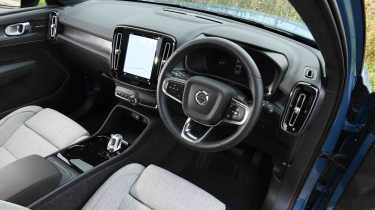
The Volvo EX40’s upright exterior is carried over to the cabin, where the dashboard carries on with a vertical theme. There’s a portrait-style touchscreen and four upright air vents across the dash, but the central display looks small when compared with the vast layouts offered by rivals. At least the black plastic is broken up by some silver material, while the charcoal-coloured fabric seats give the cabin a lift.
Materials and build quality
The EX40’s physical switchgear feels solid to use, especially the small rotary knobs on the air vents and the large volume control just below the screen, but we just wish there were physical controls for the climate, too. Another highlight is the stubby drive selector, which has a pleasingly short throw.
Elsewhere, the build quality generally holds up well and everything feels solid. Neat touches, such as the partial flock lining for the front door bins, also add to the premium character of this SUV.
Infotainment, sat-nav and stereo
When it was launched, the then-XC40’s nine-inch portrait display was a break from the norm. Today, it looks small in comparison with fresher rivals, although nothing is dated about the Google operating system that it uses.
There are a number of apps on offer, and if you have a Google account, you can sign in and sync your information with the car – a handy feature if you want to transfer mapping details to the car’s system. Apple CarPlay is also included, but it’s a wired set-up.
In addition to the main display, there is a large digital instrument cluster for the driver. This offers clear information, although the controls via the multifunction steering wheel are a little vague. There are no pictograms on the steering wheel buttons, so it’s best to get familiar with the button layout and how it all functions before setting off.
“I seem to be constantly adjusting the speed or regularity of the wipers; something my last few fleet cars have done automatically. Seems a minor gripe, but with a busy work and family life, things like this can make a huge difference.” - Richard Ingram, deputy editor.
Boot space & practicality

Pros |
|
Cons |
|
The EX40 competes in a market where style takes priority over outright practicality, but there’s just enough space for a family of four and their luggage.
Dimensions and size
Although it’s quite chunky in its physical appearance, the EX40 is a bit shorter than the BMW iX1. It’s also slightly smaller than the Lexus RZ, but this rival is far longer than both of its competitors.
| Dimensions comparison | |||
| Model | Volvo EX40 | BMW iX1 | Lexus RZ |
| Length | 4,440mm | 4,500mm | 4,805mm |
| Width | 1,873mm | 1,845mm | 1,895mm |
| Height | 1,647mm | 1,616mm | 1,635mm |
| Wheelbase | 2,702mm | 2,690mm | 2,850mm |
| Boot space | 410 litres | 490 litres | 522 litres |
Seats & passenger space
There are no issues with space up front, while the driving position and large windows offer a clear view of your surroundings. A wide range of adjustment in the seat and steering wheel means it’s easy to get comfortable, while Volvo’s seats are famous for offering long-distance comfort.
On the downside, front door bins are narrow. On the more positive side, they are flock-lined to stop items from rattling about. There’s a deep cubby just ahead of the drive selector for your mobile phone. The central armrest bin is narrow but deep, and there’s a small lidded cubby just ahead of it and twin cup-holders next to the drive selector.
The back seats are a little narrow, so sitting three abreast will be tight, while the shallow seat bases and high-set floor mean under-thigh support is lacking somewhat. The fixed rear headrests also tilt your head forward a little, while adding the optional panoramic sunroof eats into headroom slightly.
Storage in the back is fair, with the hard-backed front seats featuring elasticated nets, while the door bins are similar to the fronts, with a flock lining included. Air vents and charging sockets are also included in the back, while small trinket trays are located at either side of the rear seats.
There are two sets of Isofix mounts on the outer rear seats that are easily accessible behind plastic covers. A third set of mounts features on the front passenger seat, but these aren’t quite as easy to reach, because they’re hidden at the base of the seat cushion.
Boot space
With all four seats in place, the Volvo EX40 offers 410 litres of boot space, and folding them increases this to 1,400 litres. This should prove enough for a smaller family’s needs, but the BMW iX1 does have the advantage with 490 to 1,495 litres at its disposal.
The Volvo’s standard-fit powered tailgate opens to reveal a high loading lip, but the boot floor is level with the edge of the tailgate to help with sliding in heavier items. The floor itself is hinged to create a boot divider, while this also reveals a large well underneath for storing the charging cables.
The back seats have a 60:40 split, although there’s also a ski hatch for loading long, thin items. The EX40 has a small storage area in the nose — unlike the iX1 — thanks to the removal of the engine from the traditionally powered XC40, and at 30 litres, it’s big enough to carry a charging cable separate from the rest of your luggage.
Towing
The Single Motor EX40s are rated to tow a braked trailer of up to 1,500kg, while the Twin Motor cars can manage up to 1,800kg. This means that both variants are far more suitable tow cars than even the strongest BMW iX1, as that only manages 1,200kg. The four-wheel drive Lexus RZ is able to match the EX40 Single Motor’s 1,500kg capacity, though.
“Some useful underfloor storage, plus a decent space under the bonnet, means that I’ve not yet wished for a bigger boot. However, having a fixed parcel shelf rather than a retractable one isn’t the most practical solution; I’ve had to leave it at home on a few occasions.” - Richard Ingram, deputy editor.
Reliability & safety
Pros |
|
Cons |
|
The EX40 (nee XC40) landed a five-star Euro NCAP rating when it was originally tested back in 2021. However, due to the testing body’s increasingly stringent criteria, this score has now expired.
The original category scores were impressive, though, at 97 per cent for adult occupant protection and 87 per cent for child occupant protection. All cars feature automatic emergency braking that can spot cars, pedestrians and large animals, while a lane departure system will intervene and steer the car back into the lane if it senses a potential collision with oncoming traffic.
Pilot Assist is Volvo’s semi-autonomous driving tech, and this comes as standard on Plus, Plus Pro and Ultra models, while it’s an option on Core trim. This adds adaptive cruise control that can steer, accelerate and brake in slow-moving traffic, even bringing the car to a complete stop if necessary.
The Volvo XC40 is still proving to be a hit with owners, too, as it achieved a 37th place finish out of 50 cars on the most recent Driver Power best cars to own list. Drivers praised their cars’ safety and practicality, but were left yearning for a bit more driving pleasure.
Volvo’s reputation as a brand is a bit underwhelming, though, as it only managed 13th place out of 31 in the best manufacturer rankings. Rivals like BMW (8th), Lexus (3rd) and Mercedes (2nd) all put on a better show here.
Buying and owning
- Best buy: Volvo XC40 Single Motor Extended Range Core
While the long list of options and variants can be tempting, we think it’s best to keep things simple by opting for the Single Motor Extended Range in Core trim. This variant offers the most miles without having to fork out too many extra pounds, but there’s still enough kit fitted to make this feel like a premium SUV.
Volvo EX40 alternatives
The compact premium electric SUV market is awash with contenders. From the German ‘big three’ there’s the Audi Q4 e-tron, BMW iX1 and the Mercedes EQA. Look further afield, though and you’ll also find options like the Lexus RZ, Tesla Model Y, Volkswagen ID.4 and Genesis GV60. There’s another option that shares plenty of tech with the Volvo, too, and that is the Polestar 2.
Key updates of the Volvo EX40 review
23 April 2026: Updated to include our latest driving impressions.
Frequently Asked Questions
Volvo’s three-year/60,000-mile warranty is par for the course in the premium sector. It can be extended by 12 months at extra cost, but can’t match the 10 years/100,000 miles of cover available to Lexus buyers. In addition to the standard warranty, the EX40’s drive battery is covered for eight years or 100,000 miles, although deteriorating battery capacity isn’t part of this policy.
Deals on the EX40 and alternatives
More reviews
Which Is Best