What is a Pelican crossing?
Find out what a Pelican crossing is and how to use one

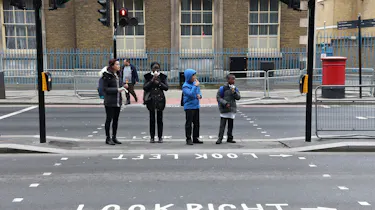
At a Pelican crossing, drivers will be faced with a set of traffic lights. The difference with Pelican crossing lights, though, is that they will flash amber when changing from red to green, rather than showing a solid red and amber light together. When the amber light is flashing, drivers may proceed if nobody is using the crossing.
Pedestrians are presented with a black and yellow box with the word “WAIT” on it, which is mounted, at hip height, to the traffic light pole. On the opposite light pole is a red light shaped like a man standing, and a green light shaped like a man walking.
When the light is green for pedestrians, a beeping sound will usually accompany it. This is used to tell visually-impaired users that they are safe to cross. Prior to this, tactile paving acts as an indicator that the person has arrived at a crossing and will need to wait for the signal before proceeding any further.
If a crossing does not feature any audible signal, a rotating knob might be fitted under the yellow and black box instead. This device is a simple plastic cone that starts spinning when the pedestrian signal turns green, and this acts as another indicator to allow those who experience sight or hearing impairments to cross the road safely.
Pelican crossings were the first pedestrian-operated crossings to be introduced in the UK when they appeared in 1969.
Pelican crossing rules and how to use one
Pedestrians
Those who wish to cross the road must press the button on the black and yellow box. When the button is pressed, this will illuminate the ‘WAIT’ sign. When the traffic lights turn red and you are permitted to cross, this light will go out and the green man will appear on the opposite side of the road.
Once the pedestrian signal has been green for a certain amount of time, it will then start to flash. If you are still in the road when this happens, you are safe to proceed. However, you must not begin to cross on a flashing green or solid red man.
Some pelican crossings are also fitted with a countdown timer to show how long there is left to safely cross the road. If you are unable to cross within the given time, or the timer has reached zero, you must wait for the next green man.
Drivers
As with any traffic light, drivers must prepare to stop at a solid amber or red light. If the Pelican crossing’s lights are flashing amber, this means you must wait for pedestrians still on the crossing to safely get to the other side.
Once you are sure that the crossing is clear, you may proceed on a flashing amber or green light.