Ford Focus ST (2019 - 2025) review
The Ford Focus ST is neither the fastest nor the cheapest hot hatch, but it’s up there with the very best

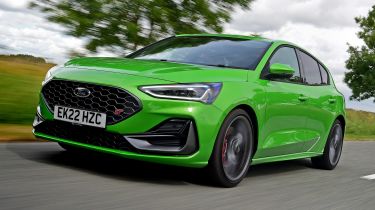

Over the years the Ford Focus ST has developed into a terrific all-rounder, and ranks among the very best hot hatches on the market right now.
It’s not perfect of course, with a lofty starting price and a lack of practicality hindering the overall package, but many will see these shortcomings as a price worth paying for such a talented machine. And while others have moved the game on when it comes to tech, the latest Focus ST still comes with the very best stuff that Ford has to offer to keep it in the running.
About the Ford Focus ST
Not long after the Mk4 Ford Focus was launched in 2018, the hot Focus ST version came bounding in with petrol and diesel engines. The former is a 276bhp 2.3-litre EcoBoost unit that shares components with the previous entry-level Ford Mustang’s powerplant, while the 187bhp 2.0-litre EcoBlue diesel was perfectly placed to take on hot diesel Octavia vRS and Golf GTD models from Skoda and Volkswagen.
A recent facelift brought in refreshed front-end styling and additional interior technology. Ford also streamlined the range, removing the diesel engine – which isn’t a huge shock given UK buyers buy petrol hot hatchbacks in much higher numbers.

Prices start at around £37,000 for a manual petrol model, which may seem a lot, but is broadly on par with close rivals. Other hot hatches stand out by offering more power, or better in-car technology, however, so how does the Focus ST fight back?
Used - available now

2024 Cupra
Formentor
68,927 milesAutomaticPetrol1.4L
Cash £17,500
2022 Kia
Niro
66,962 milesAutomaticPetrol1.6L
Cash £14,600
2022 Volvo
XC40
42,679 milesAutomaticPetrol1.5L
Cash £18,896
2023 Peugeot
2008
13,198 milesManualPetrol1.2L
Cash £16,500In a word, handling. Ford has found a sweet spot with the Focus chassis (as with the smaller Fiesta ST) that makes it come to life in a corner. The performance when you turn the wheel is truly breathtaking, so much so that you can almost feel the half a century of experience that the US manufacturer has behind it making sporty cars.
As mentioned, competition is certainly fierce, with the Cupra Leon, Volkswagen Golf GTI and the impressive Hyundai i30 N all vying to snare keen drivers. More upmarket offerings include the BMW M135i, Audi RS 3 and Mercedes-AMG A35. You could also consider the much more expensive Honda Civic Type R or used examples of the aggressive and exciting Renault Megane RS.
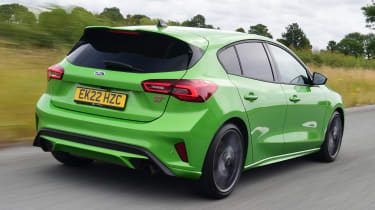
In addition to the five-door hatch bodystyle, there’s also the Ford Focus ST estate version offering more load-lugging capacity to go with the driving fun. Both the hatch and estate petrol models are front-wheel drive only and offer 0-62mph times under six seconds.
The optional Track Pack offers an even sharper hot hatch experience by adding manually adjustable KW coilovers, upgraded brakes, lighter 19-inch alloy wheels and Pirelli P Zero rubber helping to raise the ST to another level. Alternatively, the Performance Pack adds launch control, a shift light, rev matching and continuously controlled adjustable dampers.
However, neither of these come cheap. The estate model also costs an additional £1,300 over the hatchback, and opting for the seven-speed automatic gearbox adds a similar amount to the ST's price tag. By comparison, the i30 N starts at roughly £2,000 less, while the Cupra Leon is a fraction dearer in top-spec guise but offers more power and performance than the ST.
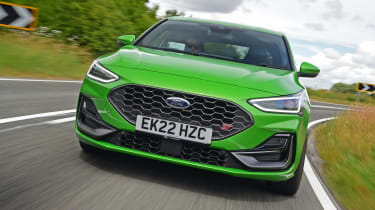
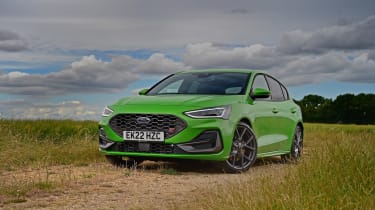
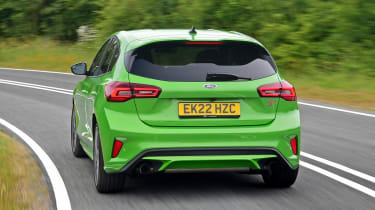
Standard kit on all Focus ST versions is impressive with eye-catching 19-inch alloy wheels in a dark-grey finish, LED headlights and tail-lights, sports seats, keyless entry, a 12.3-inch digital driver's display and 13.2-inch touchscreen running Ford's SYNC 4 infotainment system, plus Apple CarPlay and Android Auto. Solid Race Red paint is a no-cost option, with five other colours currently available including eye-catching Mean Green.
Engines, performance and drive
The previous generation Focus ST model was certainly being out-muscled by rivals from Honda, Renault, SEAT, Volkswagen and even Hyundai with the i30 N. Ford recognised the need to upgrade the ST’s driving tech and returned with the new, fourth-generation car ready and fit for action.
The 2.3-litre turbocharged petrol engine delivers 276bhp through the front wheels and a whopping 420Nm of torque, ensuring plenty of low-down grunt to help fire the car through corners and back out. Ford has also given a nod to its motorsport heritage by including rally car-like anti-lag technology. Driving purists will welcome the six-speed manual gearbox, although it doesn't offer the most precise of shifts and could be more rewarding when it comes to mechanical interaction.
The ST’s steering is now 15 percent faster than that of a standard Focus, while the Michelin Pilot Sport 4S tyres help improve front-end bite. There’s an electronically-controlled limited-slip differential to assist with finding better traction, and the chassis gets adaptive dampers for the first time.
Also debuting on the ST are drive modes that are able to alter throttle response and the noise the electronic sound enhancement system makes to augment the engine note. Buyers opting for the £850 Performance Pack will get launch control and rev matching for downshifts, plus an extra Track driving mode that puts the dampers and engine in their most aggressive setting.
The suspension is firm, even in Normal mode, and the ride can be quite bumpy on the UK’s pothole-covered roads. But, the ST’s chassis is its key strength, it’s composed through quick corners and those trick dampers offer enough adjustability to take tight turns with confidence.
Cranking things up a bit is the optional Track Pack which adds manually adjustable KW coilovers, 10 per cent larger front brake discs and 19-inch Ford Performance wheels are wrapped in Pirelli P-Zero Corsa tyres – a grippier compound than the standard car’s Michelin Pilot Sport 4s. The uprated Brembo brakes deliver phenomenal stopping power, but also have added benefits on the road. We found the standard ST’s system a little grabby, but this set-up is easier to moderate at more gentle speeds.
0-62mph acceleration and top speed
Over the years, Ford has experimented with different powertrains for the Focus ST, but has now settled on a turbocharged 2.3-litre four-cylinder engine to power the family hot hatch.
The turbo unit is an evolution of the previous Focus RS engine, although it doesn’t make as much power, at 276bhp. The extra displacement compared to the 2.0-litre units of most rivals gives the ST a strong torque figure of 420Nm. There’s also an anti-lag function that helps to keep the turbo spinning to boost throttle response.
All this means the ST is able to dash from 0-62mph in 5.7 seconds and hit a top speed of 155mph. The estate version is no slouch either, at just a tenth of a second slower than the five-door hatch.
The engine note has a little augmentation to give a slight burble under acceleration, but it still sounds quite natural. The exhaust is a bit more muted than some rivals, but still backfires on full-bore upshifts. It also has a switchable auto-blip mode for the throttle, which means that any driver can downshift as if they’ve nailed the perfect heel-and-toe change.
The now-discontinued 2.0-litre diesel ST model produces 187bhp and 400Nm of torque, with sprint times of 7.6 and 7.7 seconds for the hatch and estate, respectively.
MPG, CO2 and running costs
Despite offering strong performance, the Focus ST still manages to return decent economy figures. The recently departed diesel model was particularly frugal, although the ST's petrol engine won’t leave you constantly standing at the pumps.
Ford says the ST's 2.3-litre EcoBoost engine manages a maximum of 35.8mpg on the WLTP combined cycle, while CO2 emissions stand at 182-183g/km, depending on which transmission you select. When we pitted the Focus ST head-to-head against a Hyundai i30 N in a twin test, the Ford proved to be the more effecient of the two cars. We averaged 32.1mpg in the Ford, which beat the 28.8mpg the Hyundai could muster.
In comparison, a Mk8 Volkswagen Golf GTI manages over 38mpg, under WLTP testing, while the more powerful Honda Civic Type R is little less efficient, only delivering 34.4mpg.
The now-discontinued EcoBlue diesel was naturally more economical at 53.3mpg, and emitted 140g/km of CO2.
Insurance
Insurance for any hot hatch owner is generally a high cost to bear, but the Focus ST remains competitive in this area, as both the ST hatch and estate sit in insurnace group 27 (out of 50). In comparison, the Civic Type R is given an insurance rating of 43 and the Volkswagen Golf R occupies group 31.
Our Car Tax Checker tool lets you check your tax status and renewal date in seconds. Check your VED car tax now...
Depreciation
The previous-generation Focus ST didn’t perform well in terms of depreciation, with the petrol hatchback model struggling to keep 40 per cent of its new value after three years. This time around our experts predict the new five-door hatch will retain up to 51 per cent over a typical three-year/36,000-mile ownership period, while the estate is expected to hold onto 49 per cent of its original price after the same period.
To get an accurate valuation on a specific model check out our free car valuation tool...
Interior, design and technology
Like the rest of the Focus range, the Focus ST is based on Ford’s new C2 platform, which has allowed the wheelbase to be extended by 53mm over the previous model and created more interior space. The exterior design incorporates more flowing lines from front to back and, compared to the last car, there’s definitely a sportier, sleeker profile to admire.
Ford no longer offers the ST-2 and ST-3 trim levels, instead there is just the standard ST specification. To ensure it stands out from the rest of the range, particularly from the smart ST-Line versions, the top-of-the-range hatch comes with 19-inch alloy wheels, a redesigned grille and bumper design, a rear spoiler and two exhaust tailpipes. However, the overall effect is still relatively subtle when compared to the more outlandish and wild styling of the Civic Type R. Some onlookers may not be able to tell it apart from the ST-Line, although the new Mean Green paint option will help you stand out.
The £3,000 Track Pack bundles a combination of chassis and styling upgrades, including a new set of 19-inch flow-formed wheels that are 10 per cent lighter than the standard offerings, wrapped in a set of Pirelli P Zero rubber instead of the standard car’s Michelins. Behind these sit a pair of red-painted Brembo four-piston calipers on the front axle, gripping discs that are also 10 per cent larger than standard. Finally, the ST's electronically-adjustable dampers are swapped for a set of coilovers from KW that lowers the car by 10mm, while Ford adds a gloss back roof, front and rear bumper inserts, and mirror caps to help give the car a more aggressive look.
Most of the others optional extras aren’t strictly necessary, although the panoramic sunroof (£1,045) adds a little extra light to the cabin and the head-up display (£450) helps the driver keep their eyes on the road.
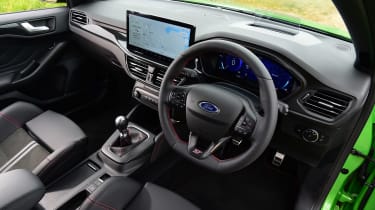
Inside, there’s plenty of up-to-date, stylish touches with heated Ford Performance sports seats (pre-facelift cars have Recaro seats), aluminium-style trim, alloy-finish pedals, a heated flat-bottomed steering wheel and two USB ports. There's lots of red stitching around the cabin, namely the seats, steering wheel and the gearlever gaiter, which lift an otherwise black and murky interior.
One problem with the cabin of the previous ST was an interior strewn with buttons and an awkward infotainment system. The new model includes a big touchscreen, which enables you to navigate through most of the car’s functions, although there are still buttons for the audio and dual-zone climate control.
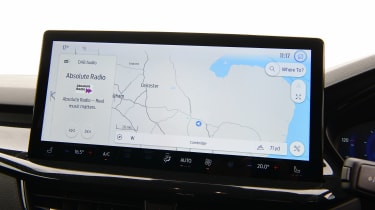
While the pre-facelift cars have an eight-inch touchscreen, new examples all get a vast 13.2-inch display that benefits from Ford’s latest SYNC 4 operating system.
Sat-nav, stereo and infotainment
The Focus ST now features a much-improved infotainment set-up with a 13.2-inch touchscreen. It runs the latest SYNC 4 operating system, which means that you get a responsive touchscreen, quick loading times and a menu structure that is fairly easy to work out.
It looks great, the colours are bright, and apps such as Android Auto and Apple CarPlay expand to fill the display. But most of the heating and ventilation controls are on the screen, and while they’re set into a permanent bar along the bottom of the display, they’re more fiddly to use than conventional buttons.
When it comes to ST-specific menus, the Focus is a little short on features. The drive-mode screen gives a choice from four modes, but that’s about it. We’d like to have an individual mode to give the driver an option to tailor the different settings to their own taste.
An upgraded 10-speaker B&O audio system is also standard-fit on the ST, as is the 12.3-inch digital driver’s display behind the steering wheel. Another piece of standard kit, for the more tech-savvy customer, is the FordPass Connect modem system. This is an app that buyers can download onto their smartphones, enabling them to connect their vehicle to the internet and provide functions such as Live Traffic information and in-car Wi-Fi.
Practicality, comfort and boot space
The Ford Focus ST is still available as a five-door hatchback and more practical estate car, which is very rare in the world of hot hatches. It also means this fast Ford offers increased flexibility for those wanting a usable, everyday performance machine.
The Focus ST’s steering is 15 percent quicker than other cars in the range, but there’s not much lock and tight turns will need a few attempts. Thankfully, front and rear parking sensors and a reversing camera are included as standard.
Previous generations of the Focus ST received criticism for a high-driving position, but the latest model includes well-set, supportive sports seats. Both of the front seats are heated, as is the steering wheel, which should be a welcome boon during colder weather.
Size
The fourth-generation ST hasn’t strayed from the basic family hatchback formula. The five-door hatch measures 4,378mm in length, 1,979mm wide and 1,471mm tall, making it longer than a Mk8 Golf GTI but still shorter than an Audi RS 3.
The Focus ST Estate model naturally brings an increased overall length at 4,668mm, although width remains the same. Height increases by 23mm to 1,494mm.
Leg room, head room & passenger space
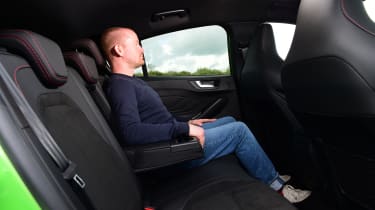
Driver and passenger space benefits from a five-door layout, with Ford claiming class-leading kneeroom in the rear cabin, alongside ample shoulder room for two rear occupants. However, headroom is a little below the best that the segment has to offer. The middle seat is fine for short trips, but its somewhat perched position only emphasises the low roof. At least those in the back get a pair of USB-C ports to keep their devices charged up.
We took our own measurements of the rear seat area when we pitted the Ford Focus ST against one of its key rivals, the Hyundai i30 N, in our twin test. We found that while the Ford has significantly more knee room, the Hyundai takes the overall win on headroom and slightly wider elbow room.
| Rear seat space comparison | |||
| Knee room (min-max) | Headroom | Elbow room | |
| Ford Focus ST | 618-858mm | 899mm | 1,447mm |
| Hyundai i30 N | 550-752mm | 961mm | 1,459mm |
Boot
Based on the same C2 platform as the rest of the Focus range, the hot ST still provides solid levels of practicality. Boot space for the five-door hatch, with all seats in place, is an ample 373 litres, however the Honda Civic Type R trumps the ST here, with a more generous 410 litres on offer. There is a ski hatch for loading long items though, and when folded, the 60:40 split rear seats drop close to flat and increase load capacity to a useful 1,250 litres
The handsome ST estate gives buyers a real reason to think about their daily driving needs – it offers a huge 608 litres with all seats upright and an even bigger space of 1,653 litres, if you lower the rear seats.
When we opened up the boot of the Focus ST hatch in our twin test against the i30 N, we found that the Ford's load lip is lower than its rival, so it’s easier to load heavy items into the Focus. The Focus ST also has a much longer boot than the i30 N, however it's not as wide as the Hyundai's load space.
| Boot space comparison | |||
| Length | Width | Lip height | |
| Ford Focus ST | 830mm | 1,010mm | 665mm |
| Hyundai i30 N | 729mm | 1,048mm | 723mm |
Reliability and safety
With the latest Focus ST sitting on an all-new platform, it will take some time to build a full picture of reliability. That said, its engine is an evolution of the unit used in the previous Focus RS model and a lot of other common components will be in use throughout the Focus range, so we’d expect the ST to be pretty dependable.
There’s a raft of safety kit offered as standard, including adaptive cruise control with lane centring assist, traffic sign recognition and a blind spot warning system. An optional head-up display system is also available.
The latest Focus achieved a full five-star rating when tested under more stringent Euro NCAP testing procedures. Adult safety was rated at 85%, child occupant safety was even better at 87%, while the car scored 72% for pedestrian safety.
In our 2023 Driver Power owner satisfaction survey, Ford finished 28th out of 32 in the best car manufacturers rankings – well behind Skoda (20th), Hyundai (17th) and Kia in sixth place. The brand will be pushing for a much higher finish next time around.
Warranty
Ford offers a 3-year/60,000-mile warranty for all Focus models, including the ST. There is the option, at extra cost, of extending this for up to 4 years/80,000 miles, or 5 years/1000,000 miles. The extended warranty is transferable to a new owner if you decide to sell the vehicle, which will potentially increase the resale value.
UK and European roadside assistance is included for 12 months, which can be extended for a further year if you opt to service the vehicle at a participating Ford dealer.
Servicing
For a one-off payment, the Ford Protect Service Plan covers the cost of recommended scheduled services for up to three years, while for those that prefer to spread the cost of servicing, Ford offers the Service Assure Monthly Payment Plan.
More reviews
Car group tests
In-depth reviews
Long-term tests
Road tests