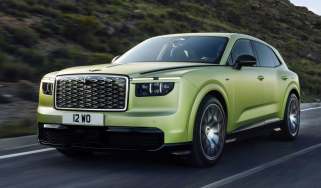
Skoda Elroq review
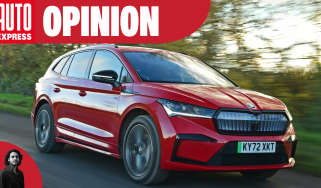
The Skoda Elroq is even more appealing than the bigger Skoda Enyaq. It's a winner of our prestigious Car of the Year title

Our opinion on the Skoda Elroq
It would be easy to say the Skoda Elroq is simply a shortened Skoda Enyaq, but there’s a lot more to it than that. In fact, it’s so good that we crowned it as our Car of the Year in 2025.
But why is the Elroq so well regarded? Well, there’s a significant price saving for starters compared with its bigger sibling, and yet the Elroq doesn’t really sacrifice much in terms of practicality, refinement or performance. The Elroq offers decent driving range, impressive performance, and all of the practical touches that Skoda is famous for, giving justification for us to give this outstanding electric car the nod over its rivals.
About the Skoda Elroq
The Skoda Elroq (a portmanteau of Electric and Skoda Karoq), is the second electric Skoda model, and is pitched at those in the market for a family SUV that’s a little easier to park than the brand’s bigger Skoda Enyaq.
The Elroq uses the same platform as the Volkswagen ID.3, and there are three battery packs offered as well as a four-wheel drive variant.
We've been in and out of various examples of the Skoda Elroq since it arrived on the UK market, as well as having both a Skoda Elroq Edition 85 and Skoda Elroq vRS on our long-term test fleet for six-month test drives, we even examined it alongside the Toyota C-HR+ in a twin test. Here, the Skoda took the win thanks to crucial factors like its value for money and efficiency.
Electric motor, drive and performance
| Pros |
|
| Cons |
|
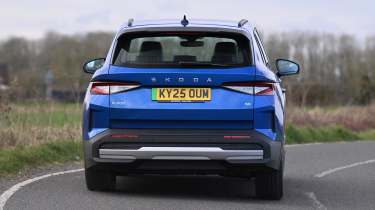
On the road, the Elroq is as composed, grippy and neatly balanced as you’d need a family car to be. In fact, it offers better ride comfort than much of its competition, with plenty of compliance and the ability to avoid jostling its occupants.
Electric motors, 0-60mph acceleration and top speed
There are three motor options in the Elroq range. Our preferred 60 version has an output of 187bhp and 350Nm, and manages the 0-62mph dash in 8.2 seconds. The 85 provides 282bhp and 545Nm and chops the 0-62mph sprint to 6.4 seconds, while the range-topping vRS turns up the wick to 335bhp, and the 0-62mph drops to 5.2 seconds.
The Volkswagen Group has improved the throttle mapping of its current EV range compared to its earlier electric models, which previously felt quite lethargic when moving off. The Elroq is considerably more sprightly, but that hasn’t come at the expense of control, because there’s still plenty of pedal travel, so it’s easy to drive smoothly at low speeds.
| Model | Power | 0-62mph | Top speed |
| Skoda Elroq SE L 60 | 187bhp | 8.2 seconds | 99mph |
| Skoda Elroq SportLine 85 | 282bhp | 6.4 seconds | 111mph |
| Skoda Elroq vRS | 335bhp | 5.4 seconds | 111mph |
Town driving, visibility and parking
From the off, the Elroq avoids the irritatingly jiggly low-speed ride that many rivals suffer from. Even the optional 20-inch wheels of our test car didn’t spoil the suppleness of the ride unduly. The tight 9.3-metre turning circle of rear-wheel drive models is superb for a car of this size.
One area where we feel could be improved is braking. While we have no issues with its stopping power, the pedal feels soft through its initial travel, which doesn't inspire confidence. We’d like the option to adjust brake regeneration via steering wheel-mounted paddles, similar to the Kia EV3 and Renault Megane. Only buyers of the Elroq SportLine and range-topping vRS get this useful feature.
B-road driving and handling
While the suspension feels forgiving around town, it is firm enough to give the Elroq decent body control at higher speeds on twistier roads. The light steering isn’t generous with feedback, but it is precise and allows drivers to guide the Elroq confidently. That’s backed up by a generous amount of grip and tight control of body movements.
The handling of the Elroq is very neutral, with harder acceleration in rear-wheel drive models gently pushing the back of the car around in a turn. It’s a stretch to call this Skoda fun, but it’s possible to flow the Elroq along a road better than a front-wheel drive Kia EV3.
The vRS feels like a slightly sharper handling Elroq. Its wide-section Hankook tyres provide plenty of grip to carry some speed on the twisties, while the extra power is easily controlled by its four-wheel drive system. All this makes it effortless to drive at a pace rather than entertaining.
Motorway driving and long-distance comfort
Strong stability and impressive comfort are both evident in the Elroq’s motorway manners. A lack of vibration from the electric powertrain means the Elroq is a relaxing long-distance car.
Road noise is a little more hushed than the EV3, and the Skoda sits solidly on the road, requiring fewer steering corrections.
“The Elroq vRS is a very similar car to the Volkswagen ID.4 GTX, with an identical power output and battery set-up, yet it’s miles ahead of its relation in almost every way. Where the GTX fails dynamically, the vRS excels.” - Pete Baiden, web producer.
Range, charging & running costs
| Pros |
|
| Cons |
|
Electric range, battery life and charge time
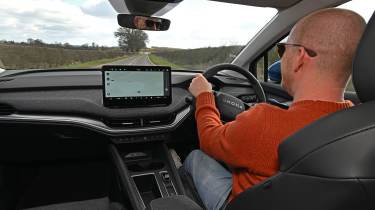
There are three battery capacities available to buyers, and while the overall ranges aren’t quite class-leading, they are competitive. The Elroq range starts with our preferred Elroq 60 that comes with a 61kWh (58kWh usable) battery and a WLTP combined range figure of 279 miles.
This particular battery’s chemistry was tweaked as part of a series of model updates. While this didn’t improve the claimed range in any way, Skoda has stated that its efforts will extend the pack’s lifespan.
The largest battery pack is fitted to the Elroq 85. This is an 84kWh (79kWh usable) unit that claims up to 370 miles, depending on your chosen spec. The performance-focused vRS, meanwhile, is fitted with a slightly smaller 82kWh (77kWh usable) battery. This only manages up to 344 miles on paper due to the four-wheel drive system imposing a weight penalty.
We tested the Elroq 60 in a twin test with the Renault Megane, and averaged 3.7 miles per kWh or 218 miles of range. That’s a little down from Skoda’s official claim of 3.9mi/kWh, but our figure included plenty of motorway driving in cool conditions, neither of which is flattering for an EV’s range. Warmer weather and more driving at lower speeds will see that figure climb, along with a heat pump (a less energy-intensive way of warming the interior in cold weather). It's a shame that the latter is a pricey £1,100 extra).
We also have experience with the Elroq 85 and Elroq vRS from our long term testing. During our time with the 85, we managed 3.8 miles per kWh or 293 miles per charge, while the vRS achieved 3.4 miles per kWh or 269 miles per charge.
With regards to charging, the Elroq 60 can hit a peak of 165kW, so charging from 10-80 per cent takes 24 minutes. Most EV owners will likely utilise a 7.4kW home wallbox charger for much cheaper running costs, and it'll take around nine hours to fully recharge the battery using this method.
The Elroq 85 model peaks at 175kW, but due to its larger capacity battery, charging from 10-80 per cent will take 28 minutes. That extra battery size means a 7.4kW charger takes around 12 hours to fully recharge. The slightly larger battery in the vRS takes a similar amount of time to recharge from a 7.4kW charger, but its higher peak DC charging speed of 185kW means a 10-80 per cent top up can be done a little quicker, in 26 minutes.
Skoda allows preconditioning the battery en route to a charging station, ensuring that the pack is ready for rapid charging. By doing this, we found the Elroq regularly hit its claimed charging speeds, but as with any other electric vehicle, the maximum rate tails off as the level of battery charge increases.
| Model | Battery size | Range | Insurance group |
| Skoda Elroq SE L 60 | 61kWh (58kWh usable) | 279 miles | 23 |
| Skoda Elroq Sportline 85 | 84kWh (79kWh usable) | 370 miles | 31 |
| Skoda Elroq vRS | 82kWh (77kWh usable) | 344 miles | 36 |
Insurance groups
Insurance groups for the Skoda Elroq sit between 23 and 37 (out of 50), with the cheapest and most expensive models predictably being the base SE L 60 and performance-focused vRS. This should mean that the Elroq is generally cheaper to insure than the Kia EV3, as that rival sits in groups 34 to 38. The Renault Megane E-Tech is even cheaper than both of these models, though, as even the range-topper only resides in group 26.
Tax
The Skoda Elroq attracts the standard rate of VED road tax, but you’ll have to adorn the fanciest variants with options in order to cross the £50,000 electric luxury car tax threshold. As with all electric cars, company car drivers will benefit from the lowest applicable Benefit-in-Kind (BiK) tax rates.
A word of caution, though, as the eVED pay-per-mile fee for EVs is looming. This is very likely to apply to the Elroq if it comes into force in April 2028 as planned.
Depreciation
Our market data indicates that the Skoda Elroq should retain between 46 and 49 per cent of its original value after a period of three years or 36,000 miles. This is on part with the Kia EV3 at 46 to 50 per cent, but both of these cars are a long way ahead of the Renault Megane E-Tech at only 35 to 36 per cent.
To get an accurate valuation for a specific model, check out our free car valuation tool...
Design, interior & technology
| Pros |
|
| Cons |
|
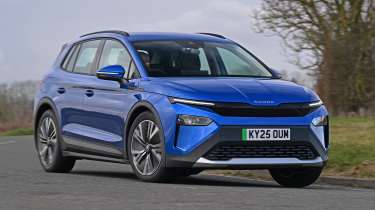
The Elroq was the first car to be designed according to Skoda‘s ‘Modern Solid’ philosophy, which has since been adopted by the Enyaq. Many details are similar to its big brother, to the point that most people will be hard-pressed to spot any differences beyond the Elroq’s shorter, stockier proportions.
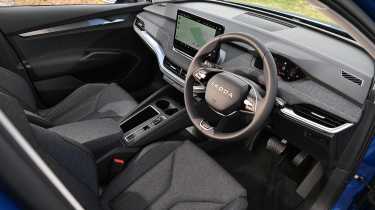
Step inside and the cabin design is largely the same as the Enyaq’s, right down to the stubby gear selector on the floating centre console and the bank of large shortcut buttons across the dashboard.
We recommend the entry-level SE L trim as our preferred version because it includes useful extras such as:
- Heated front seats and steering wheel
- Sat-nav
- Front parking sensors
Further up the Elroq range is the Edition trim, which has larger 19-inch wheels and keyless entry and start, while SportLine looks sportier by aping the vRS - just without the performance and price. The vRS somewhat justifies its price increase by being the quickest Elroq and the only way of getting this model with four-wheel drive. Plus, it has a head-up display, upgraded Canton sound system, and adaptive suspension.
Interior and dashboard design
The Elroq features a clean, uncluttered design that’s easy to understand, and SportLine and vRS trim levels add sportier details, such as a three-spoke steering wheel and aluminium pedals.
It’s a shame that the Elroq doesn’t get the rotary multi-function climate control dials used by the latest Skoda Superb and Skoda Kodiaq, which went down well with our testers during the 2025 car infotainment mega test for reducing distractions and making simple tasks like changing the climate control temperature easier to do.
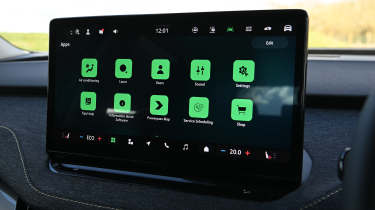
The on-screen temperature controls in the Elroq were moved from the bottom to the side of the screen as part of an update to an Android-based interface. While this means they’re now slightly easier to reach, we’d still prefer proper buttons that don’t require you to look away from the road ahead for so long.
Materials and build quality
For the past four or five years, Skoda has delivered levels of perceived quality that punch above other Volkswagen Group alternatives. The interior of the Elroq feels similarly well-built, and we like the different material choices you get with each interior theme.
Indeed, it’s only really the Peugeot E-3008 that offers plusher materials in the family-SUV segment, but the French model costs significantly more than the Elroq.
Infotainment, sat-nav and stereo
The driver gets a small digital instrument panel, and while it isn’t as fancy as bigger displays used by rivals, it presents the most important information clearly. A head-up display is available, which projects the speed and other important information onto the windscreen within the driver’s line of sight. It’s standard on vRS models, and available as part of the pricey Advance pack on SE L trim and above.
The Elroq’s 13-inch infotainment screen is standard, and while the original software was already rather good, this has since been further upgraded with an Android-based system. It includes Google Maps integration and intelligent route planning, and is refreshingly easy to understand and use.
A fairly ordinary sounding eight-speaker sound system comes as standard, while a 12-speaker, 675-watt Canton sound system is standard on vRS or as part of the Advance or Maxx equipment packages on SE L and Edition trims. Wireless phone charging is provided on Edition trim and above, and can be added to SE L trim. Base SE misses out on this feature, though.
“When the sun shows itself, the integrated window blinds are especially useful. My kids can pull them up and shade themselves without any complaints – a huge benefit, I can tell you!” - Pete Baiden, web producer.
Boot space, comfort & practicality
| Pros |
|
| Cons |
|
An SUV-sized car for hatchback money, the Elroq is impressively spacious compared with similarly priced alternatives. The Elroq feels very roomy up front, while rear passengers are spoiled for space.
Dimensions and size
The Elroq is shorter than the Enyaq by around 200mm, but it’s fractionally wider, so cabin space is similar between the two. The Elroq is larger than similarly priced rivals such as the Renault Megane and Kia EV3.
| Dimensions comparison | |||
| Model | Skoda Elroq | Renault Megane | Kia EV3 |
| Length | 4,488mm | 4,200mm | 4,300mm |
| Width | 1,884mm (2,148mm inc mirrors) | 1,505mm (2,055mm inc mirrors) | 1,850mm |
| Height | 1,625mm | 1,505mm | 1,560mm |
| Wheelbase | 2,765mm | 2,685mm | 2,680mm |
| Boot space | 470-1,580 litres | 440-1,332litres | 460-1,250 litres (plus 25 litre front boot) |
Seats & passenger space
The driver is treated to a seat and steering wheel with a wide range of adjustment as standard, but you can add an electric driver’s seat with memory function to SE L and SportLine trims as part of the Advance pack, or the Maxx pack if you’re buying the vRS. The Elroq has deep cup-holders, a large storage bin beneath the central armrest, and wide door pockets.
The deep windscreen provides a clear view of the road, and the ridges in the bonnet highlight the extremities of the car. The back window isn’t huge, but there’s better rearward visibility than in a Kia EV3 or Renault Megane.
Against the tape measure, we found that the Elroq is pretty much a match for head and knee room to the larger Enyaq. Like many electric cars, the rear floor in the Elroq is high to accommodate the battery underneath. This can leave long-legged passengers without much under-thigh support, but Skoda’s simple yet effective solution is to extend the seat bases.
Isofix child seat mounts are easy to reach, while a wide door opening makes installing a child seat simple. It’s a little stingy that only Edition models and up get extra USB charging ports for those in the back, though.
Boot space
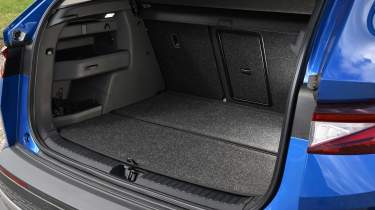
The only area where the Elroq sacrifices anything to the Enyaq is in the boot. Even so, 470 litres will be plenty for most families, and there’s underfloor storage for the charging cables, plus a load of smart little shelves and nooks for storing smaller items. Further to that, the optional transport package introduces a range of nets to hold things securely in place, along with a reversible boot floor.
The parcel shelf can be repositioned to divide the boot depending upon what you’re carrying and take a load of up to 3kg. Removing it and dropping the 60/40 split rear seats reveals a 1,580-litre black hole, compared with the 1,250 litres of space in a Kia EV3. It is a shame the Elroq doesn't have a separate boot under the bonnet to store the charging cable like its EV3 rival, though.
The trademark Skoda ice scraper/tyre tread-depth gauge is now stowed in the boot trim rather than its usual home in the fuel filler flap of internal combustion-powered Skodas.
Following a light series of updates, the Skoda Elroq now comes with 22 litres of space in a ‘frunk’ under the bonnet. This is a welcome addition as it allows for much tidier storage of the charging cables.
“My only real bugbear is the microsuede seats. They look and feel great, but are a complete nightmare to clean. My two children regularly drop crumbs, which they then grind into the upholstery whenever they brush them off. The seat fabric acts almost like Velcro, so I’ve resorted to keeping a hand-held vacuum cleaner in the car.” - Pete Baiden, web producer.
Safety & reliability
| Pros |
|
| Cons |
|
Euro NCAP has awarded the Elroq its maximum five out of five stars rating, which is on par with the five-star score of its structurally similar Enyaq sibling. All models come loaded with safety assistance features as standard, including lane keep assistance to help keep you within your lane, along with blind spot monitoring to warn you of vehicles alongside you when you go to change lanes.
The Elroq didn’t appear in the most recent Driver Power survey, but the Skoda brand wound up in 20th place out of 30 in the best manufacturer rankings. While owners spoke pretty highly of their cars’ reliability and build quality, Skoda’s on-board tech was a particular bugbear that held it back. Skoda was at least the highest scoring member of the VW Group, while Cupra was the lowest.
| Euro NCAP safety ratings | |
| Euro NCAP safety rating | Five stars (2025) |
| Adult occupant protection | 90% |
| Child occupant protection | 87% |
| Vulnerable road user protection | 77% |
| Safety assist | 78% |
Buying and owning
Best buy: Skoda Elroq SE L 60
The base SE L 60 battery is a great option, because it comes with all the features we expect in a family car and a decent driving range for a starting price of around £34,000. Long-distance drivers can choose the SE L 80, but its hefty £3,000 price jump over an SE L 60 is a pretty big one.
The Elroq applies for the UK Government’s £1,500 Electric Car Grant (EGC), but you can save even more when you configure your new Skoda Elroq through the Auto Express Buy a Car service. You can also check out the latest Elroq leasing deals or search for used Skoda Elroq models.
Skoda Elroq alternatives
The Skoda Elroq is hard to beat, but if you want more range, the excellent Kia EV3 is worth a look. However, we think the Skoda deserves its lead thanks to greater comfort, refinement and handling, as well as better in-car tech and much more space.
Renault’s EV line-up is in fantastic form, but even that has a tough challenge to face here, because the Elroq is offering buyers Renault Scenic size for Renault Megane E-Tech money.
Potential buyers may also be cross-shopping the Elroq with the Hyundai Kona Electric and Volvo EX30, or perhaps the MINI Countryman Electric, with its funky interior and sense of fun.
Key updates of the Skoda Elroq review
25 February 2026: General update of the Skoda Elroq review, including the removal of the 50 SE version from the price list.
Deals on the Skoda Elroq and alternatives
Skoda Elroq vRS: long-term test
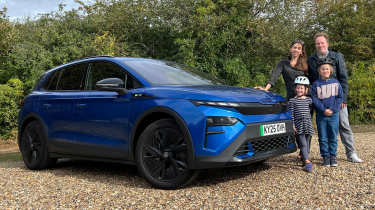
Our Web producer, Pete Baiden, spent six months behind the wheel of the range-topping vRS version of the Skoda Elroq, after an altercation with a motorbike meant his Skoda Elroq 85 Edition had to go back for repairs.
He noticed a considerable increase in performance between the two, and a harsher ride for this vRS model. But thankfully, the vRS remained just as practical as the regular Elroq, and didn't seem to be much less efficient despite the extra performance and standard four-wheel drive. You can read the full long term test here...
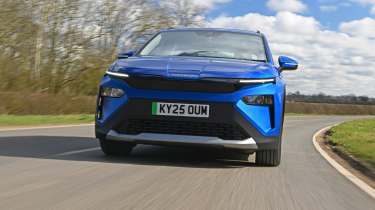
Skoda Elroq pictures
Frequently Asked Questions
When we drove the Skoda Elroq 60 in the UK we managed to achieve 3.7 miles per kWh, which equates to a real-world range of 218 miles from its 63kWh usable battery. We've also seen 3.8 miles per kWh from an Edition 85 model, and 3.4 miles per kWh from the vRS.