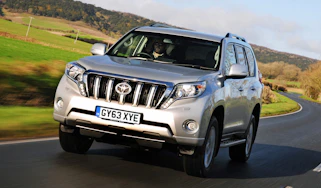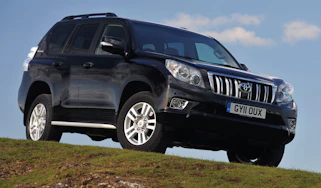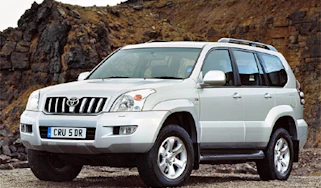
Toyota Land Cruiser review
The latest Land Cruiser is built as tough as ever, but you’ll need an equally robust bank account to buy one

Our opinion on the Toyota Land Cruiser
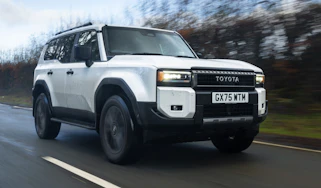
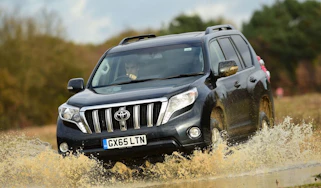
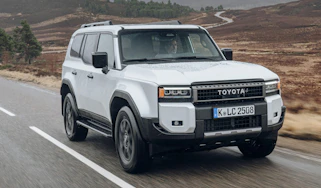
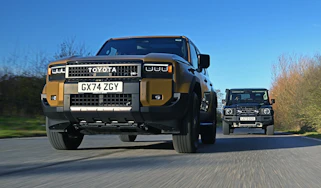
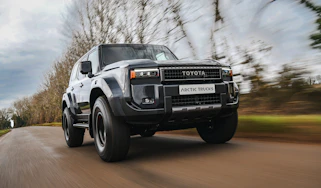
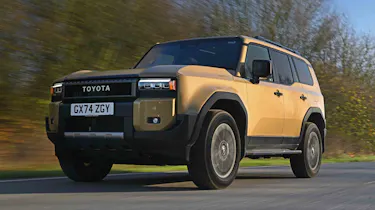
For those in the know about 4x4s, the Toyota Land Cruiser is seen as a dependable go-anywhere vehicle that offers fantastic off-road capability. The latest model injects some distinctive style to the mix, with its retro-inspired lines and colours, but the crucial toughness element remains pretty much untouched.
On the tarmac, this car is just as easy to drive as any other Toyota model – if a little less refined. The Land Cruiser is expensive to buy, especially when you consider that it’s still primarily powered by a relatively weak four-cylinder diesel when many rivals offer more powerful and quieter six-cylinder engines.
About the Toyota Land Cruiser
The latest Toyota Land Cruiser carries a suitably chunky exterior design and no shortage of tech. At present, this is the priciest Toyota that you can buy in the UK, and it’s firmly lined up against the might of the Land Rover Defender. Other markets get bigger Land Cruiser models, but the UK-market version is actually the smallest of two variants.
Mild-hybrid technology has been introduced to the diesel powertrain to improve efficiency, although this has also meant the Land Cruiser now offers only five seats rather than the seven of earlier versions, because the battery goes where the third row used to be.
Used - available now

2012 Toyota
Land Cruiser
53,790 milesAutomaticDiesel4.5L
Cash £48,995
2021 Toyota
Land Cruiser
33,656 milesAutomaticDiesel2.8L
Cash £53,489
2016 Toyota
Land Cruiser
31,008 milesAutomaticDiesel2.8L
Cash £40,986
2012 Toyota
Land Cruiser
120,342 milesAutomaticDiesel4.5L
Cash £34,995This review focuses on the regular Toyota Land Cruiser, but we also have a dedicated review of the Toyota Land Cruiser Commercial, which transforms this SUV into an off-roading van.
We’ve put the Land Cruiser through its paces since it first arrived in the UK, and our trials have even included a twin test against the Ineos Grenadier.
Performance & driving experience
Pros |
|
Cons |
|
The latest Land Cruiser’s platform is a proven set-up that’s been borrowed from the Tacoma and Tundra pick-up trucks sold in North America. Body-on-frame construction ensures the kind of off-road ability that the Land Cruiser is famous for, and it features double-wishbone suspension up front and a four-link system at the rear, with a lateral control arm to boost stability.
While the chassis is new, the UK-spec Land Cruiser features the same large-capacity 2.8-litre four-cylinder diesel that was used in the last model. Power is rated at 201bhp and 500Nm of torque, available across a very wide rev range, with peak torque coming in at just 1,600rpm. There’s impressive responsiveness at low revs and with very little turbo lag.
Drive is sent through an eight-speed automatic gearbox to a permanent four-wheel drive system, with high and low-range gears. The transmission does its part to keep the engine on the boil, and it makes quick, decisive gearchanges.
A centre Torsen diff manages power distribution, and an electronic rear diff lock boosts traction when grip is low, while the detachable anti-roll bar improves suspension articulation and helps keep the wheels in contact with the ground as much as possible over uneven off-road terrain.
Electronic assistance includes hill start and downhill assist, crawl control that maintains a set speed so you can focus on steering, and Multi Terrain, which sets up the car’s electronic systems for different conditions.
| Model | Power | 0-62mph | Top speed |
| Toyota Land Cruiser 2.8 D-4D Invincible | 201bhp | 12.3 seconds | 106mph |
Performance, 0-60mph acceleration and top speed
A kerbweight of 2,415kg is a lot for the engine to haul around, and as a result the Land Cruiser has a 0-62mph time of 12.3 seconds. This is behind similarly priced versions of the Land Rover Defender and Ineos Grenadier, because they feature punchier six-cylinder powerplants.
Town driving, visibility and parking
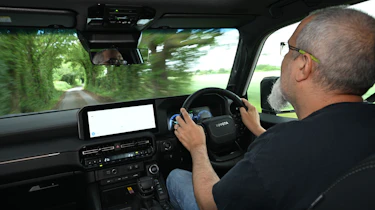
There’s no hiding the fact this off-roader has been designed to conquer off-road situations. The steering has a slow rack, and there’s a patter to the ride at low speeds that you won’t feel in a Land Rover Defender – especially with its optional air springs. Even at higher speeds where the Toyota’s ride does improve significantly, it just can’t match the Defender’s near luxury-car levels of passenger comfort.
At just under five metres long, the Toyota Land Cruiser is a big car to drive in town. However, relatively light steering and a panoramic 360-degree camera system help you to place it accurately, and the tall driving position gives you a clear view of your surroundings. There’s a firm edge to the ride when driving at lower speeds, while the diesel engine isn’t the most pleasant-sounding thing when you’re accelerating in town.
Country road driving and handling
The ride smoothes out the faster you go, while the engine settles down to a low hum as the gearbox short-shifts through the ratios. Toyota has added Sport and Eco driving modes, and selecting the former sharpens the powertrain’s responses and helps the car feel surprisingly lively, considering its size and weight.
The brakes do a good job of bringing the Land Cruiser to a halt, with good feel through the pedal. The steering is positive, but a little on the slow side.
There’s decent grip from the tyres and the permanent four-wheel drive system offers excellent traction, but it's the car’s high centre of gravity and subsequent body lean in the bends that’ll be the main factor preventing you from pushing it hard – that and the comments of feeling sick from your passengers.
Motorway driving and long-distance comfort
There’s enough power to reach the national limit before the end of a slip road, although it will be accompanied by a harsh diesel rattle from under the bonnet. However, once up to speed, the engine settles down, and road and wind noise take over. This isn’t too bad, though, and the Land Cruiser is a decent long-distance companion.
Off-road ability
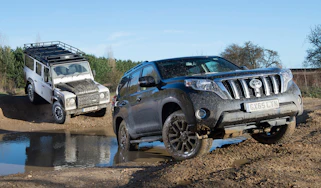
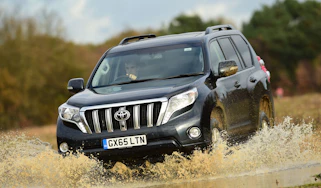
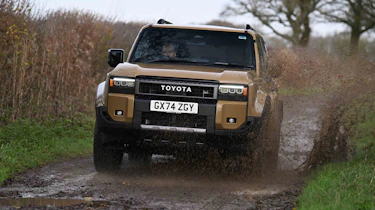
Head for the wilds, and the Land Cruiser shouldn’t let you down, although it might not be able to head as far into the rough as some rivals. There’s a central Torsen differential to send power to the corner with the most traction (or can be locked in a 50:50 split), but the rear diff lock is an electronic system that reacts to wheel slip, rather than engaging permanently before grip is lost – most won’t notice the difference, but some off-road enthusiasts prefer a mechanical rear diff lock set-up, which is something you’ll need a Mercedes G-Class or Ineos Grenadier for.
Ground clearance and a long wheelbase will limit some of the Land Cruiser’s ability, too, with 215mm of clearance and a 2.8-metre wheelbase restricting the car’s breakover angle. The rear overhang is a bit of a limiting factor as well, with a departure angle of 17 degrees being around half the figure quoted for an Ineos Grenadier, for example.
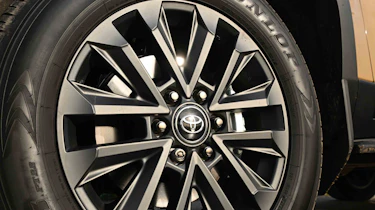
Another factor that will affect performance off the beaten track will be tyres. While rivals such Ineos and Land Rover offer all-terrain rubber as an option, you’ll have to visit a fitter to replace the road-biased cross-terrain tyres on the Land Cruiser. Thanks to the car’s global popularity, the aftermarket will be able to offer plenty of off-road upgrades, such as snorkels, storage racks and additional lighting.
“The Land Cruiser’s steering rack is light and over-assisted, so while it’s more responsive to direction changes, it doesn’t suit the car’s character.” - Dean Gibson, senior road test editor.
MPG & running costs
Pros |
|
Cons |
|
A large-capacity four-cylinder diesel connected to an automatic gearbox and a permanent four-wheel drive system is never going to be particularly efficient. Mild-hybrid technology has been added in an attempt to give this behemoth a slight efficiency boost, but an official WLTP combined fuel economy figure of 26.4mpg is still rather poor.
During our time with the Land Cruiser we managed 29.8mpg, thanks in part to a number of miles spent cruising on the motorway. When combined with the Toyota’s 80-litre fuel tank, that means there’s a range of more than 500 miles on offer.
| Model | MPG | CO2 | Insurance group |
| Toyota Land Cruiser 2.8 D-4D Invincible | 26.4mpg | 282g/km | 49 |
Insurance groups
The Land Cruiser sits in insurance group number 49 out of 50, so your premiums will be substantial. In fact, it’ll be pricier to cover than a number of Land Rover Defender variants, as these dip as low as group 40. The Ineos Grenadier carries the most eye-watering quotes, though, as it resides in group 50.
Tax
High emissions mean it’s not just fuel that requires an extensive outlay, and that’s before the luxury car tax is added on top of your annual VED road tax bill between the second and sixth year of ownership.
Depreciation
Our market data shows that the Land Cruiser should hold on to 58 per cent of its original value after three years or 36,000 miles. This is stronger than the Ineos Grenadier, at 37 to 54 per cent. However, the Land Rover Defender rules the roost at 53 to 67 per cent.
Interior, design & technology
Pros |
|
Cons |
|
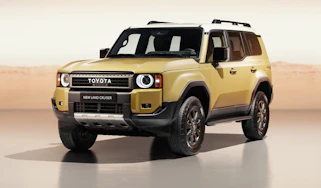
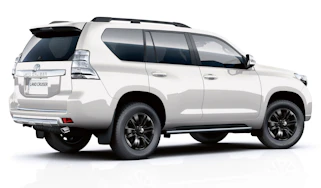
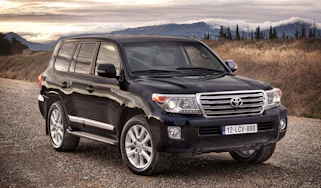
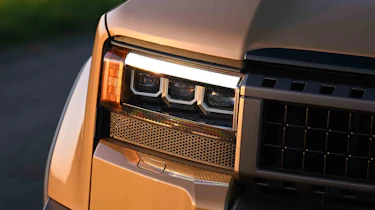
Visually, the latest Land Cruiser references the ‘J60’ Land Cruiser of the 1980s, with squared-off styling that hasn’t been seen for a few generations, but there are hints too of the ‘J70’ – a separate model wearing the Land Cruiser nameplate that was also launched in the 1980s, but is still in production in some markets. It’s not the first retro-inspired shape we’ve seen in recent years, but it’s another successful reinterpretation of a much-loved model from the past.
Interior and dashboard design
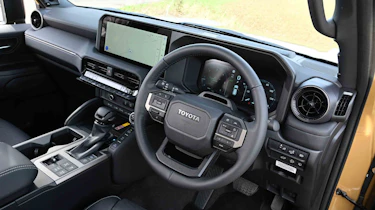
Retro lines might be the order of the day on the outside, but the cabin goes for a more modern look that has a definite chunky theme. There’s an upright, squared-off instrument pod, and large circular air vents at either end of the dashboard.
As is common with modern Toyotas, the dash has plenty of buttons and labels, including individual climate controls separate from the main touchscreen. The controls for all of the Land Cruiser’s off-road functions are clustered next to the drive selector, with additional information available on the main touchscreen.
Materials and build quality
The cabin combines hard-wearing surfaces with a smattering of elegant materials to create a sense of total solidity. In fact, the entire cabin feels almost infallible as there is barely the tiniest creak or rattle, even when articulated over an obstacle with a wheel dangling two feet in the air. The rugged plastics also feel well assembled, but we worry they may find themselves wearing a few scratches over time, especially if you’re using the Land Cruiser as a family car.
The switchgear has a familiar feel, so it works with precision, while the chunky seat mechanisms feel robust, especially when changing the configuration in the back.
Infotainment, sat-nav and stereo
Toyota has kept things simple with the infotainment system. The large 12.3-inch touchscreen is joined by a similarly sized dashboard cluster. Some manufacturers make a point of joining these screens for one sweeping display, but in the Land Cruiser the dials are deeply recessed to help mitigate reflections and look like regular instruments. Electronic control for the 4x4 functions helps to free up space on the dashboard for cup-holders and storage.
The main touchscreen is supplemented by buttons and knobs that allow you to operate some functions by feel and a quick glance, rather than staring at a screen. Notably, the air conditioning, seat heating and seat cooling controls are all physical switches. Likewise, you can select driving modes via a rotating knob near the gear selector, and while most audio controls are on the touchscreen, you still get steering-wheel buttons and a volume knob on the dash.
The 12.3-inch touchscreen is standard Toyota fare, using the brand’s Smart Connect+ media interface, which many owners will barely interact with since Apple CarPlay and Android Auto integration is standard. While this system isn’t exactly a groundbreaker, it’s fine for the most part. Smart Connect+ has a native navigation system, and sends sound through a 14-speaker JBL audio set-up in all variants. There’s a wireless charging pad for a phone, too, although Toyota has provided plenty of USB-C ports for charging various devices whether you’re popping to the shops or are out in the wilderness.
Boot space & practicality
Pros |
|
Cons |
|
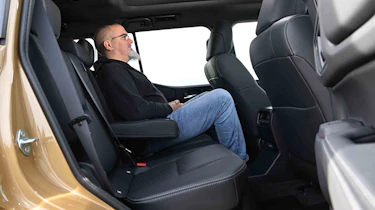
Large, boxy dimensions mean that the Toyota Land Cruiser can’t help but offer generous space inside. While the rearmost seats have been lost to make way for the mild-hybrid battery pack, these seats were difficult to access and cramped anyway, so we don’t think it’s a big loss. That being said, it’s a pain if you have a big family, so if you need an off-roading seven-seater car, you’ll need to look towards a Land Rover Defender in 110 or 130 forms.
Dimensions and size
To state the obvious, the Toyota Land Cruiser is huge. However, both the Land Rover Defender and Ineos Grenadier beat it for boot space.
| Dimensions comparison | |||
| Model | Toyota Land Cruiser | Land Rover Defender 110 | Ineos Grenadier |
| Length | 4,925mm | 4,758mm | 4,896mm |
| Width | 1,980mm | 2,008mm | 1,930mm |
| Height | 1,935mm | 1,927mm | 2,036mm |
| Wheelbase | 2,850mm | 3,022mm | 2,920mm |
| Boot space | 742 litres | 786 litres | 1,255 litres |
Seats & passenger space
There’s a wide range of seat and wheel adjustment in the Land Cruiser, and a tall driving position gives a good view ahead. The glovebox is small, though, and the armrest bin is restricted because it features a coolbox function.
The back doors are a little narrow for such a large car, so access isn’t brilliant. Inside, you’ll find a high seating position with lots of elbow room, but taller occupants may brush the headlining. The third row is only really for small adults due to the limited legroom on offer. Getting to those seats can be awkward because the middle row just tumbles forward and doesn’t slide to boost access. The backs of the middle seats can be reclined or set upright to make a bit more space in the back.
Boot space
Now that the rearmost seats are no more, the Land Cruiser’s boot has expanded to 742 litres. A maximum capacity of 2,000 litres is also offered when the remaining rear seats are folded forwards.
The tailgate is large, but to help with access in tight parking spaces, the Land Cruiser’s tailgate glass opens separately, allowing you to quickly load smaller items.
Towing
The Land Cruiser will be a perfect tow vehicle, with that torquey diesel providing lots of pulling power from as little as 1,600rpm, while trailer sway control is part of the car’s electronic stability control. A maximum towing capacity of 3.5 tonnes is offered, while Toyota has a range of fixed and detachable towbars available on the accessories list.
“The old rear seats were cramped and access was tricky, while the folding mechanism was a little cumbersome in use. We think the 742 litres of boot space now on offer will be far more useful.” - Dean Gibson, senior road test editor.
Reliability & safety
Pros |
|
Cons |
|
The Land Cruiser is a relatively low-volume seller, so it’s unlikely that Euro NCAP will run it through its safety assessment programme. But there shouldn’t be much to worry about, because Toyota Safety Sense is standard. This system features on lots of other five-star-rated Toyotas, and includes adaptive cruise control, road-sign recognition, lane-departure warning and a pre-collision system among its tech.
Toyota is generally very strongly regarded for its cars’ reliability, but the brand’s fortunes in the Driver Power owner satisfaction survey have waned a bit in recent years. With a 19th-place ranking out of 30 in the most recent best manufacturer results, Toyota ranked below rivals like Honda (16th), Suzuki (15th), and Mazda (11th). However, it was better news for Toyota’s luxury arm, as Lexus managed fourth place. As usual, build quality and running costs were two highlights for Toyota owners.
Buying, prices and deals
Best buy: Toyota Land Cruiser 2.8 D-4D Invincible
There’s only one variant of the Toyota Land Cruiser (aside from the Commercial), so choosing the best buy is a very easy task. Considering that this car starts at over £80,000, though, we’d strongly recommend shopping around for a deal. Even if you can save a few hundred pounds, this’ll go towards the incoming diesel fund.
Fortunately, we can make your search for a deal stress-free. You can find the latest Toyota Land Cruiser deals through the Auto Express Buy A Car service right now. We can also help you to sell your car.
Toyota Land Cruiser alternatives
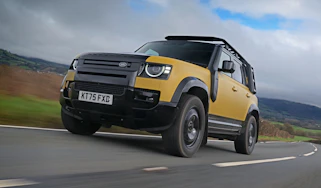
The Toyota Land Cruiser is a serious 4x4, and it has some serious rivals. The most obvious Land Rover Defender, and while it isn’t as basic as its predecessor, it is still a proper off-roader. Unlike the Toyota, this comes with a number of bodystyles and powertrains to choose from.
Next up is the car that, for some, has replaced the old Defender, the Ineos Grenadier. It has a few different body options, including the Ineos Grenadier Quartermaster pick-up, and a choice of two BMW six-cylinder engines, one petrol and one diesel.
Finally, the Mercedes G-Class is similar to the Toyota and Land Rover in that it has a long heritage and a no-nonsense attitude. However, while it’s still incredibly capable as an off-roader, it’s squarely aimed more at those who appreciate its image rather than those who enjoy spending their days driving over rough terrain. It’s expensive, with prices for some versions that are double those for the Land Cruiser. If you’re prepared to spend the really big bucks, you can have a fully electric variant, the Mercedes G 580 with EQ Technology.
Toyota Land Cruiser pictures
Key updates of the Toyota Land Cruiser review
15 September 2026: Latest driving impressions and model information.
Frequently Asked Questions
The Land Cruiser has a three-year/60,000-mile warranty from new. This can be extended to 10 years or 100,000 miles (whichever comes sooner) if annual servicing is carried out at an official Toyota dealer.
Deals on the Land Cruiser and alternatives