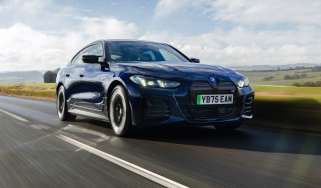
BMW i4 review
Sophisticated, well-built and typically great to drive, the all-electric BMW i4 is an easy car to recommend

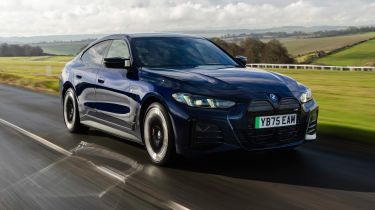

Our opinion on the BMW i4
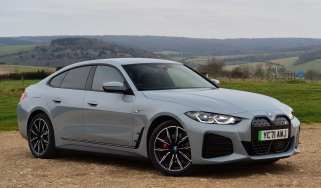
The engineers in Munich have done a fine job with the BMW i4. It’s the fully electric version of the 4 Series Gran Coupe, and the move to battery power has simply highlighted the German manufacturer’s renowned engineering skill. Buyers can rest assured that none of the company’s driver-focused DNA has been lost in translation.
But it’s not just keen drivers who will be impressed with the i4, because it oozes quality and is packed with up-to-date technology. A sensible electric driving range and useful rapid-charging capability also add to its appeal as a superb all-rounder. Yes, the i4 costs more than its close rivals, but we think it’s worth every penny.
About the BMW i4
BMW has a rich heritage of producing cars that are fantastic to drive. Whether it’s an executive saloon or a large SUV, the Bavarian automaker rarely misses when it comes to delivering a car that just makes you want to get behind the wheel and hit the road. It’s a trait not only shared by its combustion-engined cars, but its EVs, too.
While the electric i3 is arriving soon, the i4 is a more than capable substitute. It’ll be instantly familiar to many BMW owners because it’s essentially a battery-powered BMW 4 Series Gran Coupe, so you get five doors, including a handy hatchback tailgate.
Used - available now


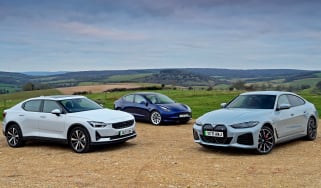
The i4’s placement as an executive EV plonks it straight in the firing line of almighty foes like the Tesla Model 3 and Polestar 2, but the electric BMW offers some of the best driving characteristics of the bunch.
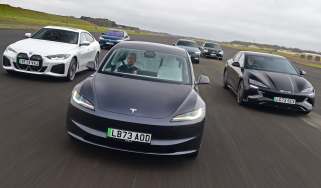
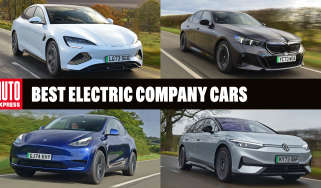
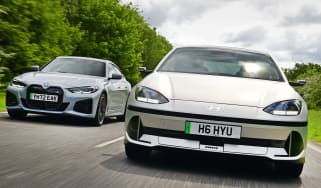
We’ve tested the BMW i4 against its five closest rivals in an electric company car megatest. While it couldn’t top trend-setting Model 3, the BMW i4 still managed a highly respectable second place due to its outstanding driving experience and refinement.
BMW i4 prices and latest deals
The BMW i4 is a premium car so you'll be looking at an equally premium starting price of around £51,500 for the entry-level eDrive35 in Sport trim, while M Sport trim adds £1,500 to the price. Naturally, moving upwards through the powertrains and trim levels will drive the cost further upwards until you end up with the i4 M60 at around £71,500.
However, you can save thousands when you build your perfect BMW i4 through the Auto Express Buy a Car service. We also have a range of i4 leasing deals along with used i4 models to choose from. We can even help you to sell your car.
Performance & driving experience
Pros |
|
Cons |
|
The BMW i4 features the brand’s fifth-generation of eDrive electric motors, with the motor, transmission and electronics all contained in a single unit for greater efficiency.
BMW has also been particularly clever with the position of the i4’s battery; it sits low in the car’s floor and gives a centre of gravity that is 53mm lower than a BMW 3 Series saloon – going some way towards offsetting the extra weight of the electric i4.
The i4's refinement is excellent. This electric BMW was the quietest car in our company car megatest, even against the improved Tesla Model 3, which has had a lot of work done to dampen down unwanted noise.
| Model | Power | 0-62mph | Top speed |
| i4 eDrive35 Sport | 282bhp | 6.0 seconds | 118mph |
| i4 eDrive40 M Sport | 335bhp | 5.6 seconds | 118mph |
| i4 M60 | 593bhp | 3.9 seconds | 140mph |
Electric motors, 0-60mph acceleration and top speed
The rear-wheel drive, single motor i4 eDrive35 produces 282bhp, which enables it to sprint from 0 to 62mph in six seconds exactly, while the eDrive40 pumps out a more generous 335bhp, shortening the same sprint to a brisk 5.6 seconds. The top speed for both models is 118mph.
The quickest i4 is the twin-motor M60. This produces a punchy 593bhp, which is sent to all four wheels, resulting in a 0-62mph sprint of just 3.9 seconds. This will allow you to take on plenty of sports cars if you so wish, but it doesn’t come at the cost of refinement. If you’re determined to win the traffic light grand prix and don’t mind running the risk of violently bringing up your last meal, though, the Tesla Model 3 Performance is a whole second quicker.
Town driving, visibility and parking
The BMW i4’s responsive controls contribute towards its enjoyable driving dynamics, but they also make it very easy to simply potter around town. One-pedal driving is also available via the regenerative braking system, which proved very useful to our testers when we hit stop-start traffic.
Parking shouldn’t be an issue, even in awkward spaces, because every i4 comes with BMW’s Parking Assistant pack as standard, which includes front and rear parking sensors along with a rear-view camera. If you add the Technology pack, a 360-degree surround view camera is added.
Country road driving and handling
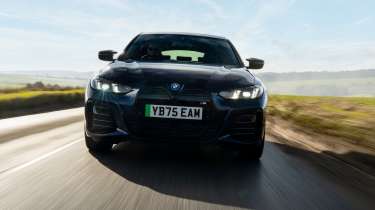
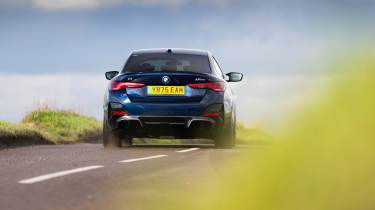
BMW’s greatest achievement with the i4 could well be the way it drives. Despite weighing in at over two tonnes, the five-door Gran Coupe is superb through the corners with plenty of grip, a precise feel to the steering and no hint of understeer. Aside from the lack of combustion noise, we think you’d struggle to tell the difference between the i4 and a fossil-fuelled BMW 4 Series Gran Coupe out on the road.
Considering how heavy the i4 is, you might think it would deliver a firmer ride, but if you go for an M Sport model, you can add adaptive suspension as a £450 stand-alone option (it’s standard on the range-topping M60 model). It’ll allow you to customise the car’s ride from a more agreeable comfort mode, where the dampers soak up most road imperfections and help keep things relaxed, to a firmer sport mode with sharper handling characteristics.
Motorway driving and long-distance comfort
Not only is the BMW i4 exceptionally refined on B-road drives, but it’s also a superb motorway cruiser. Wind and tyre noise are kept well under control, and every model has more than enough power on tap to keep up with traffic just as a BMW should.
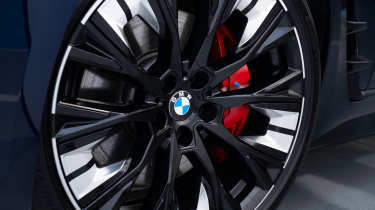
For the very best experience here, we’d opt for the smaller-wheel options and the adaptive suspension.
“When the mood dictates, the i4 M60 transforms into a rocketship. Teleporting you from A to B with its prodigious instant torque, a flex of your right foot is all it takes to send you hurtling towards the horizon. Any stress when joining busy dual-carriageways or pulling out of lay-bys is a thing of the past.” - Richard Ingram, deputy editor.
Range, charging & running costs
Pros |
|
Cons |
|
Every version of the BMW i4 officially exceeds the 300-mile electric-range sweet spot. The eDrive35 claims up to 319 miles, the eDrive40 380 miles, and the four-wheel drive M60 338 miles. This is all more than enough range for daily driving, and you’ll be free to tackle longer trips without having to keep leapfrogging between rapid chargers.
The efficiency of the i4 helps contribute towards such a long range. During our company car group test, a pre-facelift version of the eDrive35 managed 3.6 miles per kWh, putting it behind the 3.8 miles per kWh a Tesla Model 3 Long Range got, but ahead of the 3.3 miles per kWh of the Polestar 2 Single Motor Long Range, and 3.1 miles per kWh of the Hyundai Ioniq 6.
The eDrive35 uses a 70.2kWh battery (67kWh usable), while the eDrive40 and M60 both use an 83.9kWh (80.2kWh usable) battery for greater range. All models get a standard heat pump, which provides a more efficient way of heating the interior in cold weather without compromising the electric range too much, so you should still be able to go quite far, even in colder climates. Just be warned that the extra weight and four-wheel drive system of the M60 reduce the range dramatically, as do some of the larger wheel options.
The i4’s maximum charging speed depends on which model you get: the base eDrive35 maxes out at 180kW, while the eDrive40 and M60 can hit 207kW if you use an ultra-rapid charger capable of those speeds. Regardless, a 10 to 80 per cent charging session will take just over half an hour for all versions. Hook up to a typical 7.4kW home wallbox charger instead, and the eDrive35 will take around 11 hours to charge fully, while the eDrive40 and M60 will take 13 hours.
| Model | Battery size | Range | Insurance group |
| i4 eDrive35 Sport | 70.2kWh battery (67kWh usable) | 319 miles | 34 |
| i4 eDrive40 M Sport | 83.9kWh (80.2kWh usable) | 380 miles | 38 |
| i4 M60 | 83.9kWh (80.2kWh usable) | 338 miles | 45 |
Insurance groups
With insurance premiums for electric cars often being higher than those of combustion-engined cars, BMW has achieved a competitive insurance group rating for the i4. On the 1-50 scale, the i4 eDrive35 sits in group 34, but even the monstrous M60 only reaches group 45 rather than the dreaded 50.
Following some revisions, the Tesla Model 3 is now a bit cheaper to cover than it used to be. However, it’s still not too far off the BMW i4 in groups 36 to 48.
Check any car's MoT history in a few easy clicks with our MoT checker tool...
Tax
Although the electric luxury car tax bracket now sits at £50,000, every BMW i4 still sits on the wrong side of this figure. This means you’re looking at hundreds of pounds on top of the standard VED road tax rate between years two and six after the car is registered.
Company car drivers won’t have too many problems, because the i4 incurs the very lowest applicable Benefit-in-Kind (BiK) tax rates, just like any other electric car.
Depreciation
Our market data makes grim reading for potential BMW i4 owners, because this premium electric car is predicted to retain only 37-40 per cent of its initial value after three years or 36,000 miles. Tesla Model 3 drivers face a slightly less upsetting outcome at 41 to 48 per cent, while the Volkswagen ID.7 only manages 40 to 41 per cent.
To get an accurate valuation on a specific model check out our free car valuation tool...
Interior, design & technology
Pros |
|
Cons |
|
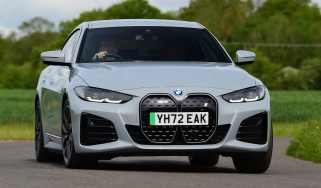
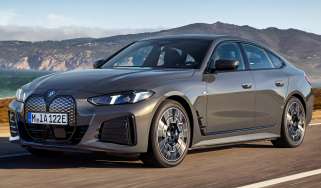
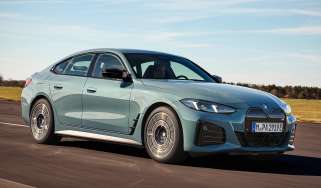
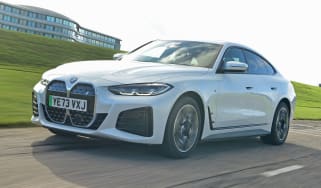
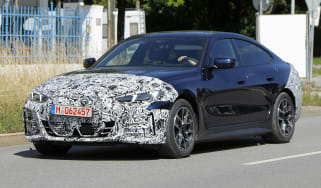
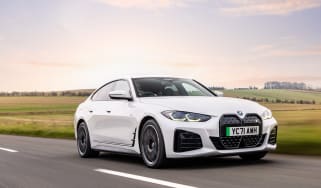
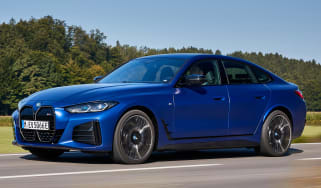
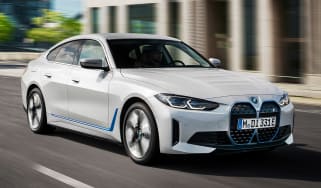
The BMW i4 blends into traffic a lot better than the more grandiose BMW iX SUV and BMW i7 limousine. In fact, the i4 doesn’t look that different to the BMW 4 Series Gran Coupe it’s based on, apart from its closed-off kidney grille and subtle blue accents, which are the biggest giveaways of not having a combustion engine under the bonnet. Overall, the look of the i4 remains suitably smart and sophisticated, while the five-door body style ensures it maintains a real presence on the road.
The entry-level Sport model is also pretty well equipped with 17-inch alloy wheels, an electric tailgate, front and rear parking sensors, heated front seats, automatic lights and wipers, and a 14.9-inch touchscreen infotainment system with sat-nav and Apple CarPlay and Android Auto smartphone connectivity.
We’d recommend the mid-range M Sport trim because it offers a wider range of options, and its M Sport exterior and interior styling make it a more appealing resale prospect. The most expensive M60 rewards you with a more powerful dual-motor xDrive four-wheel-drive setup, standard adaptive suspension, and electric front seats with memory settings.
There’s a lengthy list of optional extras for i4 buyers to choose from, or you can add one of the several option packs – although not all are available on every trim level. The £900 Comfort pack is available across all trims and adds adjustable lumbar support, wireless phone charging, and keyless entry. There’s also the £2,100 Technology pack with various driving assistance features like lane-keeping assist, rear cross traffic alert, and a speed limit warning. You also get a 360-degree camera system and a head-up display.
M Sport trim allows you to add the £3,125 M Sport Pro pack with adaptive LED headlights, shadowline black exterior trim that better hides its oversized grille, bigger M Sport brakes, high beam assistance, and M Sport seatbelts. Finally, on M60 models, you can add a £2,500 M Carbon exterior pack, although why you’d want to add a lot of tacky-looking carbon fibre trim to your BMW that’ll cost a fortune to replace when it inevitably gets damaged is beyond us.
Interior and dashboard design
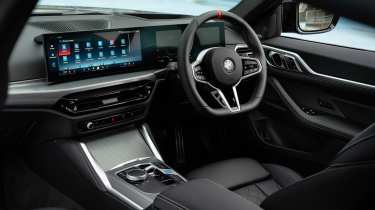
The i4’s cabin doesn’t make any drastic departures from the layout you’ll find in a regular 4 Series. While it’s technically one of BMW’s older layouts now (with the BMW iX3 kicking off the brand’s next generation of interiors), the twin digital screens and curved display still look the part.
Materials and build quality
As usual, BMW hasn’t scrimped on build quality here. The i4’s interior is typically faultless, with lots of soft-touch materials in use, along with brushed metal and carbon-fibre-effect accents.
Infotainment, sat-nav and stereo
The i4 borrows its infotainment tech from the iX SUV, with a 12.3-inch digital instrument panel placed alongside a 14.9-inch touchscreen in one seamless, gently curving display. It looks stunning, and manages to strike a usable balance between contemporary touchscreen functions and the iDrive clickwheel and shortcut buttons. These are so intuitive that they barely need a second glance to use. In fact, it's a shame that BMW is now phasing out this layout in its more recent arrivals, so make the most of it while you can.
The screens look fantastic, too, although some drivers who are used to BMW’s simple analogue clocks might think the semi-hexagonal speedometer design is a little fussy. The graphics are clear, though. If you’d rather make the most of your smartphone’s processing power, then the latest iDrive system integrates the Apple CarPlay and Android Auto apps fully into the main touchscreen, and they both look and function brilliantly as a result.
“There’s something reassuringly familiar about the outgoing iDrive system, especially with the i4’s much-lauded centre-console clickwheel. This seemingly simple piece of hardware has been phased out from many new BMWs, in spite of its obvious benefits when it comes to controlling the myriad functions and sub-menus.” - Richard Ingram, deputy editor.
Boot space & practicality
Pros |
|
Cons |
|
The BMW i4’s hatchback tailgate offers more practicality than the more traditional letterbox-style opening found on the Tesla Model 3 and Hyundai Ioniq 6, while the three-way split rear seats provide increased flexibility for carrying passengers and bulkier items. Up front, the standard fabric sports seats offer lots of adjustment to help you find a comfortable position, although if you fancy leather upholstery you’ll need to pay over £1,000 more.
Meanwhile, the door bins are large enough to hold drinks bottles securely, there are phone storage and charging sockets ahead of the gear lever, and the armrest cubby is deep, too.
Dimensions and size
At 4,783mm long, the i4 is longer than the Tesla Model 3, but it’s also a touch narrower, which should help when navigating through town traffic and dealing with narrow parking bays.
| Dimensions comparison | |||
| Model | BMW i4 | Tesla Model 3 | Volkswagen ID.7 |
| Length | 4,783mm | 4,724mm | 4,961mm |
| Width | 1,852mm | 1,933mm | 1,862mm |
| Height | 1,448mm | 1,443mm | 1,536mm (1,535mm GTX) |
| Wheelbase | 2,860mm | 2,880mm | 2,971mm |
| Boot space | 470 litres | 594 litres (measured to the roof) | 532 litres |
Seats & passenger space
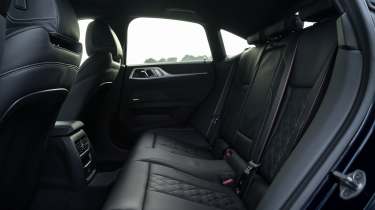
The i4 offers a low-slung driving position, but the cabin doesn’t feel cramped and has plenty of space upfront for the driver and front passenger. Those travelling in the rear aren’t as well catered for, as there’s quite a large hump in the floor, which takes up valuable space in the footwell – a downside of not using a bespoke EV platform.
Two adults can sit happily with a fair amount of headroom to enjoy; however, because the rear bench’s outer seats are so heavily sculpted, you get a narrow centre seat that doesn't offer much room for a third rear passenger. Two Isofix mounting points for child seats are provided on the outer positions of the rear bench.
Boot space
With a 470-litre boot capacity, the i4 offers more luggage space than a Hyundai Ioniq 6, and it benefits from a practical hatchback tailgate so the boot is much more accessible, too. However, unlike its fellow electric saloons, the i4 doesn’t get any extra storage under its bonnet. If you’re after a little extra practicality, then folding the i4’s 40:20:40 split rear seats opens up a 1,290-litre space for carrying larger items.
“While the Ioniq 6 is a genuine five-seater, the i4 has more of a 4+1 layout. The rear bench is narrow, and the outer chairs are more heavily sculpted, leaving a perch in the middle.” - Dean Gibson, senior test editor.
Reliability & safety
Pros |
|
Cons |
|
The BMW i4 was crash tested by industry safety experts Euro NCAP in 2022 and was awarded four out of a possible five stars. The experts criticised the lack of a countermeasure to prevent injuries between the driver and front passenger in a side impact, and a system to apply the brakes after a collision. It also wasn’t so good at preventing pelvic injuries in pedestrian impacts. A four-star result is a shame, because the Hyundai Ioniq 6 and Kia EV6 were also tested in 2022 under the same criteria as the i4, both receiving the maximum five-star rating.
Standard safety kit for the i4 is excellent though, and includes BMW’s Driving Assistant package of camera and radar-based driver assistance systems that help prevent a potential collision. The optional Tech Plus pack offers an opportunity to upgrade to the Driving Assistant Professional system, which provides further semi-autonomous safety functions, along with a head-up display.
The i4 didn’t appear in the most recent Driver Power survey, but the combustion-powered BMW 4 Series landed in seventh place out of 50 models in the best cars to own rankings. It’s a pretty safe bet that aspects of what owners liked about the petrol and diesel version is shared by drivers of its electric cousin.
The BMW brand has also made strides to improve its position on the best manufacturer scoreboard. After a troublesome few years, it now sits in eighth place out of 31. Audi, meanwhile, only managed 19th, although Mercedes bagged second.
| Euro NCAP safety ratings | |
| Euro NCAP safety rating | Four stars (2022) |
| Adult occupant protection | 87% |
| Child occupant protection | 87% |
| Vulnerable road user protection | 71% |
| Safety assist | 64% |
Buying and owning
- Best buy: BMW i4 eDrive40 M Sport
Seeing as it offers higher specification and a larger-capacity battery range for a reasonably modest outlay, we’d go for the eDrive40 M Sport as the best all-rounder. While it’s nowhere near as fast as the almighty M60, this model should still provide more than enough driving thrills for the average driver. It’ll also double up as a pretty solid commuter and family car, and M Sport trim generally has better residual values than its Sport sibling.
BMW i4 alternatives
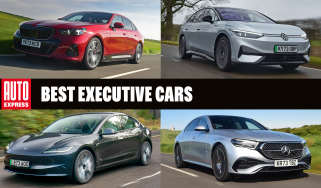
The electric executive car market consists of some of the best-known EV names, along with some newer contenders. The Tesla Model 3 is perhaps the most obvious alternative, but we’d also direct your attention towards the Audi A6 e-tron, BYD Seal, Mercedes EQE, Polestar 2, and Volkswagen ID.7. If you want something a bit bigger, there’s also the BMW i5 to consider.
Key updates of the BMW i4 review
31 March 2026: Updated to include the latest i4 model line-up, battery range and depreciation information, along with more recent driving impressions.
Frequently Asked Questions
When we tested the i4 eDrive40 in M Sport trim, we achieved an average efficiency rating of 3.8 miles per kWh, giving us around 307 miles of range in mixed driving.
Deals on the i4 and alternatives